
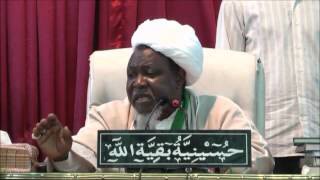
Ibrahim El-Zakzaky started propagating Shiite Islam in 1979, during the Iranian revolution which led to the overthrow of the monarchy and the enthronement of an Islamic Republic under Ayatollah Khomeini in Iran.
Also known as Islamic Movement in Nigeria, the sect doubles as both a religious and political organisation believed to be backed by the Iran government. The movement is noted for introducing Shiite ideology to Nigeria in the 1980s.
The headquarters of the movement is in Zaria, Kaduna State, where most of its spiritual activities are conducted at its Husainiyya Baqiyatullah Centre.
According to historians, the division between the Shiite and Sunni Muslims is rooted in disputes over the proper succession of leadership after the death of Prophet Muhammad in 632
The Shiite maintained that the rightful successor of the Prophet was his cousin and son-in-law, Ali. The Shiite especially respects a succession of scholars (Imams). To them, the Imam is both a political and spiritual leader.
Born on May 5, 1953, in Zaria, El-Zakzaky attended the traditional Quranic and Islamic schools in Zaria under the tutelage of scholars such as Mallam Isa Madaka and Mallam Ibrahim Kakaki.
He proceeded to the Provincial Arabic School, Zaria between 1969 and 1970 and Law School (now the School for Arabic Studies), Kano between 1971 and 1975.
The Shiite leader was at the Ahmadu Bello University (ABU), Zaria between 1976 and 1979 and graduated with a First Class in Economics.
While in the university, he was elected the secretary-general of the Muslim Students Society of Nigeria (MSSN) and later Vice President (International Affairs) of the National Body of the MSSN in 1979.
Zakzaky was detained several times on charges of sedition by successive Nigerian regimes in the 1980s and 1996.
One aspect of the sect’s religious rites involved procession by thousands of its members, including women and children, trekking from one city to the other. But this has come under serious complain and criticism by members of the public as such processions always cause serious traffic gridlock.
Anytime the sect members trooped out to cities like Kaduna, Zaria and Kano as well as other Northern cities, residents are usually stuck in apparently bad traffic as members in the thousands march.
“The 1999 Nigerian Constitution (as amended) and international law recognise the inherent right of every person to life, and that no one shall be arbitrarily deprived of life. Indeed, everyone is entitled to the protection of the right to life without distinction or discrimination of any kind, and all persons shall be guaranteed equal and effective access to remedies for the violation of this right.
“Moreover, article 4, paragraph 2, of the International Covenant on Civil and Political Rights provides that exceptional circumstances such as internal political instability or any other public emergency may not be invoked to justify any derogation from the right to life and security of the person.
“Similarly, the UN Principles on the Effective Prevention and Investigation of Extra-legal, Arbitrary and Summary Executions in Principle 4 sets forth the obligation of governments including Nigeria to guarantee effective protection through judicial or other means to individuals and groups who are in danger of extra-legal, arbitrary or summary executions.
“The proportionality requirement under human rights law limits the permissible level of force based on the threat posed by the victims to the Chief of Army Staff or his convoy. The necessity requirement imposes an obligation to minimize the level of force used, regardless of the amount that would be proportionate.
“Thus, states’ duty to respect and ensure the right to life entails an obligation to exercise “due diligence” to protect the lives of individuals from attacks, including members of the Shittes Muslim group in Zaria, Kaduna.”
Avoiding the Pitfall of the Past
Remember Mohammed Yusuf, the late founder of Boko Haram? Some people in the authorities then thought that the best way to kill the movement he led was to kill him. Following the July 2009 Boko Haram uprising, the Nigerian military captured Yusuf at his parents-in-law’s house and handed him over to the Nigerian police force for prosecution.
The police then summarily executed him in public view outside the police headquarters in Maiduguri. Police officials later lied to the whole country that either Yusuf was shot while trying to escape or died of wounds he sustained during a gun battle with the military.
When Boko Haram reacted with bomb blasts, a feeble attempt was made to placate members of the sect. But by then, it was a little too late. The policemen, who allegedly shot and killed him were arraigned for murder. Government filed criminal charges it had no plan to prosecute at the Federal High Court in Abuja. Members of Boko Haram were not deceived. Today, no one had been convicted for the killing of Yusuf.
Yes, there are a lot of similarities in how the army arrested Yusuf and handed him over to the police, who in turn killed him extra-judicially. Today, the rest is history. What the soldiers did in Zaria may eventually set in motion another round of events that may result in another round of insurgency. Today, the army had lost many of its men in the fight against Boko Haram.
The truth is that in arresting Yusuf, the army set in motion the chain of events for which many of its men had to pay the supreme price. Just as it was then, those in authorities are giving tactical backing to the attempt by soldiers to flush out Zakzaky and his followers. The little fire ignited in 2009 had become a conflagration which today threatens to consume all.
As it is, no one knows for sure how many Shiite members were killed during the attacks. The seeming cover-up surrounding the whole issue had blindfolded the Nigerian leaders into taking the right steps. It is however important to know the number of the deaths and other casualties recorded so that immediate steps could be taken to de-escalate the tension. As at today, there are conflicting figures. While the army has tried to play down the figure, members of the sects are likely to inflate the figures.
Red Flags Everywhere
Sadly, while the country is still battling to contain the menace of the Boko Haram insurgency, which has so far resulted in numerous civilian and military casualties and over 2 million people displaced, agitation for a Republic of Biafra which has never been taken serious received a boost in Nnamdi Kanu. He had taken the agitation to an-all-new level that the authorities could no longer turn a blind eye. The truth is that the agitation enjoys a lot of sympathy, albeit irrational, from a section of the country. This is why it must be handled with utmost caution.
Not to forget the relative peace in the Niger Delta, no one knows how long this peace will last but everyone knows that the issues there have not been resolved in finality. It is a region that can erupt anytime. Yet there are other flashpoints: the recurrent clashes between Fulani herdsmen and farmers in some north central states, the seemingly intractable crisis in Jos, Plateau State to mention just a few, coupled with the growing robbery and kidnapping have combined to complicate the nation’s delicate security situation.
The least the government can do now is to add to this catalogue of crisis by igniting another flame through avoidable attacks on the Shiites. But that is what just happened. Unfortunately, el-Rufai appears set to exacerbate the crisis with his threat to demolish houses in Zaria. And should this happen a new reign of terror might just have been unleashed in the country, especially given the Iranian connection of the Shiites, a country known to export only one thing: terrorism.
But in the final analysis, it is not too late to reverse this trend. President Muhammadu Buhari should therefore put his sentiment aside and perform his job as the Commander-in-Chief of the Armed Forces, needless to remind him he is President of Nigerians, the Shiites inclusive.
 OBLONG MEDIA GLOBAL INTELLIGENCE
Leave a comment