
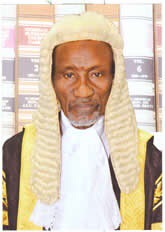
What is going to be the position of the Supreme Court on the controversial rulings of the different divisions of the appeal court on the various governorship election petitions the latter determined in the last one month, now that the Chief Justice of Nigeria (CJN) has spoken on the very vexatious issue? What position will the seven justices of the apex court take after the head of the judiciary arm of government publicly put a question mark on the rulings of the appeal court? Will the highest court in the land restore the image of the judiciary that has been badly damaged by the rulings that have defied legal explanation and common sense, with the potential to put the country’s fledgling democracy in great jeopardy?
Mr. Mahmud Mohammad, the CJN, recently expressed worry and, one can add, disappointment, at the conflicting and directly opposing rulings that have come out of some divisions of the appellate court handling election petition matters. A case in point is the obvious double standard of the appeal court on the use of card readers.
For instance, while the Lagos division of the court held, in the case of Jimi Agbaje versus Governor Akinwunmi Amode in Lagos State, that the card reader is not known to the 1999 Constitution as amended and the electoral act and refused to grant Agbaje’s prayer for cancellation of the election, the Abuja division, which heard the cases involving Governor Udom Emmanuel and Umana Okon Umana in Akwwa Ibom and the one involving Governor Nyesom Wike and Dakuku Peterside in Rivers, thought otherwise. The court in the nation’s capital ruled that the card reader should be the determinant in the eligibility or otherwise of a registered voter to vote, and accordingly made its lack of use in all the polling units in the two states, even where there was widespread malfunctioning of the device, one of the basis for its decision to annul the governorship election in the two states.
In Akwa Ibom, the appellate court went a step further to rely on the testimony of one witness each in three local government areas to cancel elections not just in those areas, but in the entire state. In other words, his lordships in the appeal court based their ruling on the testimonies of people who relied on hearsay, since they could not have been in all the polling units in the local government areas to know what transpired in those areas. Yet, the electoral act says that a petitioner must prove a case of malpractice unit by unit in the areas on which his petition is based – a provision that does not recognize hearsay.
The Supreme Court has also ruled in previous cases that the burden of proof of irregularity or non-compliance with electoral guidelines lies with the petitioner. Did the petitioner in the Akwa Ibom governorship election, the All Progressives Congress (APC) and its candidate, Umana Okon Umana, prove widespread malpractices and non-compliance in the 31 local government areas of the state? It is the same state where the election petition tribunal had earlier upheld election in 13 government areas, and ordered a re-run in the remaining 18.
The question has been asked as to why there seems to be no template for ruling on cases as important as governorship elections. Perhaps it was the need to avoid the confusion like the one the discordant tunes from the different divisions of the appeal court on the 2015 governorship election has caused that made the late then Supreme Court justice, Niki Tobi, to advise in 2008 that a ruling by one division of the appellate court should be transmitted to other divisions as soon as it is made, so it would guide them in their rulings, especially in similar cases. Regrettably, this advice has remained unheeded till date, thus opening loopholes that have created the inconsistencies that Mohammad complained about at the 2015 annual conference of the Appeal Court, which took place in Abuja.
Now, is it possible the appeal court that handled the Akwa Ibom and Rivers states governorship election petitions was not aware of the ruling of the Lagos division of the same court, even though it was made long – about one month – before the election petition tribunals on those states completed their assignments? Worthy of mention is the fact that the Supreme Court upheld the ruling of the appeal court in Lagos, and declared Ambode as duly elected.
Or is there any truth in the allegation that the judiciary is dancing to the tune played by the ruling party? It is difficult to fault this line of thinking, when it is considered that the rulings in Lagos, Akwa Ibom and Rivers states, whichever direction they went, favoured the All Progressives Party (APC). This is to say that the APC emerged triumphant where the appellate court, in one division, ruled that the use of card readers was not sine qua non to the conduct of elections, and was also victorious where the same court, in another division, decided that any election that was not conducted with the use of the card was not valid.
The Supreme Court justices that will give the final ruling on the governorship cases must be guided by the precedence they set when they agreed with the Lagos division of the appeal court that the use of card readers for the 2015 election was not mandatory. They will need to visit the position of the apex court on the onus of the petitioner to prove that elections either did not hold in some units or, where they held, did not follow stipulated guidelines. They will also have to determine if the testimonies of witnesses, based on hearsay, could be considered sufficient to determine the outcome of a petition relating to state-wide elections.
The Supreme Court must determine whether or not over voting in some local government areas, as is being alleged by the APC in Akwa Ibom and Rivers states, can form the basis for annulling election in an entire state.
Mohammad’s public worry should be a wake-up call to the court of which he is the chairman to distance itself from the allegation of partisanship in the handling of governorship election petitions. The importance of the verdict of the apex court lies in the fact that anyone not satisfied with it can, as they say, only appeal to God, an exercise that has never been known to have any effect on court rulings anywhere on the planet.
 OBLONG MEDIA GLOBAL INTELLIGENCE
Leave a comment