
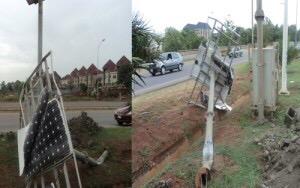

The House of Representatives, last week, began another round of investigation into the $470 million Abuja and Lagos Closed Circuit Television Camera (CCTV) contracts, with stakeholders submitting conflicting evidences on why the contracts failed. PHILIP NYAM, captures proceedings at the ongoing probe
As part of efforts to beef up security in major cities across the country, the Federal Government awarded a contract for the installation of Closed Circuit Television Cameras (CCTV) to a Chinese firm, ZTE Corporation in 2010.
The contractual terms involved a down payment of 15 per cent ($70.5m) by the Federal Government, while the Chinese EXIM Bank would pay the balance of 85 per ($399.5m) to be repaid within 10 years at the prevailing interest rate. Unfortunately, while Abuja and Lagos have been at the receiving end from activities of insurgents and criminals, the CCTV have not been put to use. The project has largely been a subject of controversy as its execution is mired in mystery.
In the 7th Assembly, the House of Representatives had investigated the same projects and produced a report, but no action appeared to have been taken by the Federal Government. The 8th Assembly is again investigating the contract but submissions so far from the exercise have revealed a buck passing scenario.
While the process of the contract itself is been contested for lacking transparency, the Bureau of Public Procurement (BPP) has claimed ignorance of the entire contract. Even as the contract is said to have been abandoned, the contracting firm, ZTE has maintained that it executed the project to completion but it was the Federal Government that failed to play its part, to make it work.
BPP and CBN’s ignorance
Testifying before the House ad hoc committee led by Hon. Ahmed Yarima, the directorgeneral of the Bureau of Public Procurement (BPP), Engr. Emeka Eze, declared that the $470 million contract for the installation of 2,000 CCTV in both Abuja and Lagos was entered into without recourse to the procurement law. It was curios that such a huge contract would be entered into by the Federal Government without going through the Due Process office.
But when the investigating committee took on the director general under cross examination, Eze explained that based on the provisions of section 16 (1) (b) of the procurement Act 2007, the execution of $470 million magnitude contract, ought to have been issued a certificate of no objection by the BPP, unless it concerns national security or by presidential approval.
“The contract for the CCTV installation in Abuja and Lagos under the National Public Security Communications System was not processed at BPP prior to the award. In other words, the project was not issued the certificate by BPP. Testifying further, the director general noted that “without a due process certificate of ‘no objective’, all payments made in respect of this project are illegal and the contract is null and void.
These positions are supported by sections (16) (2) and (4) of the Public Procurement Act, 2007 respectively.” Similarly, the Central Bank of Nigeria (CBN), which is the government’s official banker towed the line of BPP, feigning ignorance of the contract.
In his evidence before the committee, CBN governor, Mr. Godwin Emefiele said there was no “nexus between the Central Bank and the contract. We don’t know anything about the contract.” Represented by a director at the apex bank, Mr. Taiwo Amodu assured the committee that further investigation into the payments regarding the contract would be carried out by the apex bank, and would return to the committee with more details.
ZTE’s submission
ZTE Nigeria, the local component of ZTE Corporation has however been consistent insisting that it delivered timely on the specifications of the contract. The managing director of ZTE Nigeria, Mr. Hao Fuqiang, in his presentation before the ad hoc committee said contrary to public perception, the project was not to merely installed cameras but one conceived to deploy comprehensive, reliable, modern and robust public security communications technology.
The ZTE boss explained that the GoTA technology deployed in the NPSCS project has grown to be the global leader in specialized digital truncking standards. It has been deployed in over 40 countries including Norway, Poland, Russia, Ghana, Morocco, Chech Republic and China among others.
While insisting that ZTE has completed the execution of the project and that Acceptance Certificates (PAC) were issued by the Federal Government indicating, that the project was successfully completed and functioning, he said any perception that the NSPC project was not working was unfounded.
Hao disclosed that the GoTa system was used by the Police and the Presidential security on several occasions: “These include the inauguration event of President Goodluck Jonathan first term, the World Economic Forum (WEF) held in Abuja and other events hosted at the Eagles Square Abuja. “The VSS was also successfully used by the Nigerian Police on some instances such as; Abuja Airport Incident involving theft US$1million, tracking and arresting of drug dealers in Oshodi, Lagos and capturing the Lagos Airport robbery.”
NIGCOMSAT angle
In spite of the no-knowledge submissions made by the CBN and BPP, a former managing director of the Nigerian Communication Satellite (Nigcomsat), Engr. Timasaniyu Ahmed- Rufai also confirmed the positon of ZTE Nigeria.
He said the contract for the installation of CCTV Cameras in Abuja and Lagos was fully completed by the then contractor, ZTE Nigeria Limited but the Federal Government falter to operate and maintain the project. According to Ahmed-Rufai: “We had a team of 25 engineers that went to every location to verify different stages of the project.
We issued Acceptance Certificates after which payments were made to the contractor. There were milestones that were all carefully and professionally observed by the project implementation team. “As the Project Consultant, I stand by every payment that was made and every decision taken on the project. The project was completed, tested and every component was working.
“It is erroneous for anyone to call the project a CCTV project because the Video Surveillance System (VSS) is even less than 8 per cent on the project. There were five components and they were all completed we need to be straight in how we discuss this issue.”
When asked why the cameras in Abuja and Lagos were not working currently, Ahmed-Rufai likened what happened to someone who bought a brand new car and refused to fuel it. “There were emergency communication vehicles, they were all delivered, People were trained, from the police and other agencies but somehow some people decided not to operate the system.
Those cameras depend on a backbone that has over 670 base stations. Those BTS has to be powered for the cameras to work,” he said.
House stance
Despite the opaque picture of the status of this contract, Speaker Yakubu Dogara has assured of the commitment of the House to unravel and eliminate all defects in the contract imbroglio and “ensure that the intent which is to set up a secure communication channel for security agencies in the country is realized”.
Dogara, who declared the investigative hearing opened promised that the House shall not hesitate to hold to account the relevant actors for the expenditure of public funds where improprieties are detected. It is hoped that the report of this committee will no longer be swept under the carpet but appropriate actions will be taken to put things aright concerning this important project. Similarly, the ad hoc must be fair, objective and non-partisan in handling the investigation.
 OBLONG MEDIA GLOBAL INTELLIGENCE
Leave a comment