
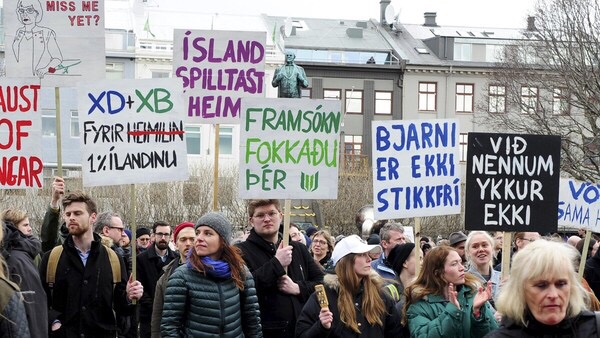
 People demonstrate against Iceland’s Prime Minister Sigmundur David Gunnlaugsson in Reykjavik, Iceland in this April 5, 2016 files. REUTERS/Stigtryggur Johannsson/Files©Reuters
Even sharp subarctic spring sunshine could not pierce the fog of political uncertainty that shrouded Iceland’s political circles on Wednesday — or even clarify the whereabouts of its prime minister.
Less than a decade after it took a starring role in the global financial crisis, Iceland is back in the international spotlight as home to the first government leader likely to be toppled by revelations of offshore accounts contained in the huge Panama Papers leak.
Amid official silence, baffled local and international journalists ambushed politicians in the outer corridors of the modest parliament building in downtown Reykjavik on Wednesday, hoping to locate and establish the intentions of embattled premier Sigmundur David Gunnlaugsson.
“There is so much corruption in this country it is unbelievable,” said Helgi Felixson, a film maker, who added that his compatriots were furious at a government that only represented those with money.
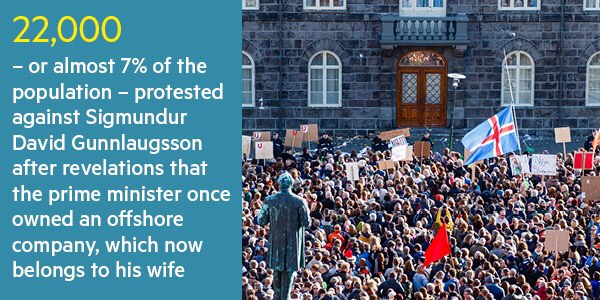
On Wednesday evening thousands of protesters braved the rain to mass outside the parliament, where they banged pots and pans and tossed eggs and at least one fish head. Placards they carried read: “This is not my government.”
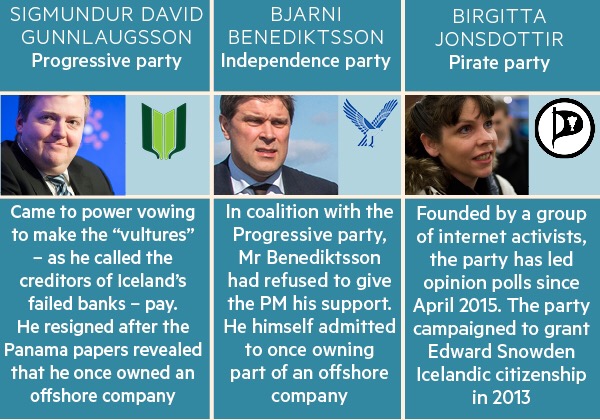
The crisis looks set to fuel the rise of the radical “Pirate party” to unprecedented national influence. Polls suggest Iceland’s version of the international direct-democracy and free-speech movement is now the island’s most popular political group.
Mr Gunnlaugsson became the target of public fury after news that he once owned part of an offshore company, now controlled by his wife, that owned claims in three Icelandic banks that collapsed in 2008.
The prime minister announced on Tuesday he would resign, but in a later statement suggested he only wanted fisheries minister Sigurdur Ingi Johannsson to take his place temporarily at the head of government.
With government officials unable to offer any explanation of Mr Gunnlaugsson’s plans, opposition politicians ridiculed his apparent desire to retain influence.
Asta Helgadottir, one of the Pirate party’s three members of parliament, riffed on Erwin Schrödinger’s famous thought-experiment in which a cat could be alive and dead at the same time. “[Mr Gunnlaugsson] is our ‘Schrödinger’s prime minister’,” she said.
An opinion poll published on Wednesday morning made clear that in spite of its anarchic roots, Iceland’s Pirate party — founded only four years ago by a group of internet activists — has become a major political force.
The poll found a record 43 per cent of voters would back the Pirates, far more than the 8 per cent who would support Mr Gunnlaugsson’s Progressives or the 22 per cent favouring his centre-right coalition partners, the Independence party.
The Pirate party does not have conventional policy-setting procedures, but Ms Helgadottir, 26, said its MPs — who hang a large skull-and-cross bones in their parliamentary office — were demanding an immediate election to resolve the crisis.
Mr Gunnlaugsson’s links with an offshore company destroyed the coalition’s credibility, she said, dismissing the prime minister’s defence that the offshore venture was his wife’s and that his joint ownership had been an oversight.
“This is just unacceptable,” she said. “You have to deliberately sign something to have ownership,” she said. “It’s not something that happens by accident.”
The demand for a snap election was echoed by the Social Democratic Alliance, even though the same poll suggested that it would be likely to lose seats. Arni Pall Arnason, alliance leader, told the Financial Times that it was not a time for political calculation.
“It’s important that we have a fresh start through elections, and the sooner the better,” he said.
Any attempt to force a new election before the end of the parliamentary term next year will require support from at least some coalition MPs, however.
Gudlaugur Thor Thordarson, an Independence party MP and former health minister, said the ruling parties were seeking instead to agree on a replacement for Mr Gunnlaugsson as soon as possible in order to continue in government.
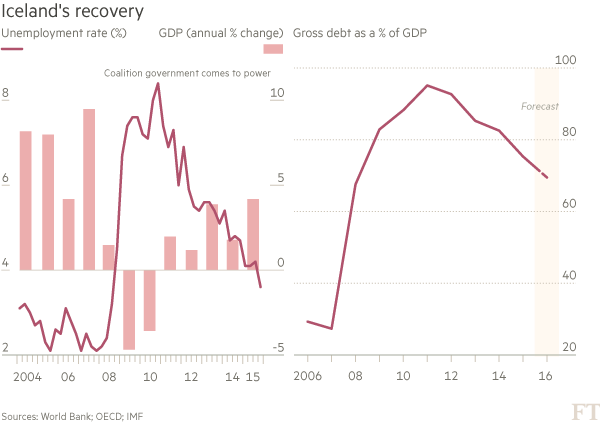
He added that the government’s priorities were to complete the country’s recovery from the financial crisis, in particular proceeding with plans to lift Iceland’s capital controls and to repay debt.
“We are definitely on the right track, but when you have political instability that can change in a very short period of time,” he said.
Einar K. Gudfinnsson, speaker of the Althingi, which has claims to be the world’s oldest parliament, said he had rebuffed opposition party calls for an immediate session to challenge the prime minister.
“Things are changing very rapidly, so best not to have that discussion right now,” Mr Gudfinnsson said.
Opposition parties had already put forward a motion of no confidence against Mr Gunnlaugsson, but this will be moot if he is replaced before a planned session of parliament on Thursday morning, the speaker said.
Opposition parties would be likely to put forward another motion against a new prime minister as soon as the ruling parties decide who Mr Gunnlaugsson’s successor will be, however.
Mr Arnason of the Social Democrats said that despite the ruling coalition’s majority, its efforts to stay in power were likely to prove vain given the weight of public opinion against the two big parties.
“Why do they want to prolong the agony?” he said.
 OBLONG MEDIA GLOBAL INTELLIGENCE
Leave a comment