
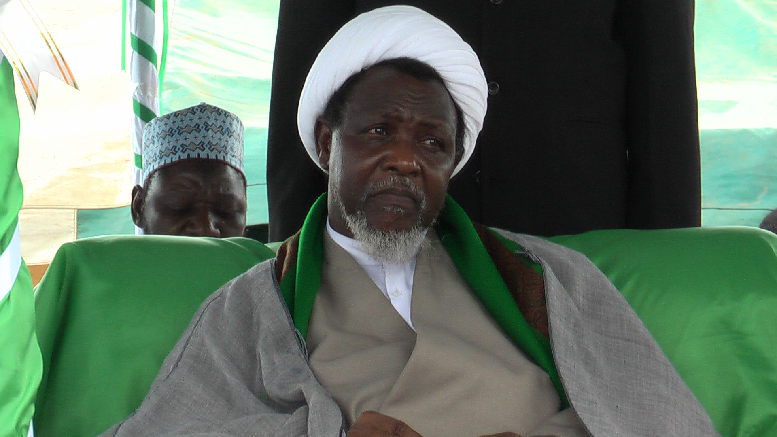
 Zakzaky- Iranian Shiite
The Kaduna State Government yesterday revealed that 347 persons were killed during the December 12 Shiite/Nigerian Army clash in Zaria. The Secretary to the State Government (SSG), Alhaji Balarabe Lawal, disclosed this in a government submission at the ongoing Public Hearing of the Judicial Commission of Inquiry into the clash.
Lawal, who led a six-man government witnesses before the panel, said that 191 corpses were taken from the Nigerian Army Depot, Zaria, and were buried in Mando area in Kaduna. He said 156 corpses were also conveyed from Ahmadu Bello University Teaching Hospital (ABUTH), Zaria, to the same Mando area.
The SSG said the corpses included that of youth members of the Islam Movement of Nigeria (IMN) who allegedly attempted to attack the convoy of the Chief of Army Staff, Lt.-Gen. Tukur Buratai, on December 12, 2015, in Zaria.
The state government said the corpses were committed into a single grave (mass burial) at the Mando area jointly supervised by the state government officials and about 40 men of the Nigerian Army, led by an officer in the rank of a Major. The SSG said 189 suspects were being prosecuted for alleged involvement in the Zaria crises while one suspect had died in custody. He said the state government had received several security reports from the Department of State Services (DSS) on the activities of the movement.
According to him, several measures had been taken to address the situation before it finally escalated into the clash with the Nigerian Army. Balarabe also said the state government demolished the Gyelasu residence of El-Zakzaky, Hussainiyya centre, Dembo centre, Jushi and the houses of Alhaji Aminu Idris and Alhaji Tijjani Mohammed for safety reasons.
According to him, the report from a team of engineers which carried out inspection on the buildings, said the buildings are failed structures.
Another witness and Director-General, Kaduna State Interfaith Agency, Mr. Namadi Musa, said the mass burial was conducted on December 14 and 15, respectively, and it took the officials about six hours to complete the burial. He said the burial was carried out 12 midnight and lasted up to 5a.m. Musa said while six tonnes of Mercedes tippers conveyed the 191 corpses from the ABUTH; the Army used three heavy-duty trucks to convey corpses from the Zaria Army Depot.
“We left Nigerian Army Depot with three heavy duty trucks and 60 young officers who escorted them to assist in offloading the corpses. From ABUTH, Zaria, five small trucks carried the 196 corpses. Most corpses were covered with black materials and they included women and children. “The mass burial was authorised through a warrant of burial obtained from a Kaduna Chief Magistrates’ Court in Kaduna,” he said.
The state government blamed some of the lapses and the excesses of the movement on the inability of the previous government, which did not take serious action to curtail the activities of the sect. On alleged demolition of buildings and structures of the IMN leader, the witnesses said that the demolitions were based on recommendation of a committee set up by the state government.
The witnesses, including officials of KASUPDA, KAPWA and the state Ministry of Works, Transport and Housing, told the panel that several other structures belonging to individuals had been demolished for poor building specifications and standards. General Manager, KASUPDA, Mrs Saratu Haruna; DG, Interfaith Agency, Mr Namadi Musa; and Deputy CMD ABUTH, Prof. Adamu Ahmed, appeared before the panel.
Meanwhile, elder brother of Sheik Ibraheem El- Zakzaky, the leader of the Islamic Movement in Nigeria, Muhammad Sani Yaqoob, who gave a sepa-rate testimony, said he is happy with the actions taken by the Nigerian Army during the clash.
He said that the Nigeria Army would have lost integrity if it had turned back when the shiites barricaded the road stopping the convoy of the Chief of Army Staff, Buratai, from passing. The Justice Muhammed Lawal-Garba panel also took submissions from the Izala Islamic group and Gyellesu Community in Zaria.
 OBLONG MEDIA GLOBAL INTELLIGENCE
Leave a comment