

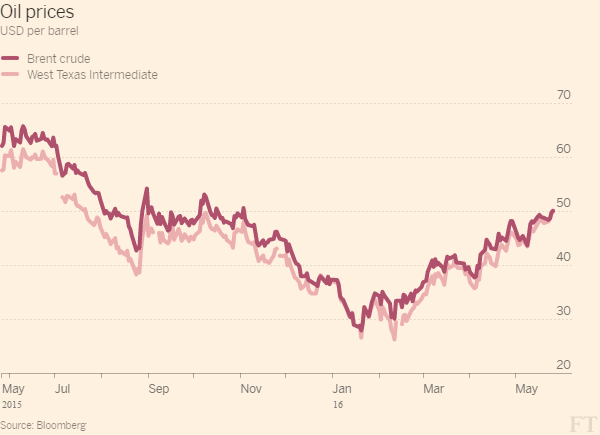
Oil prices on both sides of the Atlantic have pushed above $50 a barrel for the first time this year as investors weigh the impact of supply disruptions and US figures showing a decline in crude inventories.
ICE July Brent crude rose as much as 1 per cent to $50.51 a barrel on Thursday in London and US benchmark West Texas Intermediate also topped $50, rising 0.7 per cent to $50.21. They later pared gains and dropped below $50 a barrel.
Michael Wittner, analyst at Société Générale, said: “We expect global crude markets to continue to be driven by supply disruptions, especially in Nigeria and Canada.”
Wildfires are estimated to have knocked out about 1m barrels a day of Canadian production in May and militant activity has cut output in Nigeria to less than 1.4m b/d, 40 per cent down from its recent peak.
Crude has almost doubled since hitting 12-year lows in January on the belief the market will start to rebalance as supplies of high-cost oil decline and rising consumption from motorists and other oil users helps take care of excess stocks.
Government data on Wednesday showed a sharp decline in crude stocks in the US, the biggest oil consumer, from near-record levels of about 540m barrels. The US Energy Information Administration reported that crude inventories fell by 4.2m barrels in the past week, surpassing expectations.
“US oil inventories have largely topped out and should decline through the summer,” said analysts at Citi. The bank believes global oil stocks could start falling by the end of the second quarter, spurred by disruptions in countries such as Nigeria and the wildfires in Canada.
Months of cheap petrol and an improving jobs market have spurred US drivers to use their cars more. Petrol use in the US will this year surpass a previous record set in 2007, the government estimates.
Oil demand is also growing in India, China and Russia, which together used about 1m b/d more in the first quarter of 2016 than in the same period a year before, according to the International Energy Agency.
“Driven by strong gasoline and petrochemical feedstock consumption, we see potential for year-on-year global oil demand growth to reach 1.5m b/d in 2016,” said Facts Global Energy in a recent report.
Demand growth averaged about 1.1m b/d between 1990 and 2015. Last year it reached 1.84m b/d on the back of lower prices and was expected to fall sharply this year.
While supplies remain healthy, the effects of the disruption in Nigeria and Canada have helped underpin the rally.
Militants calling themselves the Niger Delta Avengers have cut Nigeria’s oil output by almost 1m b/d since the start of the year. On Thursday they claimed responsibility for an attack on a power line feeding Chevron’s Escravos terminal.
Reuters quoted a company source as saying Chevron’s onshore activities in the region had been “grounded”. A Chevron spokeswoman was not immediately available to comment.
David Hufton of PVM, an oil brokerage, said: “The Nigerian situation is a serious wild card with the two-week ultimatum from the Avengers for oil majors to cease operations ending today.”
If oil remains above $50 some producers might be spurred to increase supplies, threatening to cap further price gains. Pioneer Natural Resources, an independent producer, said last month that it would add drilling rigs if the price of WTI in 2017 was above $50 and inventories were declining.
“The return of US oil production on the back of higher oil prices, cost deflation across the sector, and Saudi Arabia’s intentions to raise crude production and exports are headwinds to a price rally,” said Citi.
Traders are also wary of the rally petering out once refiners have bought the crude they need to feed the coming US driving season. In early 2015, oil prices similarly rallied from January to May before collapsing again.
 OBLONG MEDIA GLOBAL INTELLIGENCE
Leave a comment