
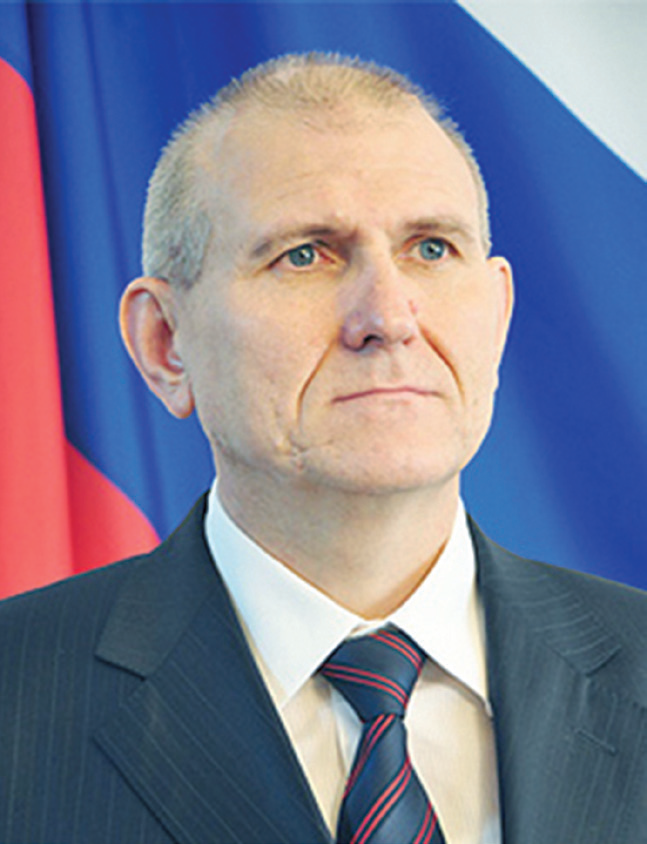
Russian investment in Nigeria covers such areas as energy, iron and steel, and hydro carbon. Over the years, the diplomatic relationship has also witnessed the establishment of a Russia-Nigeria Business Council (RNBC) which oversees economic activities between both countries. Speaking with our Correspondent, GIFT CHAPI in this interview, the Russian Ambassador to Nigeria, Nikolay Udovichenko, explains Russia’s intentions and commitment to the growth and development of Nigeria’s economy.
Nigeria is considered the economic powerhouse in the West African sub-region. As it is popularly known, Nigeria is one of Africa’s fastest growing economies and boosts the largest population. When Presidency to Muhammadu Buhari took over in 2015, the Nigerian diplomatic mission said it was ready to take practical steps to bolster economic and strategic ties with Russia.
Nigeria and Russia have held three meetings of the Joint Commission, the last being in 2009. Both countries had drawn up agreements and Memorandum of Understanding (MoU) on how to conduct businesses and investment in each other’s country.
Speaking on the Russian-Nigerian bilateral relations so far, Udovichenko stressed that during this long and vibrant period, both countries have become real partners. He said both countries are committed to the same traditional values and have similar approaches to the main issues of international agenda. This, he said is a great basis for partnership in the modern turbulent world.
According to him, Russia is open to cooperation in all spheres: development of mining industry, advancement of technological sector as well as infrastructure, nuclear energy.
“We want to see Nigeria strong, independent and prosperous. It’s no coincidence that in our bilateral cooperation Russia focuses on perspective projects and training of skilled specialists in our universities – we take it as the basis for further progress and dynamic development of Nigeria. Our cooperation in all fields is lasting and trustworthy, which means that no one side tries to impose its own hidden agenda or push its vision and approaches to economic and political issues, he said.
Interestingly, Russia and Nigeria’s two-way trade has so far improved. Authorities in both countries have repeatedly said that it should be many times larger, given that Russia is the biggest market in the former Soviet Union and Nigeria the biggest market in Africa.
He said: “Our trade volume is about 0.5 billion dollars. Of course, I guess that potentials of Russian-Nigerian bilateral trade are much higher. From our side, we offer our Nigerian partners implementation of new projects, including those with modern technologies.
“We are ready to increase imports from Nigeria – with regard to agricultural products and seafood – but these products should be vendible. I hope an upcoming session of the Joint Russian-Nigerian Commission on Economic and Scientific-Technical Cooperation will discuss and take decisions on implementation of bilateral projects, which could bring benefit to both countries. By the way, the Co-chair of the commission from the Russian side is the Minister of Agriculture, Mr. Alexander Tkachev.
Speaking also on areas where Russia hopes to improve its partnership with Nigeria, Udovichenko said both countries have a colossal potential, which, unfortunately, has not been fully utilized up till now.
He said Russia, however, has already completed many essential infrastructure projects in different spheres, such as power supply, railways, aviation, industrial development, agricultural self-sufficiency.
“Our achievements in high technology sectors like space research or nuclear power engineering are known all over the world. We are ready to share our experience and results with Nigerians, especially in such critical sectors as power industry, oil refining, infrastructure facilities and more.
“No doubt, that technological advancement means stable economic development. Let’s think what Nigeria really needs in this way. In my opinion, it is, first and foremost, skilled workers and commitment to technological breakthrough. I am sure that fundamentally, Nigeria doesn’t need donations, because your country is of huge possibilities. The first step might be prioritising tasks and, above all, implementing them consistently on the basis of political consensus. It stands to reason that development of such basic spheres as agriculture, commodity production, manufacturing industry is crucial for nation’s economy.
“Let me give you an example. There is aluminium production in Nigeria established with the assistance of the Russian company called Rusal. In fact, it is a very helpful development for Nigeria’s economy – it received a new aluminium industry; many people found their jobs, a power plant supplied local community with electricity. But as a result of inexplicable court decision, this production was stopped a few years ago, and up to date the company in fact has not been allowed to resume it.
“Another example is the Ajaokuta Steel Company. As a matter of fact, in 1980s it was a plant virtually ready for operations, but for different reasons it hasn’t been launched. Russia is ready to bring it back to life, so, you can be sure that Russia will share its technologies, bearing in mind conditions of market economy, of course. However, Nigeria itself should decide which projects it wants to prioritise, he said.
“Russian companies have been really influential in Nigeria- Rusal, like I mentioned earlier, is an influential aluminium producer. Lukoil is one of the leading oil companies which recently entered the Nigerian market; Gazprom- one of the world’s biggest gas companies – is offering perspective projects. We also know that RusHydro took part in the renovation of Jebba and Kainji hydro-dams.
“It’s another matter that for all foreign companies it is a key point when the current investing climate is more favourable. They want to see more clear regulations and stability. Economists and politicians argue all over the world, what is better for their countries – either to have underdeveloped industrial base, but at any costs collect taxes from it, or to lift taxes for, say, 5-10 years, stimulating infrastructure projects.
“Of course, the second way won’t increase tax revenues, but balance tax exemptions for business, create a perfect environment for development of industries, and for me personally, this approach seems more attractive. In any case, I am sure that Nigeria will find solutions meeting its own interests,” he said.
On the strategic front, Russia has also pledged to help Nigeria turn the tide against insurgency in the country’s North East. Russia has experience with that challenge, having battled insurgents in its Caucasus region for almost 25 years.
“Russia makes a fair contribution and renders assistance to Nigeria in military-technical sphere. For example, I can refer you to the comments of the Nigerian military on the purchase of military transport helicopters, part of them is expected to be delivered by the end of this year. This is reliable and proven flying machines which Nigerian pilots are familiar with. Besides, we carry on a dialogue between intelligence services, provide training courses for the military and police. And, of course, we are open to further cooperation in this very sensitive area.
This he said, would be the largest scientific and research base in Nigeria for training of highly qualified specialists in the sphere of atomic energy. He said the centre will promote the growth of profile education and science level in Nigeria.
“In fact, we witnessed the creation of a whole high-technological industry, which will allow to solve the problem of power supply once and for all. I am sure that resumption of aluminium production by Rusal, for example, will contribute to the development of Nigeria’s industry.
“I would like to stress again that the main thing necessary for successful operation of big investors in Nigeria is a political will. I think that investors come to Nigeria, not to get here-and-now-profit, but to develop industries; this could be treated with more preferences, especially in terms of taxes and doing business. For Nigeria, in its turn, the most perspective way might be not to rely on donations or occasional assistance, but to build a long-term partnership. I am convinced, should Russian companies see this approach, they will be more interested in close interaction with Nigeria.
“Finally I would like to congratulate all Nigerians on the just concluded 56th Independence Day celebration and express confidence that your great nation, Nigeria will overcome all challenges it is facing today. I wish Nigeria peace, happiness and prosperity,” he concluded.

 OBLONG MEDIA GLOBAL INTELLIGENCE
Leave a comment