
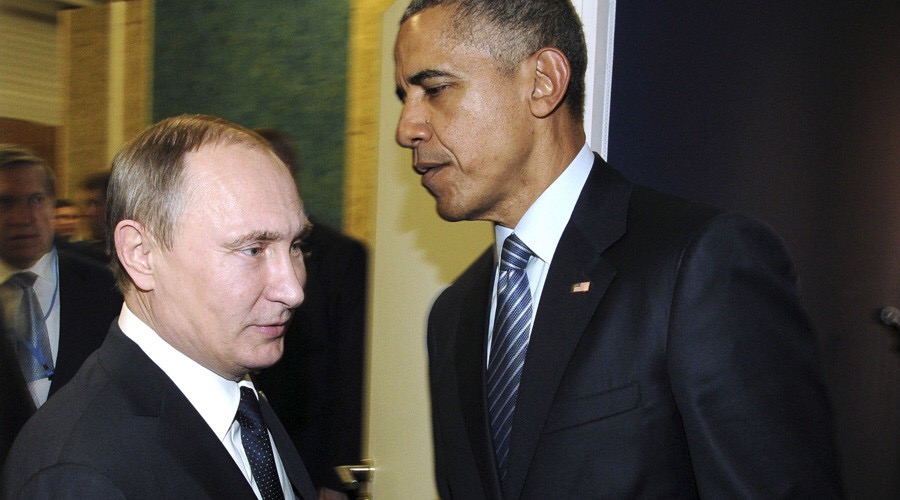
As the relationship between Russia and the West has deteriorated, some have hastened to blame the United States and NATO for starting a new Cold War, while others entirely blame Putin for annexing Crimea. There is, however, another way to think, both more plausible and more troubling: the question is not “Has a new Cold War started?” but rather “Did the old Cold War ever end?”
In my opinion, WWI began around 1870-75, when the scramble for Africa and Asia really began. European nations were amassing territorial control over large parts of the world, and there were constant battles as there was a lot of mineral wealth in Asia and Africa, and the populaces there had weaponry that was not as advanced. Tensions between European armies throughout Africa and Asia never spilled over into an all-out battle because Europe was still reeling (historically) from the Napoleonic wars. But tensions grew and nations split constantly, and by the time 1914 rolled round this had gotten to an extreme point.
During the scramble for African and Asia Jingoism had been promoted. This was a very staunch and firm type of nationalism that was built on the idea of dominance of European people worldwide, both technologically and economically. However false or unfounded, this led to a competition for dominance of single united countries. Jingoism was encouraged to inspire patriotism and higher taxation in European countries. People became strongly nationalist, and tensions rose between nations. Finally, one assassination of a fairly minor figure was enough to tip it all over the edge (arguably) and WWI began, incorporating not just post-Napoleonic Europe, but all of those occupied states across the globe.
Second, let’s do WWII
After WWI the nations of Europe wanted to ensure that another catastrophic war would never break out, so they formed the League of Nations, but not without first devastating Germany’s military power. At the time most of central Europe had lost its former glory – the Ottoman Empire was a shadow of its former self; The Austro-Hungarian empire was splitting; Poland was struggling economically and the post-Prussian united German state was vindictively limited from expansion by the harshness of the Treaty of Versailles. As with all wars, there were no “good guys” or “bad guys” in WWI, but the winning nations made sure to humiliate or incapacitate the losing ones on the basis that it would prevent future wars.
Then along came Hitler & company. Nazi politics in Germany fought against the humiliation of the country, and they were elected off the back of this. It is well documented what happened next, but the cause is quite important. That weakness in central Europe mentioned above gave an opportunity for Germany, now united under a singular humiliation, to expand their empire unlawfully. They broke the treaty and eventually split the League of Nations in order to conquer a vulnerable Europe. Uniting with Italy (a dominant controlling force in Africa) a second war began that was really just a continuation of the first, with the same battlegrounds in Asia, Africa and Europe, with one key difference: the active inclusion of the USA as a new superpower.
Key conditions: Extremist & humiliated nation, power struggle over fragile states
Finally, we’ll consider WWIII
I note that a lot of people have mentioned the Cold War here as a sign that a third world war could not start. I would dispute that to a degree, because I think the cause is what we need to identify. I’ll expand, using the key points above. I will write a little on each:
1) Staunch Nationalism
During the Cold War (and following WWII) heavy-handed nationalism was reigned in to a large degree in European countries. However, the struggle between the USA and the USSR developed fervent feelings of “good vs bad”, “east vs west”, “left vs right” etc. These feelings have matured, and while the Berlin wall has come down, American and Russian sentiment on a strong national front has been a constant (the existence of Fox News is testament to the fact that nationalism is rife in the US; Putin wrestling bears ditto). Throw in Britain under Margaret Thatcher and the new breed of Imperialism that this inspired in the UK (see UKIP) and the similar increase in Nationalist parties being elected across the EU. Add a dash of sudden economic might in China and belligerent nationalism in the middle-east (Israel, Pakistan, Saudi Arabia, “ISIS”*), there is certainly plenty of condition 1 to mull over.
2) Economic Struggle
Without labouring the obvious, the battle for control of spheres of influence in Iraq, Iran, Afghanistan, Kuwait, Ukraine and Georgia are all to do with money. Oil and gas are key resources, and large powers like Russia and the US want to keep these resources for economic dominance. Furthermore, the enormous national debt of the USA to China (and their need to meet this debt) gives plenty of reason for economic struggles to continue and tensions to grow. The interdependence of Saudi Arabia (oil) and the USA (military), creates ongoing issues in the middle east, where resources are rich, the powerful are rich, and the majority of people are starving or oppressed, or both.
3) Long History of Violence
This is where the Cold War comes in. While the Cold War has managed to pacify some areas (Taiwan, Vietnam etc.) it has exacerbated violence in others (Korea – via the split in the nations, Afghanistan). The violent and ongoing struggle between Israel and Palestine (and other surrounding states that became involved in this war in the 60s and 70s) has reached boiling point only recently with the formation of ISIS. Which leads us to:
4) Extremist and humiliated state
ISIS was formed from post-Wahhabist, post-Mujahideen extremists that developed from the base of Saudi Arabia after WWII. With enough money (provided by the west guzzling oil) and military power (provided by the west selling weapons) to be a serious threat to the current landscape, the state has grown. There are any amount of poor, hungry people who have had their families killed by Russian, European or American military over the last 60 years to make recruitment in the fervent nationalistic ideals of the extremist group easy. Originally backed by American and British money in Saudi Arabia, ISIS is formed from people who were humiliated by western aggression, but who have the economic power and strength of numbers to pose a serious threat as a nation state.
5) Power struggle over fragile states
I’ll quickly qualify: A fragile state (as I am referring to it here) is a state with unstable government and small military power to defend itself. I can name a few such states: Afghanistan, Iraq, Kuwait, Palestine, Egypt, Syria, Lebanon, Ukraine, Georgia. Notice the repetition from above? After WWI, Germany’s humiliation was an attempt to turn it into a similar fragile state, but it rallied against this (similar to ISIS). The aggressive dominance over fragile states in Africa and Asia was mimicked by the US and Russia. China has begun to take economic control over large parts of Africa, particularly Nigeria, to assert further economic dominance over the world, spreading the potential battlefield if a war should happen.
Conclusion
OK, I’ll pull back the negative a little bit. I believe that at any moment since WWII there could have been a third world war. These struggles listed above are ongoing and extreme, but they are not new. However, there is certainly a dangerous cocktail of nationalism and military might to consider, and the possibility can’t be ruled out. I hope that I will not see a major war in my lifetime (I have already seen enough minor wars through television, and grew up only a few miles from one in Ireland). War is an atrocious thing, and there is no just war (not even against ISIS in my opinion: it will not solve anything). The state of affairs in the middle east are terrifying, but they were created through unjust and power-hungry behaviour. I would love to believe that there will be some form of diplomatic resolution, but it seems unlikely.
I wish that people would just remember that we are all sharing a tiny blue planet on the edge of the universe, and that power and greed really don’t matter, they just make the world worse for others.
 OBLONG MEDIA GLOBAL INTELLIGENCE
Leave a comment