
INTRODUCTION
In the late 1950s Nigeria was not yet independent and, therefore, was not a full member of the British Commonwealth of Nations but was allowed to attend its meetings as an observer. At one of such meetings, Mr. Jawahalral Nehru, the then Prime Minister of India, took the liberty to offer advice to the then Prime Minister of Nigeria, Alh. Abubakae Tafawa Balewa, in three key areas:
1) Power Generation; this being an important resource, our country needed to develop sources especially the hydroelectric type that is cheaper to run
2) Rail transportation; especially mass transit for movement of goods and people Nigeria being a fairly large country
3) Steel development; as without steel no country can advance rapidly and technologically
Our Prime Minister appeared to have taken his counter-part’s advice seriously in all three areas as evidenced by the actions he took immediately after our independence.
1) In the case of Power Generation, he embarked on the establishment of the Kainji Dam paving way for the establishment of NEPA from the merger of new but now defunct Niger Dams Authority and the older but now equally defunct ECN or Electricity Corporation of Nigeria.
2) In the case of Railway development, he extended the railway network to Maiduguri and was planning other extensions, but was brutally cut down in the first ill-fated and disastrous military coup early 1996.
3) As for steel development, he commissioned Hatch Associates, a Canadian Steel Consultants Company to carry out a feasibility study to advise him on the viability of setting up a steel plant. That company came up with a bogus projection that there would be a glut of steel world-wide to the end of year 2,000 advising Nigeria not to waste its then meagre resources on steel. It was only after the civil war that Gen. Gowon decided to revive the steel dream by trying our new friends who helped us successfully execute the civil war, the Soviet Union. He commissioned them to carry out a fresh feasibility study on the prospects for locally producing steel. Their preliminary findings confirmed the availability of the major raw materials for setting up an integrated steel plant. Consequently, Gowon established the Nigerian Steel Development Authority (NSDA) in 1972 and mandated it to work with the Soviets to come up with a detailed report on Steel production. Gowon was quite slow as nothing much was done until 1975 when his regime was toppled. It took the Murtala-Obasanjo-’YarAdua regime finally in 1979 to create out of NSDA several steel companies in Ajaokuta, Jos, Katsina, Oshogbo, Iron Ore Mining Company in Itakpe and Steel Councils in Jos and Kaduna. The Ajaokuta plant was to be completed by 1985 to keep pace with the development of Abuja, the new Federal Capital. Due to a combination of lack of political will, greed and outright political sabotage, the plant is yet to be completed even though the cost so far has trebled or quadrupled most of which was spent ironically not on the project but in its name only. What is needed now to complete the project is more political will as the plant has the huge potential to create massive economic activities, huge job opportunities, vast multiplier effects, etc. as will be shown later. One can have a glimpse of how the Ajaokuta area would look like by a cursory study of the Sheffield area of Britain or the Ruhr district of Germany.
THE AJAOKUTA STEEL PROJECT (ASP)
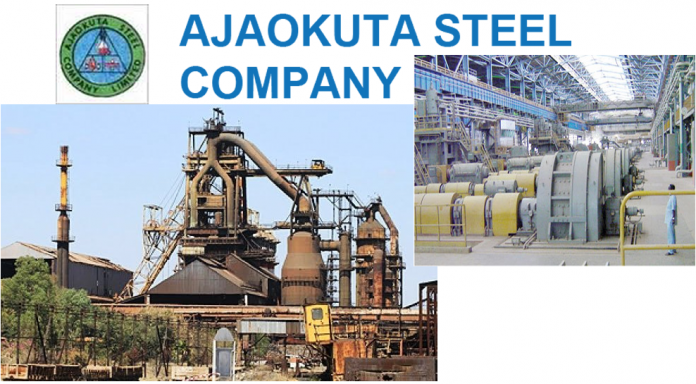
The Ajaokuta steel project is an integrated steel plant designed to use raw materials like iron ore, cokable coal,etc. to produce cast iron in the blast furnace that is then transferred to the steel=making shops where it is reacted with oxygen, alloy materials and fluxes as raw materials to produce varying grades of steel. Three stages have been designed with the first stage having a capacity of producing 1.1 million tonnes of liquid steel in form of iron rods, wire rods, angles, strips, medium sections, structural sections, rails, billets, etc.. The second stage is to double the capacity to 2.2 million tonnes of identical products but including flat sheet steels. The third stage is to double the second stage i.e. 4.4 million tonnes producing all the profiles listed in the second stage.
An interesting feature of the Ajaokuta Steel Project is the provision of the massive Central Maintenance Facilities incorporated into the plant that aims to supply the plant’s 40 to 60% spare parts in normal operation. These consist of pattern-making shops, foundry shops, machine shops, fabrication shops, mechanical repair shops, electrical repair shops, etc. In addition, most of the plants and equipment erected and installed in the Steel Plant were actually finished in what is called the Erection Base another entirely different manufacturing complex right there at the Plant Site.
Other facilities incorporated into the Project are gold-plating facilities, zinc-plating facilities, galvanising facilities, spent lubricating oil recovery facility, etc.
So the Ajaokuta Steel plant is not only a steel producing complex but a concentration of high-tech plant and equipment-designing or -producing or –fabricating or -finishing facilities and can profitably be used to service other industries in Nigeria as happened in the 1980s and 1990s with customers like the Kaduna Refinery, Cement plants, PAN, Paper mills, Sugar Mills, etc.
THE ASP AND ITS MULTIPLIER EFFECTS
People familiar with integrated steel plants will easily appreciate the hectic economic activities it generates in its environments – both the immediate and the remote. In fact, in the 1980’s a study was conducted in this area and it was found that for every US $1 worth of steel product put out into the market, it would go on to generate another US $20 worth of economic activities in its immediate and remote environments. To illustrate the economic impact of this multiplier effect expected to be fostered by ASP on the Nigerian economy, suppose the plant when completed at the first stage and operated at full-capacity of 1.1 million tonnes and the various products sold at an average price of US $500 per tonne. This would translate into a revenue of US $550 million. Multiply this by 20. The total value of the economic impact would be US $11,000 million or $11 billion in addition to ASP itself! At the second and third stage, it would translate into US $22,000 million or $22 billion and US $44,000 million or $44 billion respectively! The project was planned to be completed (3rd Stage) by 1990 or 1992 under the first Buhari administration before IBB and co selfishly and for no other reasons truncated that government unceremoniously in 1985. Imagine the staggering loss in the opportunities as a result of that senseless change of government! If it had been finished in 1992 and operated continuously since then, the total impact would have been 24 times US S44 billion or over US $1,056 billion, that is over US$1 trillion! Equally important is the fact that these opportunity costs will continue as long as we don’t complete that project. It is hard to imagine any other single project that has so much impact on our economy. The impact is more staggering in terms of job opportunities and is an entirely another fascinating topic.
ASP AND THE ASSOCIATED INDUSTRIES
Several industries can be identified as likely to spring up as associated industries:
i) Upstream industries
ii) Downstream industries
iii) Ancillary industries
iv) Derived services
1 UPSTREAM INDUSTRIES
Upstream activities of the steel plant are the operations of the various units of the integrated steel plant made up of i) the blast furnace, ii) the steel-making shops, iii) continuous casting mill, iv) the billet mill, v) the medium section and structural mill, vi) the light section mill and the wire rod mill. Of course there are major supporting units like the coke-oven mill, the sintering plants, the central mechanical workshops, etc.
Upstream industries are those whose activities precede the iron and steel production but are in one way or another connected with the operations of the steel plant, eg preparation of or transporting the secondary raw materials to the battery limits, examples of which are fluxes, scraps, ferroalloys, sand, gravels, quartz, addition agents, lubricating oils and greases, etc. Most of these inputs are required in very large quantities whose procurement, therefore, constitute the major activities of the steel company itself. Still outside suppliers complement the internal efforts. The following are examples;
Scraps constitute 55% of the content of the final product and their suppliers are major partners of the steel company
Lubricating oils and greases are also needed in very large quantities and can best be handled by major oil companies like Conoil, Oando, etc but in compliance with the local content law, independent marketers can be patronised.
Fluxes are also needed in very large quantities but their requirements can be met partly by the use of locally available sand, gravel, quartz, etc. through the use of local suppliers.
2 DOWNSTREAM INDUSTRIES
The innumerable products of steel plants provide unbelievably wide varieties of opportunities in the downstream side of the plant.
Briefly the products from the various units of the ASP are as follows:
Con-cast mill: Blooms, slabs
Billet mill: Billets
Medium sections and structural mill: I-beams, channels, angles, zees, tees, rails, etc.
Light section mill: bars, rounds, squares, strips, angles, channels, etc.
Wire rod mill: wire rods of all shapes and sizes.
Just to give an idea of the types of products obtainable from an iron and steel complex consider the following list:
i) From wire rods- welding electrodes, brush wires, music wires, piano wires, wire nails, fence wires, concrete reinforcing wires, wire ropes, wire springs, bridge wires, etc
ii) From steel plates, sheets, strips – tubular products, pipes, tubes, etc.
iii) From rails and rail rods – rail sections, rod axles, wheels, wagons, sleepers, locomotives, etc.
iv) From carbon steels: castings, forgings, tubular products, plates, sheets and strips, wire products, structural shapes, bars, tools, rail items like rails, wheels, axles, etc.
v) Alloy steels – special elements added to steel to enhance its properties like manganese, silicon, chromium, eg low alloy steel, alloy steels, alloy tool steels, stainless steels, heat-resisting steels, electrical steels, etc.
vi) From the blast furnace – slag (the residue formed at the bottom of the blast furnace but above liqid iron as a result of action of flux on the gangue of iron ore) which is used to produce Portland cement, structural concrete, fireproof materials, floor tiles and roofs, building blocks, bricks, rail construction, etc.
vii) From coke ovens – coal chemicals like hydrogen, methane, ethane, CO, CO2, ammonia, O2, N2, pyridine, tar acids, creosote oil, coal tar pitch, benzene, toluene, xylene, naphtha, etc.
3 ANCILLARY INDUSTRIES
Ancillary industries are those that take products from the steel mill and other sources and produce items that are required by the steel plant.
4 DERIVED SERVICES INDUSTRIES
These are industries or agencies that arise of the needs of the steel plant and or its staff. Examples are Banking and insurance, Immigration, Filling stations, utilities suppliers like gas, water, electricity, sewage, etc., telecommunications, hotels and restaurants, housing, abattoirs, auto repair shops, markets and supermarkets, hair salons, barbershops, travel agents, bus/train services, taxis, schools, health centres, spas, sports facilities, mosques and churches, etc.
 OBLONG MEDIA GLOBAL INTELLIGENCE
Leave a comment