
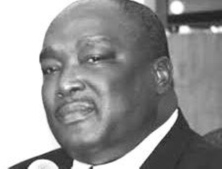
MR. JOSEPH BODUNRIN DAUDU (SAN) is a former President of the Nigerian Bar Association (NBA). He is currently the Chairman of the African Bar Association and founder of the Rule of Law Development Foundation, an interventionist civil society organisation with an interest on rule of law issues. In this interview with AMEH EJEKWONYILO, the SAN maintained that the proposed special anti-corruption courts by President Muhammadu Buhari through the office of the Attorney General of the Federation is aimed at stifling members of the opposition political parties ahead of the 2019 general elections so as to pave way for his re-election. He also spoke on other topical national issues.
Is the N100 billion appropriation to the judiciary from the N70 billion last year enough in carrying out the far-reaching reforms that are needed in the justice sector in 2017?
First of all, you must understand that every budget is a proposal; it merely seeks to set plan for the financial year. No money in physical cash has been expended or disbursed.
Now, you would realize that between April and May of 2015 and today, we have suffered at least a 300 per cent devaluation in the naira by causing inflation in the value of foreign currency. And therefore, if the judiciary uses a certain proportion of N70 billion to import like every Nigerian person or agency does, it then follows therefore that that N70 billion would translate to N240 billion today for the judiciary to be able to run in the capacity which it ran in the previous year.
First of all, the earning capacity of every person (not even judges) has been greatly reduced by this inflation. You can see those who are either giving money for Christmas expenditure in houses know that the times are hard. The long and short of what I’m saying is that the N100 billion is indeed a reduction of the N70 billion given in the light of the devaluation of the naira and the inflation. Of course, the judiciary will not be in a better position just because N30 billion has been added, when what should have been added is a N140 billion to it, that is the minimum to which it can go. But as it is apparent even the amount budgeted, the question will arise, how do we finance it?
Will Nigeria be in a position from its oil exports to be able to raise 50 per cent of that amount of money? What about the existing loans and the existing commitments that Nigeria has which monies are taken from source? Therefore, we are not only in recession, we are approaching bankruptcy as a nation. And I think the earlier our government comes out to tell us how much we earn or earned in this last financial year, how much we are likely to earn, how much is the cost of governance and how much is the cost of fighting this recession, how much our over-bloated government costs us, we will not be able to say whether we are out of the woods or not.
So, our leaders should be able to tell us what is the amount that you earned in the last year and how the monies were spent to the last kobo. If there is no accountability, then of course we are left to infer that the money has been frittered away.
Section 174 of the 1999 constitution, refers to the functions and duties of the Attorney General of the Federation. Does it include being asked by the President to investigate the fallout of the Senate conclusion that the acting Chairman of the EFCC, Mr. Ibrahim Magu was unfit to hold the office as well as the numerous allegations made against the Secretary to the Government of the Federation, Mr. Babachir Lawal?
Now, two points arise from this. Firstly, section 174 does not contain such powers. The president is entitled to conduct his own investigations and have recourse to Tribunal of Enquiries Act which allows him to inquire into anything happening within the Federal Capital Territory or conduct an internal inquiry within his administration. He is the head of the executive and he is entitled to ask questions and get answers, but to formalize an inquiry and ask the AGF to conduct an investigation into the outcome of the fallout of Senate inquiry, is in my humble view is completely wrong.
It shows a great disrespect to the Senate. It is not a matter to be investigated; Senate’s decision is final. Even if he conducts his investigation, his (AGF)’s investigation cannot override what the Senate has constitutionally determined as the outcome of the qualification of Magu to occupy that office. The President is engaged in filibustering; he is just wasting time. The essence of democracy and not dictatorship is that the President himself should accept the result of the Senate with equanimity. There are numerous Nigerians in the police force and in other aspects who can run (some even more ‘wicked’ than Magu); there are s many people he can put there if that is the kind of person he wants. We will not be cowered; we will still continue to do our work as required by the ambit of the constitution. But when the constitution is supreme is most important and therefore, if an arm of government that has equal powers as the President takes a decision, the President cannot take advantage of his executive powers and seek to undermine the constitution. That is most important because what goes round comes around, and the day the President will need the constitution to act in his favour, this kind of conduct will be cited as precedent for him not to enjoy the same protection or benefit.
What do you make of the AGF’s bill to the National Assembly for the establishment of special anti-corruption courts?
Straightaway, I would say that even if that bill sees the light of day, that is a throwback to 1983/1984 of the creation of special military tribunals which had a very sorry effect on our judiciary, whereby speacila courts were set up sentencing people to hundreds of years imprisonment without following due procedure and evidential safeguards.
To start with, section 66 of the Nigerian constitution itemizes the courts that are the superior courts of record of the federation in the constitution. Unless you amend the constitution and add special criminal courts, you will not be able to vest them with powers. Secondly, Section 36 (4) of the Constitution says it is those courts that are listed (not the ones that are yet to be created) that are vested with the powers to try criminal cases. So, sending a bill at the instance of Prof. Itse Sagay’s Presidential Advisory Committee on Anti-Corruption, is an exercise in futility. I can assure you that (not because people do not want to fight corruption but) because all these stopgap measures are not the way to fight corruption. There are still sound judges within the judiciary who have no blemish. The judge who made an order against the excesses of the Department of State Services had his house raided for no other reason other than he tried to correct the excesses of the agency which is the function of the judiciary. So, you cannot tell me that there are no persons that can determine cases in a free and fair manner.
In any event, the judges that are to man the so-called special courts, where are you bringing them from; from heaven or hell? If they are Nigerians and they are Nigerian judges, then you cannot tell me that because you labeled them “Special anti-corruption judges” that they do not have those tendencies that people say is what is wrong with the judiciary. So, the remedy does not lie in ad-hoc and fire-brigade approach; the remedy lies in sanitizing the existing system and in ensuring that anyone who aspires to be a judge has the requisite character, has the requisite knowledge to administer the law.
Again, the government is not sincere about the special anti-graft courts; it just wants to use the special courts as EFCC is using to witch-hunt people and to ensure that before 2019 (election year), most of the political opponents are sent to prison by ad-hoc courts that really have no legal basis. But I can assure you; this is Nigeria, that kind of thing cannot happen.
If we didn’t allow the Peoples’ Democratic Party (PDP) to get away with certain things, we will not allow the All Progressives Congress to get away with this, because if the PDP fenced everywhere like that, they would not have been able to take power and rule today. Therefore, they should not teach the opposition bad things because God gives power, you may be there today, tomorrow, you will not be there.
 OBLONG MEDIA GLOBAL INTELLIGENCE
Leave a comment