
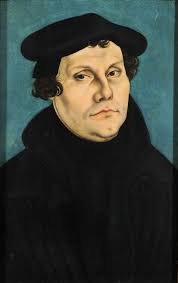
The anti-Jewish hatred of Nazi Germany was sown into the German soul by Martin Luther. Luther once expressed his violent fantasy against the Jews as such:
“Were I able, I would knock him [the Jew] down and stab him in my anger. It is lawful according to both the human and the divine law, to kill a robber; then it is even more permissible to slay a blasphemer”
He also said, “We ought to take revenge on the Jews and kill them”, and he lamented:
“it is our own fault that we have not annihilated the Jews but placidly let them stay where they are in spite of all their murders, their curses, blasphemies, lies, violations, and that we even protect their schools, their dwellings, their persons and property.”
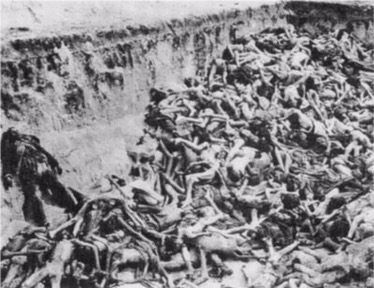
What Luther wanted
Hundreds of years before the Nazis took power, Martin Luther introduced the idea of forcing all of the Jews into concentration camps and work camps. He pushed for this imposition in his anti-Jewish code:
“Pack them all under one roof or stable, like the gypsies, that they may know that they are not lords and masters in our land as they boast. …Deprive them of the right to move about the country. … Hand the strong young Jews of both sexes flail, axe, mattock, spade, distaff, and spindle; and make them work for their bread in the sweat of their brow, like all the children of Adam. Confiscate their property and drive them out of the country.”
The German Nazis would follow the words of Luther, with their Darwinist ideology, in the Holocaust. German scholars, contemporary to Luther, were repulsed by Luther’s violent envisioning. For example, Heinrich Bullinger of Zurich wrote: “Everyone must be astonished at the hard and presumptuous spirit of the man (Luther). The opinion of posterity will be that Luther was not only a man, but a man ruled by criminal passions.”
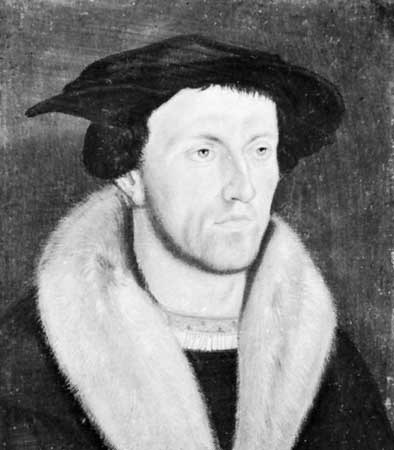
Heinrich Bullinger of Zurich
Martin Luther was the patriarch of German nationalism. He appointed himself as the mouth piece for the German race, saying:
“I am the prophet of the Germans, for such is the haughty title I must henceforth assume.”
Luther moreover declared:
“As I am the prophet of the Germans, I will act as a faithful teacher and warn my staunch Germans of the danger in which they stand.”
Luther also said:
“I have been born for my beloved Germans, for them will I die!”
For Luther, the Germans were the Herrenvolk,, or “the best nation.” “The Germans are conspicuous for their nobility of character,” said Luther, “their constancy, an fidelity.”
In another pompous and antichrist statement, Luther said:
“If God is concerned for the interests of His son, He will watch over me; my cause is the cause of Jesus Christ. If God careth not for the glory of Christ, He will endanger His own and will have to bear the shame.”
If the Germans were so enthusiastic about a man like Luther, then it should have been no surprise that they accepted Adolf Hitler as their leader. Or in the words of Wiener:
“A nation which found it easy to accept a character like Luther as Christ, could not find it difficult to accept a man like Hitler as Messiah.”
And that is exactly what happened. The Germans were looking for really the fulfillment of Luther’s envisioning of an absolutist leader — a fuehrer — for Germany. Luther once said:
“Germany is like a beautiful horse that has everything it needs. But it needs a horseman. In the same way as a good horse runs occasionally astray without a good horseman who governs it, so Germany has enough strength and people, but it lacks a good leader.”
Hitler was seen as the grand emulator of Luther. Karl Litzmann, a German general in the First World War who later joined the Nazi Party, definitely saw Hitler in this light. “Hitler,” he said in 1933, “is the greatest German, who can only be compared to Luther.”
In this inquest on the connections between Darwinism, Protestantism and Islam, the First World War is of the utmost of significance. For in this conflict — amongst the most horrific ones experienced by mankind — Islam, Darwinism and Protestantism, converged together to war against the true faith of Christianity. When observing the problems of our present day, and how they presage the rise of another bloody conflict, one realizes somewhere along the road of inquiry, that the First World War parallels our own, and thus is a prerequisite for us to learn about it.
In the words of historian George Kennan:
“all the lines of inquiry, it seems to me, lead back to it.”
In the heart of Germany’s vision of supremacy, one will find Luther’s name engrained. Adolf Deissman, who was amongst Germany’s leading Protestant theologians during the First World War, unequivocally placed Luther as an inseparable pillar holding up German militarism. In 1914, Deissman wrote down the points of ideology which German Protestants had to follow. It was entitled: “The War and Religion” and in it he proclaimed the diabolical equation of Christianity with German supremacy. He wrote:
“The war has steeled our religion … We Germans can’t believe in anything else but a German God.”
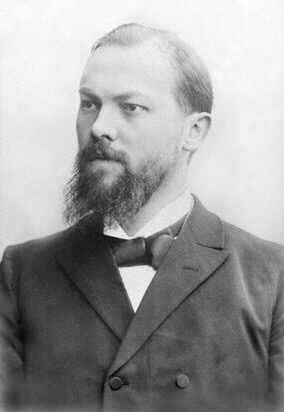
Adolf Deissman
Deissman also said:
“Our present religion is natural and German, and we preach a German God! A German, a national God!”
By Making God German, what Lutheran ideology did was bring back the German people to its pre-Christian religion, when the Germans worshipped their own Germanic gods. By doing this under the guise of Christianity, it made it easier for people to return to paganism, without the trouble of appearing rebellious. Jesus Christ all of a sudden became a German, as we read in Deissman:
“Only in a German cloak can the real Christ breath.”
This type of teaching went directly in line with the “back to roots” paganism that so grew in 20th century Germany. It also emanated from the Lutheran urge to form a German Christianity, in which lies the heresy of putting the race before the Faith. From nationalist religion, comes the idea that the race is above the Faith, and in this, do men put their own pride above mankind, and war against humanity itself. Hence why Protestant Germany had no problem in absorbing Social-Darwinism. Even in the words of the Protestant theologian, Deissman, do we find the Darwinist sentiment of “might makes right,” for he said:
“I am proud to preach the religion of might and what our enemies call barbarism.”
Before the Protestant revolt, the German people were under the Universal Catholic Church, in which lied many nations, peoples and languages. There was a unified body called Christendom, under the Church, wherein Christian spirituality was the center of everything, culturally and politically. When the Pope declared a Crusade in the 11th century, French, Italians, Irish, Germans, and others, all gathered together to join the holy cause. There was spiritual unity, guided by the Church and not divided by the ideas of nations. What hindered the cause of Christendom was nationalism.
There was actually a natural factor behind the development of nationalism: the Black Death of the mid 14th century. Estimates put the death toll, for the era of 1346 to 1353, from 75 to 200 million deaths. But even after this, the Plague continued all the way on to the year 1671, and even continuing in other parts like Russia, to the late 18th century. Before the outbreak of the horrors of the Black Plague, the unity of Christendom, for the most part, was maintained by a common religion and Catholic civilization, and a large body of governors.
There was immense intermarriage between the people, there was free travel from kingdom to kingdom, people from different regions met one another through common zeal for holy causes — the Crusades and pilgrimages —, councils massed people from various areas of the continent together, and wars as well gathered them. People throughout England could speak French, with a man of Northumberland speaking not too differently from a man of Bordeaux. And even in other areas where they spoke different languages, like Spain and Italy, there was still a great amount of traveling and journeying being done by government officials, the upperclass, soldiers, clerics and scholars.
From the Black Death came the loss of tens of millions of people throughout Europe. The fear of infection kept people from traveling, and confided them to remain within their own lands. This serious decline of traveling naturally helped lead to the creation of national identities. Nationalism was something that was going to happen no matter what, but the Black Plague accelerated the process like yeast in water. Because of the Black Plague, within one lifetime the majority of people in England no longer spoke French, but English. In every place where the Black Plague had its effect, there was developed what has been called “particularism,” a rooting of the divisions between Christians peoples. By the year 1400, there were established differences developed between nations that greatly penetrated and altered the soul of Europe.
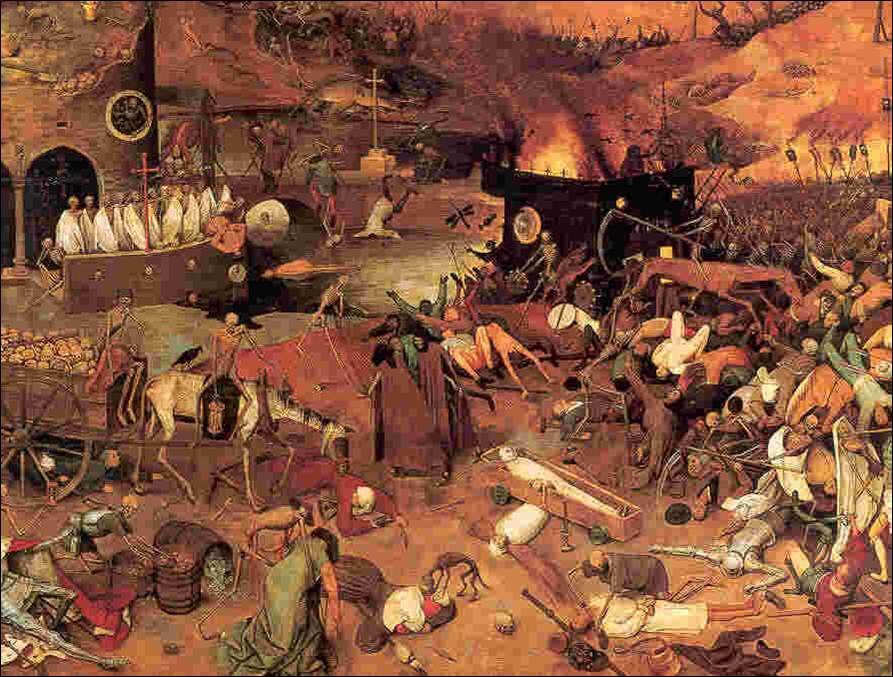
Illustration of the Black Plague
Within the 15th century, Jan Huss (inspired by John Wycliffe) led a revolt in Bohemia against the Catholic Church, calling Her the Harlot of Babylon and the Pope the Antichrist. He rejected the Eucharist and the priesthood, and his followers exhibited their destructiveness and cruelty when they smashed Catholic icons, which they believed to be idols, and beheaded and butchered Catholics. They revolted against the Holy Roman Emperor, Sigismund, and this led to the most brutal Hussite Wars, which lasted from 1419 to around 1434.
This revolt, and the wars that followed, were part of more so a nationalist movement than a theological one. The Hussites were separatists that wanted to make Bohemia into a Hussite state severed from the Holy Roman Empire.
It is no wonder, then, that the father of German nationalism, Martin Luther, was inspired by the Hussite revolt, fervently writing:
“my soul burns to see Bohemia and the religion so odious to the papal monster,” and
“I do not fear the shame of the name ‘Bohemian,’ which is glorious in the sight of God.”
A similar observation of nationalism can be made in regards to the Wycliffite revolts in England, in which Lollards, led by Wat Tyler, caused an uprising against King Richard II, in which they decapitated the Catholic Bishop Simon of Sudbury. The goal was to sever England from the Universal Church and create an English Wycliffite church.
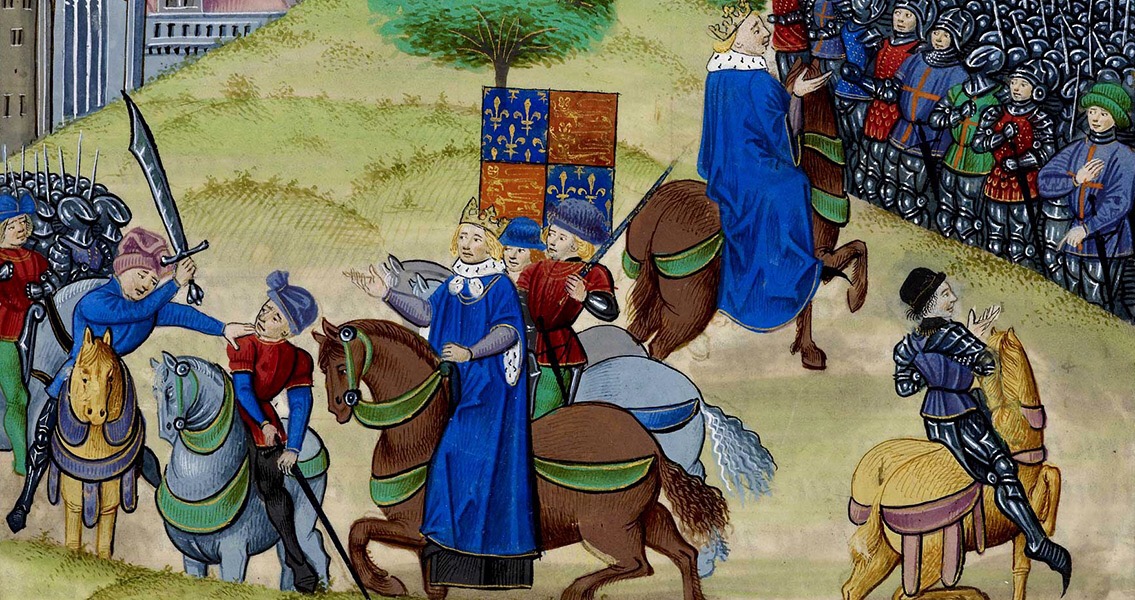
The execution Wat Tyler, before King Richard II
These revolts, and the political effects of the Black Plague, presaged how Protestantism would break down Europe and act as a seminal mover in the development of nationalism. Hilaire Belloc spoke of this consequence of Protestantism,
“that unity has been broken by a religious revolution in which the corporate economy of the craftsmen disappeared and the already long- decaying village system disappeared with it.”
In England, the State established an English church — the Anglican Church — and when English revolted against the Protestant policy of William Cecil, 1st Baron of Burghley, hundreds of Catholics were rounded up and butchered and, in the words of Belloc,
“there was not a village that had not its corpses swinging from trees.”
The inevitable result of Protestantism was the perception of the Catholic Church as an evil and foreign entity, and the push for the formation of national churches.
Luther and Zwingli may have hated each other, they may have disagreed on the sacraments, but they agreed on one thing: to attack the organization of Christians under the Universal Church.
Luther held that there needed to be a separation between the German kings and rulers, and the Catholic Church. In his Address to the Nobility of the German Nation (a title that unto itself denotes German pride), Luther praised the heretical, pro-Islamic German tyrant, Frederick II, speaking about how
“those beloved princes the Emperors Frederick, the First and the Second, and many other German emperors were, in former times, so piteously spurned and oppressed by the popes, though they were feared by all the world.”
It is interesting that he would pick Frederick II, he was not too different from Luther. Frederick was, as Belloc said, “one of the most intelligent and most dangerous men that ever ruled in Christendom”.
He preferred Islam over the Catholic Faith, saying to the ambassador of Sultan al-Kamil, Fakhr-ad-Din:
“That [the Islamic religion] is excellent, far superior to the arrangement of those fools, the Christians. They choose as their spiritual head any fellow they will, without the smallest relationship to the Messiah, and they make him the Messiah’s representative. That Pope there has not claim to such a position, whereas your Khalif is the descendent of Muhammad’s uncle.”
Now, contrast these words with this statement of Luther:
“They say that there is no better temporal government than among the Turks, though they have no canon nor civil law, but only their Koran; we must at least own that there is no worse government than ours, with its canon and civil law, for no estate lives according to the Scriptures, or even according to natural reason.”
Hitler, like Luther and Fredrick before him, also preferred Islam over Catholic Christendom, saying:
“You see, it’s been our misfortune to have the wrong religion. Why didn’t we have the religion of the Japanese, who regard sacrifice for the fatherland as the highest good? The Mohammedan religion too would have been much more compatible to us than Christianity. Why did it have to be Christianity with its meekness and flabbiness?”
(From left to right): Luther, King Frederick II, Adolf Hitler
Frederick II signed a treaty with the Muslims, giving the Christians control over Jerusalem for only ten years while giving the Muslims possession of Solomon’s Temple. He even told the Muslims one day,
“God has now sent you to the pigs,”
referring to the Christians. It was this same Frederick who, in 1240, brought an army of Muslims, alongside Europeans, into Central Italy. The Muslims did not hesitate to fight and kill the Pope’s troops. They ascended the walls of the church of San Damiano, saw a multitude of women and charged with the intention of ravishing them. A pious woman, St. Clare, was present, and before the heretics could seize their victims she cried out to God:
“Lord Jesus, do not permit these defenseless virgins to fall into the hands of these heathen. Protect them; for I, who have nourished them with Your love, can do nothing for them.”
All of a sudden the spirit of fear seized the barbarians; their boldness turned to panic, they clambered over the walls and fled with fright, (134A) and the heretics emulated the demons whom they worshipped, and fled from the ever glorious church.
That Luther would praise an emperor who praised Islam, hated the Catholic Church and brought in Muslim mercenaries to invade Catholic Italy, in a speech directed to the German elite. shows that he really wanted a German severed from Catholic Christendom, severed from the Roman Church, a separate nation and people; it shows a sign of nationalist fervor.
What Luther did was really sow the seeds for German nationalism. One can say that Luther’s revolt was the incipient stage of of German nationalism and identitarianism, as it emphasized the importance of a German Christianity, a German Bible, a German church, as opposed to a Catholic Universal Church. Once you remove the Universal nature of the church, then it becomes a national church, and from this, comes nationalist religion. “I thank God,” Luther would say, “that I can hear God now in my German tongue. Neither in Latin, nor Greek, nor Hebrew language would He be the same.”
The reverence for Luther as the patriarch for German identitarianism was very vibrant and animate in 19th and 20th century Germany. Wilhelm Wundt, a pioneer behind the racialist “folk psychology” of the 19th and 20th centuries, wrote: “The work of Martin Luther made possible the rebirth of Christian faith through the German spirit.”
For philosophers like Hegel, the Catholic Faith did a heavy blow against the German people for having gotten rid of its native pagan religion, and replacing it with the Semitic religion of Israel and the Jews.
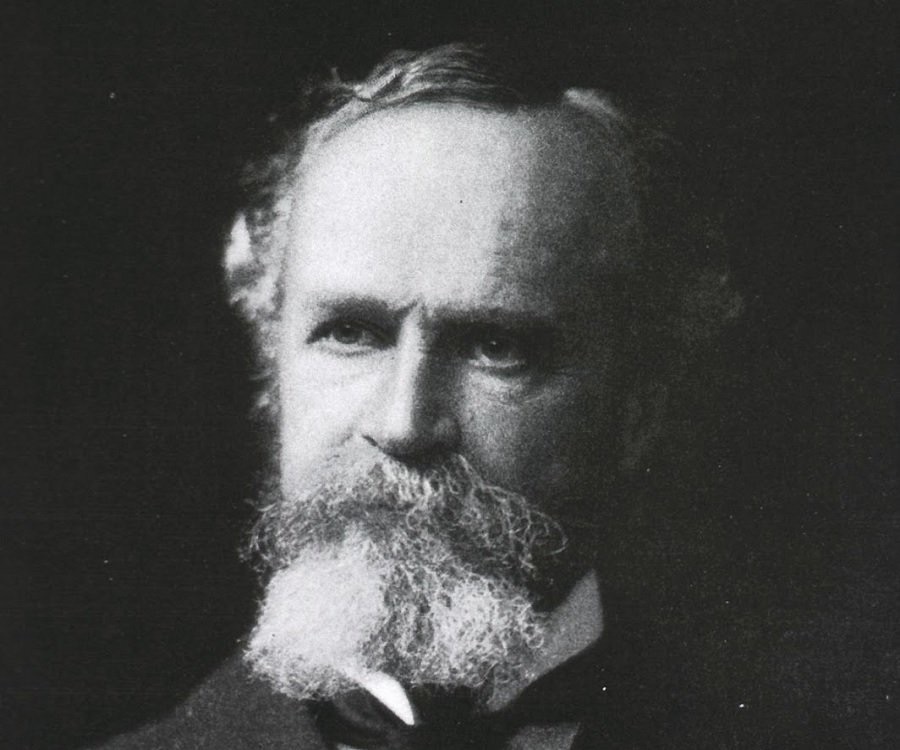
Wilhelm Wundt.
The Reformation, on the other hand, was for Hegel the exemplary collective expression of German national identity. As he wrote:
“Christianity has emptied Valhalla, felled the sacred groves, extirpated the national imagery as a shameful superstition, as a devilish poison, and given us instead the imagery of a nation whose climate, laws, culture, and interests are strange to us and whose history has no connection whatever with our own. A David or a Solomon lives in our popular imagination, but our country’s own heroes slumber in learned history books, and, for the scholars who write them, Alexander or Caesar is as interesting as the story of Charlemagne or Frederick Barbarossa. Except perhaps for Luther in the eyes of Protestants, what heroes could we have had, we who were never a nation? Who could be our Theseus, who founded a state and was its legislator? Where are our Harmodius and Aristogiton to whom we could sing scolia as the liberators of our land? The wars which have engulfed millions of Germans were wars waged by princes out of ambition or for their own independence; the people were only tools, and even if they fought with rage and exasperation, they still could only ask at the end: ‘Why?’ or “What have we gained?’ The Reformation, and the bloody vindication of the right to make reforms in religion, is one of the few events in which a part of the nation took an interest, an interest which did not evaporate, like the interest in the Crusades, as the imagination cooled, but which was animated by a sense of an abiding right, the right in matters of religious opinion to follow one’s own self wrought or self-acquired conviction.”
Luther’s hatred against the Jews became a central focus in German nationalism, and this is especially seen in anonymous 1881 German nationalist essay, entitled “Luther and the Jews”, in which the idea of being a Protestant Christian is synonymous with being German, interlinking race with religion:
“A Jew cannot be a German because a true German can only be someone who is a Christian. …How can we callow among us a people that slanders and derides every day our Lord and Savior? And because Christ stands in the center for our Dr. Martin Luther, he speaks with a true, holy wrath against the Jews.”
Luther wanted to reduce the position of the Pope to just one of prayer and weeping, saying to the German nobility:
“His office should be nothing else than to weep and pray constantly for Christendom and to be an example of all humility.”
One can see the motivation of separating the German race from the universal Church of Rome, setting a difference between Germans and “the Romanists,” saying in one part of his address to the German nobility:
“let us rouse ourselves, fellow-Germans, and fear God more than man, that we be not answerable for all the poor souls that are so miserably lost through the wicked, devilish government of the Romanists, and that the dominion of the devil should not grow day by day, if indeed this hellish government can grow any worse, which, for my part, I can neither conceive nor believe.”
Luther marked a line between the Italians the Germans: the Roman Church, in Luther’s eyes, had destroyed Italy and now wanted to come for Germany:
“Now that Italy is sucked dry, they come to Germany and begin very quietly; but if we look on quietly Germany will soon be brought into the same state as Italy”
The historian, Thomas H. Dyer, in his History of Europe, astutely observed that Luther’s cause was for a German attack on Roman thought. “The Reformation,” he writes, “was a reaction of the Teutonic mind against the Roman.”
In the words of Luther, German.
“Princes, nobles, and cities should promptly forbid their subjects to pay the annates to Rome and should even abolish them altogether.”
Luther took whatever corruptions he saw in Rome as a pretense to foment division between Germans and the universal Church, saying that the German “Christian nobility should rise up against the Pope as a common enemy and destroyer of Christianity, for the sake of the salvation of the poor souls that such tyranny must ruin. …Thus those at Rome would learn that we Germans are not to remain drunken fools forever”. Luther demanded that German governments outlaw any German from going to Rome for pilgrimage, stating to the German nobility:
“Pilgrimages to Rome must be abolished, or at least no one must be allowed to go from his own wish or his own piety, unless his priest, his town magistrate, or his lord has found that there is sufficient reason for his pilgrimage. This I say, not because pilgrimages are bad in themselves, but because at the present time they lead to mischief; for at Rome a pilgrim sees no good examples, but only offence. They themselves have made a proverb, ‘The nearer to Rome, the farther from Christ,’ and accordingly men bring home contempt of God and of God’s commandments. … That this false, misleading belief on the part of simple Christians may be destroyed, and a true opinion of good works may again be introduced, all pilgrimages should be done away with. … If any one wishes to go on a pilgrimage or to make a vow for a pilgrimage, he should first inform his priest or the temporal authorities of the reason, and if it should turn out that he wishes to do it for the sake of good works, let this vow and work be just trampled upon by the priest or the temporal authority as an infernal delusion”
Luther, thus, wanted the German governments to prevent their subjects from going to Rome, and therefore, to further isolate the German Christians from the universal Church. This was amongst the steps towards German nationalism and the end of the unity of Christendom. Writing as a seminal influence towards nationalism, and with the desire to sever the German nation from Christendom, Luther once wrote:
“the German princes have now learned — they who were formerly most worthy of trust, to submit to the Roman idol to do nothing better than break their word, to the perpetual ignominy of our nation.”
To Luther, for the German princes to remain loyal to Rome was a disgrace, not for orthodox Christianity, but for the German nation. Destroying the relationship between the German nobility and Rome was, thus, essential for Christianity, and ultimately, for the rise of the German’s peoples dignity. This envisage to fully sever Germany from Roman influence was held in Germany, even to the times of Hitler himself. “I do insist,” Hitler once said, “on the certainty that sooner or later — once we hold power — Christianity will be overcome and the German church established. Yes, the German church, without a Pope and without the Bible, and Luther, if he could be with us, would give us his blessing.”
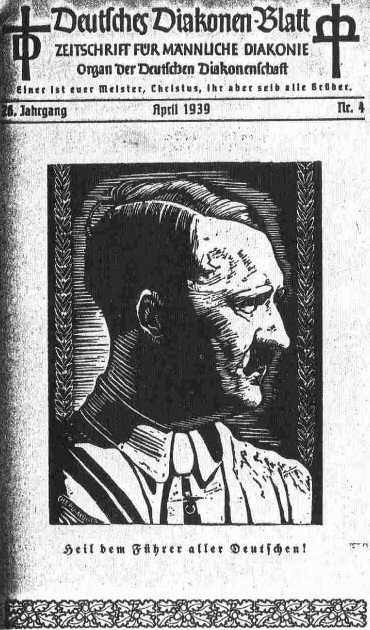
Luther also pushed the German nobility to control the building of Catholic monasteries: “Let no more mendicant monasteries be built! God help us! there are too many as it is.” In other words, Luther wanted the State to overpower the Church. The Catholic Church, to him, had become an entity that overlapped the national boundaries of German governments. By the late 16th century, 50 of Germany’s 65 imperial states had become Protestant. It was the Protestant religion that helped solidify the German identity and nation.
In fact, one of the reasons why Austria was not included in Germany’s 1871 unification was because it was traditionally Catholic. In 1906, the German Chancellor, Prince Bernard von Bulow, told his government’s representatives abroad in 1906, that if Austria were to be added into Germany, “We shall thereby receive an increase of about fifteen million Catholics so that the Protestants would become a minority … the proportion of strength between the Protestants and the Catholics would become similar to that which led to the Thirty Years War, i.e., a virtual dissolution of the German empire.”
Protestantism is no rooted in the political essence of Germany, that till this day Luther is used for populist movements. For example, the rising Alternative for Germany party (AfD) presents posters with Luther’s portrait adjacent to his infamous words: Here I stand, I cannot do otherwise (Hier steje ich und kann nicht anders), alongside the slogan: “Courage to Truth” (Mut zur Wahrheit):

There is a video of a speech given by one of the AfD leaders, Bjorn Hocke, and it is prefaced by a Protestant hymn, Wach auf du deutsches Land (Wake up, you German land), written by Johann Walter, a Lutheran poet of the Reformation era. The first verses of the song sing:
Wake up, wake up, You German land!
You have slept enough,
bethink, what God has turn to You,
wherefore he has created You!
Bethink, what God has sent You
and entrust You his utmost pledge,
therefore You should arise!
In the video, social-Darwinistic influence and apocalyptic language is expressed. In one part of the video, Bjorn Hocke, with words reminiscent to the prefacing Protestant hymn, says:
“Perhaps it is the last chance for our people to once again awaken.”
Later on he speaks of mass violence in the streets of Germany, saying: “this country will quickly become a country of civil war.” He then goes on to express gratitude to Thilo Sarrazin, a German eugenist, social Darwinist and high ranking member of the Social Democratic Party of Germany. Bjorn says of the German eugenist: “I believe without Thilo Sarrazin we would not be sitting here today… he characterized Germany as self-abolishing, it is not simply a prophecy of doom, but a reality.” The influence and impact of Luther and apocalyptic Darwinism in current German politics, is seen in this video:
Try watching this video on http://www.youtube.com, or enable JavaScript if it is disabled in your browser.
The Berlin pastor, Ernst Shaeffer, wrote in 1917 that Luther pursued the defense of “a German national Christian religion”.
English eugenist, Houston Stewart Chamberlain, loved Germany so much that he became a German citizen, and was admired by both Wilhelm II and Adolf Hitler. He too loved Luther and once said: “Unconditional patriotism and conditional theology made him [Luther] throw off his monastic habit.” (144) In other words, a limited theology with fanatic nationalism is what drove Luther to war against the Catholic Church. “Luther was more of a politician than a theologian,” said Chamberlain, he was “above all a political hero.” Chamberlain also wrote of Luther:
“It was Luther’s first thought to look in the Scripture for a political reformation. …Religious and social questions mingle together in the Reformation; it was in fact quite as much a social and political revolution as a religious movement. … Thus it was no accident that Luther was called on to take a leading part in the social and political struggles which followed on his theological controversies.”
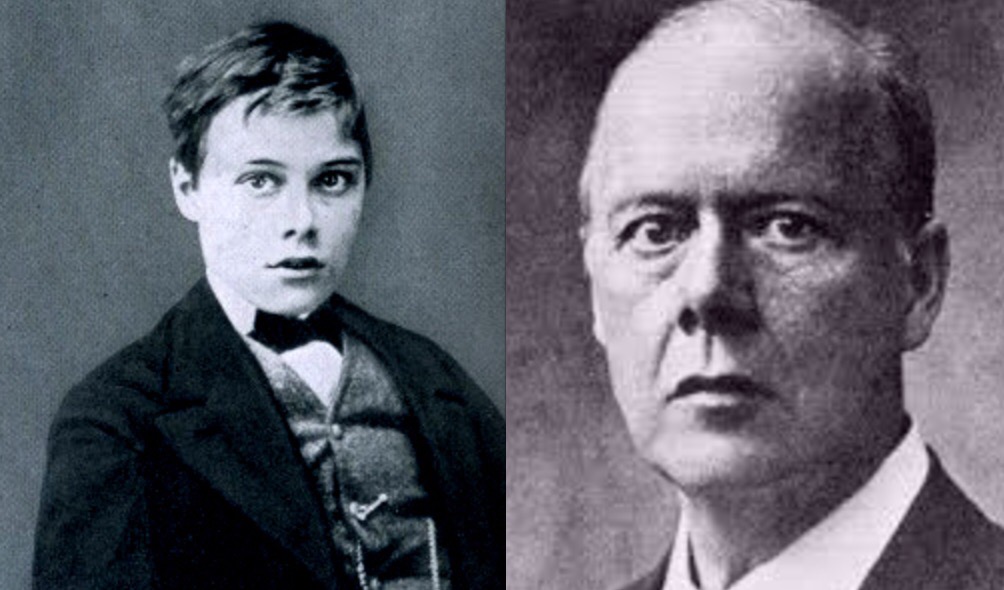
Houston Stewart Chamberlain, both as a young man and as an adult. Even at a young age, he looked sinister.
It is not to our marvel that Protestant church historian, H. Hermelink, called Luther “one of the greatest politicians of Germany”.
German nationalist, Alfred Falb, wrote in a 1921 book, Luther and the Jews: Germany’s Leading Men and Judaism, that:
“At a time when the pagan-Jewish spirit in the Roman Church had conquered the West, when the Jewish loaning of money dominated Europe and slowly gave birth to capitalism… there arose in the most dire circumstances the liberator in Luther’s fighting heroism. Pure German in his blood and born in poverty, he carried the fate of Germany in his chest. But this fate is yet to be fulfilled! He foresaw what is happening now; posterity ignored his warnings. Only the future will complete what he already felt in his anxious soul. …A pointer in this book.”
In the official publication for the German Faith Movement (Deutsche Glaubensbewung), it said:
“His [Luther’s] literary attacks against Judaism are the fruit of an enduring struggle for the birth of an unlimited, European Christian way of thinking and feeling; they are a legacy of the eternal German spirit that shall never be forgotten.”
In the 450th birthday of Luther in 1933, Julius Streicher, in his weekly journal, Der Sturmer (“the Assailant”), spoke of Luther as such:
“Luther stands before us as the warrior against the international power of the Jews. But his stance has been concealed from us. This is the great sin of omission of all responsible national educators. For enlightenment about the true nature of the Jews is neither an act of hate or envy but a duty for self-preservation patriotism. We hope that this is the time when Luther will be shown as a warrior to the people. We also want to see the full picture of Luther’s life in the church as the most proper place where truth must be honored.”
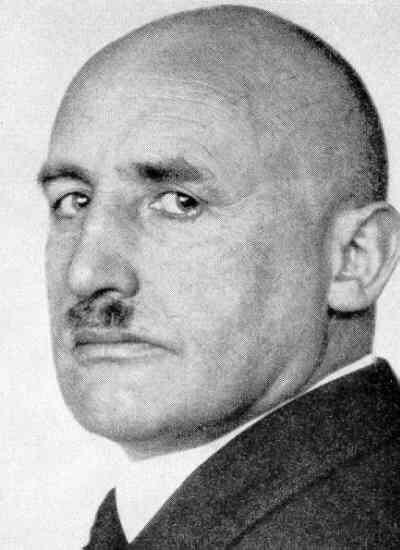
Julius Streicher.
For Alfred Falb, Luther had become the father of a “German religion.” He defended Luther’s rage against the Jews, speaking of them as such: “a hereditary, pernicious mental faculty in a people that, more than any other, inclines to be mentally ill, perverse, etc.”
In the 1930s the German Faith Movement hailed Luther as the presager of a world struggle for a new order of the earth dominated by en “eternal German spirit” and that Luther’s book, “The Jews and Their Lies” should be a “folk book” (Volksbuch) for the education of the German populace on the Jewish threat to civilization.
MARTIN HEIDEGGER, LUTHER AND NAZISM.
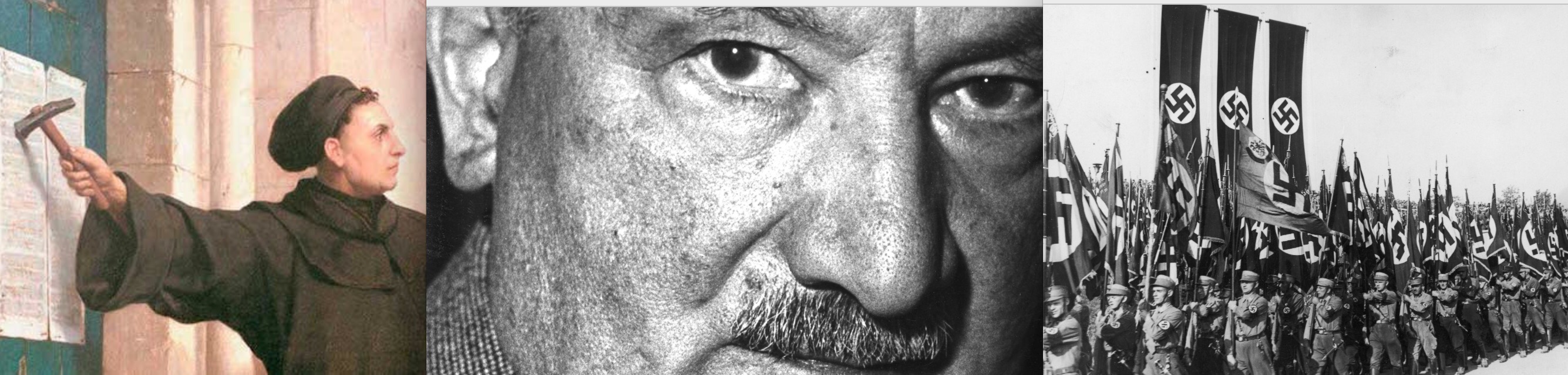
Martin Luther would influence Martin Heidegger, who would in turn be very influential on Nazi ideology.
One of the most influential Nazi ideologues was Martin Heidegger, and amongst the biggest influences on his own philosophy, was Martin Luther. Although Heidegger was born Catholic, he eventually left the faith, writing to his priest, Engelbert Krebs, in 1918, that “the system of Catholicism” is “problematic and unacceptable.” He believed — as all heretics do — that the Catholic Faith was far away from the original state of Christianity, writing in 1919 that
“the ancient Christian achievement was distorted and buried through the infiltration of classical science into Christianity. From time to time it reasserted itself in violent eruptions (as in Augustine, Luther, and Kierkegaard).”
Rejecting the Church, Heidegger turned, with strong fixation and focus, upon the works of Luther. From 1919 to 1923, Heidegger frequently referenced Luther in his lectures. In 1921, Heidegger possessed a full set of volumes of Luther’s writings. By 1922, Heidegger was seeking a teaching position at the University of Marburg. The German philosopher, Edmund Husserl, wrote a letter in support of him being a professor there, in which he mentions his desire to link Protestant theology with philosophy:
“There is one major theme of [Heidegger’s] studies, which are centered essentially upon the phenomenology of religion, that he, as a former ‘Catholic’ philosopher, understandably cannot treat here [at Freiburg] freely, namely, Luther. It would probably be of great importance for his development if he could go to Marburg. There he would be an important link between philosophy and Protestant theology (with which he is thoroughly acquainted in all of its forms and which he appreciates fully in its great unique values).”
According to American lawyer, John van Buren, “Heidegger saw himself . . . as a kind of philosophical Luther of western metaphysics.” According to Bultmann, “Heidegger himself never made a secret of the fact that he was influenced… most notably by Luther.”
Luther demanded a rejection of Catholic scholasticism and a return back to a “primal” Christianity. Heidegger, inspired by Luther’s aspiration, called for the “destruction of Christian philosophy and theology” and a return back to what he thought of as original Christianity.
Heidegger took Luther’s theology, secularized it and made it into a philosophy. As Edmund Schlink, a prominent scholar on Luther wrote,
“Heidegger’s existential analytic of human Dasein [presence] is a radical secularization of Luther’s anthropology.”
Heidegger’s teachings on Luther in the 1920s would have deep influence on well known Protestant theologians, such as Bultmann, Paul Tillich, and Heinrich Ott. He saw metaphysics as “the way of salvation”. Heidegger wrote that “religious consciousness wins its new position with Luther.”
Heidegger took Luther’s fanatical emphasis on man’s enslavement to sin and interpreted it as being, that man is sin itself: “The being of man as such is sin. . . . Thus sin is not affixing moral attributes to man but rather his real core. In Luther, sin is a concept of existence.” St. John tells us, “He that committeth sin is of the devil: for the devil sinneth from the beginning.” (1 John 3:8) Since sin is of the devil, then to Luther, all of mankind’s existence itself is of the devil; and for Heidegger, humanity’s existence is enslaved to its fallenness, for as he writes: “Da-sein (human existence) has initially always already fallen away from itself and fallen prey to the ‘world.’” When writing this, he was doing so under the influence of Luther’s belief that man’s will was utterly controlled. In Heidegger, one find’s both Luther and his gnostic leanings.
In contrary to these evil writers, St. John says: “He that doth justice is just, even as he is just.” (1 John 3:7) Man, then, can be free from this enslavement from doing justice, or as Gregory Palamas wrote: “those who have elevated their minds to God and exalted their souls with divine longing, their flesh also is being transformed and elevated, participating together with the soul in the divine communion, and becoming itself a dwelling and possession of God;”
God, then, when man elevates his mind towards Him and strives to do good, transforms man into an instrument for His justice. While the gnostic worldview makes God into a hater of the physical body, St. Maximus the Confessor writes that “because God cares for what is lower, that is the body, and has given the command to love one’s neighbor, the soul prudently makes use of the body. By practicing the virtues the body gains familiarity with God and becomes a fellow servant with the soul.”
Such a beautiful teaching was conveyed by St. Bernard of Clairvaux in his letter to Pope Eugene III:
“If the heart be cleansed, free from vice, and relieved of the burden of its sins, it may hereby be easily relieved of the burden of its sins, it may hereby be easily raised to things above; the admiring soul may sometimes also for brief intervals be even kept entranced with wonder and amazement.”
St. Maximus the Confessor (top left), St. John the Apostle (top right), St. Bernard of Clairvaux (bottom left) and St. Gregory Palamas, all men who fought gnosticism.
At the heart of Heidegger is the aim at destroying tradition. His mission was to obliterate the tradition of Aristotelian scholasticism and go back to the pagan philosophers before Aristotle and Socrates, and he looked up to Luther’s mission of destroying Catholic tradition and replacing it with “primal” Christianity as his inspiration. As scholar Ken Hiltner notes:
“What Luther and Heidegger each envisioned was a deconstruction which could reclaim Christianity’s original revolutionary spirit from the Greek philosophical thinking co-opting it. The irony here is that the Greek tradition threatening Christianity was, in part, the very tradition that these thinkers argued Christianity itself was designed to deconstruct. As the young Heidegger progressively put it in lecture notes that have recently come to light, “the great revolution [of Christianity] against ancient science, against Aristotle above all,” not only failed, but turned on itself as he became “the Philosopher of official Christianity—in such a manner that the inner experiences and new attitude of [Christian] life were pressed into the forms of expression in ancient science.”
In 1929, Heidegger had written to Viktor Schwoerer with regard to appointments at the university:
“Either we restore genuine forces with educators emanating from the native soil to our German spiritual life, or we abandon it definitively to the growing Jewification.”
According to historian Yvonne Sherrat: “The term Heidegger used was Verjudung, an anti-Semitic term used in Mein Kamp.” Emmanuel Faye also confirms this in his book:
“As for the word Verjudung, it is the most egregious example of anti-Semitism. It shadows precisely the discourse of Hitler, who, in the first part of Mein Kampf, speaks of the ‘Jewified universities’ (verjudeten Uniiversitaten).’”
Adam Kirsch, the director of the MA program in Jewish Studies at Columbia University, once wrote on the connection bettwen Heidegger’s Nazi beliefs and his own philosophy:
“’The question of the role of World Jewry is not racial; it is, rather, the metaphysical question of the nature of a type of humanity, the absolutely unbound, that can assume the world-historical ‘task’ of uprooting all beings from Being,’ runs one of Heidegger’s dozen or so remarks about Jews.
But this is hardly exculpatory. On the contrary, it is especially damning because it brings anti-Semitism into the central precincts of his thought. For Heidegger, the ‘uprooting of beings from Being’ was the metaphysical curse of the modern world, the source of the nihilism that afflicted humanity.”
Joshua Rothman of the New Yorker writes that notes of Heidegger show that, even as Heidegger held the most banal and ignorant anti-Semitic beliefs (he wrote about a worldwide conspiracy of “calculating” Jews “unfurl[ing] its influence”), he also tried to formulate a special, philosophical, and even Heideggerian kind of anti-Semitism. (Jews, he writes, are “uprooted from Being-in-the World”—that is, incapable of authentically caring and knowing.)
According to Thomas Assheuer, writing in Die Zeit, “The Jew-hatred in ‘Black Notebooks’ is no afterthought; it forms the foundation of the philosophical diagnosis.” In other words, these newly published writings show that, for Heidegger, anti-Semitism was more than just a personal prejudice. In the Guardian, Philip Oltermann offers some choice passages:
“World Judaism,” Heidegger writes in the notebooks, “is ungraspable everywhere and doesn’t need to get involved in military action while continuing to unfurl its influence, whereas we are left to sacrifice the best blood of the best of our people.”
Photographs, impossible to unsee, show him wearing a Hitler moustache; that year, Heidegger told his students, “Let not theories and ‘ideas’ be the rules of your being. The Führer himself and he alone is German reality and its law, today and for the future.” In 1935, he spoke about “the inner truth and greatness” of National Socialism.
In ways large and small, he happily furthered the Nazi program—he applied the regime’s “cleansing” laws to the student body, for example, denying financial aid to “non-Aryan” students.
Heidegger never truly apologized for being a Nazi; even worse, he never directly and publicly addressed the reality of the Holocaust before he died, in 1976. (Thomas Sheehan’s essay “Heidegger and the Nazis” is an excellent, and dispiriting, overview of the philosopher’s Nazi years.)
Michael Wyschogrod (Professor of Religious Studies at the University of Houston) wrote in 1982:
“Not once did he utter a word of sorrow for what Germany had done to its victims. Instead, he tried to portray himself as an anti-Nazi who had joined the party only to protect the University of Freiburg. Even if this is true-personally, I do not believe it–the absence of a public condemnation of Nazi crimes makes Heidegger, in my view, a moral accomplice of those crimes. Once he had made his choice, Heidegger did not want to join what he considered the post-war cowards who reneged on their original loyalty. He was not going to besmirch a holy cause of his life. In that way, he remains fixed in history as a Nazi.”
Emmanuel Faye did a very in depth study on Heidegger and concluded:
“We now know that the attempt at self-justification of 1945 is nothing but a string of falsehoods. Heidegger claims that from 1934 on he no longer had a hand in the affairs of the university. In fact, at the request of Secretary of State Wilhelm Struckart, a high dignitary of the party close to Hitler and Himmler and the first president of the German Association for Racial Hygiene, he agreed to participate in the constitution of a new school of professors of the Reich.”
CONCLUSION
In the First World War one will find Protestantism, Islam and Darwinism to be the ideologies of great influence, for the Germans were Protestants and Darwinists, and while it is true that the Austrians were traditionally Catholic, atheism and Darwinism had greatly corrupted their society. Moreover, Islam was very much involved in the Great War, since the Ottomans were a great ally to the Germans, but even with them there was be a mixed ideology of both Sufism and Social-Darwinism, with the Ottomans seeing themselves as a superior people. The Young Turks utilized a mixture of Islam and Darwinian ideology to justify their genocide upon Greek, Assyrian and Armenian Christians.
In the Second World War, there was still this joining between Darwinism, Protestantism and Islam, with the Germans, fanatically upholding Luther and eugenics, and conspiring to butcher Catholics, Orthodox Christians and Jews, with Muslim auxiliaries. The Second World War was really a continuation of the First. Hence, in 1924, Thomas Mann wrote of “the Great War, in the beginning of which so much began that has scarcely yet left off beginning.” And while our own times are referred to as a “post-Cold War” era, the reality is, in the words of Sean M. Lynn-Jones, “in many ways our age is better defined as the post-World War I” epoch. Therefore, if we are really living in the aftermath of the First World War, and since history is repeating itself, then we should look to the First World to have an idea as to what state the world will soon be in.
In that era leading to the First World War, that is, the nineteenth century, Social Darwinism had become extremely influential and popular. It is not as though Darwin’s theory just suddenly appeared and then took time to be grasped by the people. Darwin was merely feeding bread to ducks whose mouths were already open. On the very day it came out, on November of 1859, all of the 1,250 copies of his first book on evolution, On The Origin of Species, sold out. His publisher, John Murray, at that point was already about to publish three thousand copies of the second edition. “We shall soon be a good body of working men,” wrote Darwin to his colleague, Joseph Hooker,shall have, I am convinced, all young rising naturalists on our side.”
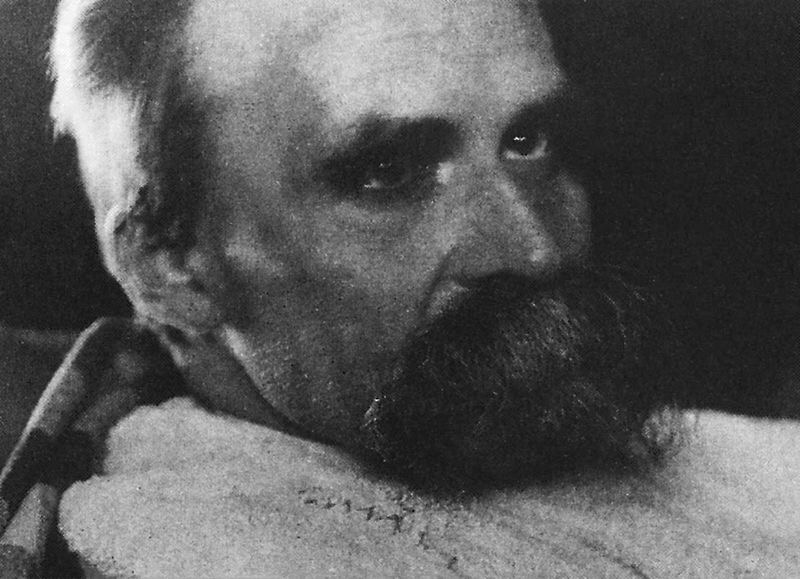
Nietzsche one year before his death.
Indeed, these naturalists would eventually set the stage for a Darwinist society, wherein war, destruction and Darwinian struggle would be the new creed. If Protestantism paved the road towards a society vacuous of the Catholic Faith, Darwinism would now build on this, making not only a secular Europe, but one that made war on humanity itself. If Protestantism abolished free will for slavery under our sin nature, Darwinism as well abolished free will, but this time under “natural selection,” in which there is not the Creator of Order, but an embracing of utter chaos.
Luther saw his doctrine of rejecting free will as worthy of bringing the world to ruins for, and the Darwinists — or the “young rising naturalists” — of the 19th and 20th centuries, saw Darwinism as worthy of bringing utter destruction and disarray to the earth for. If Luther said, “No sin will separate us from the Lamb, even though we commit fornication and murder a thousand times a day”, then the violent idealists of the twentieth century would see violence and carnage as a means to their own ascendency and redemption.
An authority of this worship of chaos was Friedrich Nietzsche, who, in the words of Fromkin, was the “prophet of the age” in the twentieth century, in which it was “widely believed that only destruction could bring regeneration.”
The favoring of the destruction and annihilation of human life, based on the ideology of Darwinism, was taught and promulgated by Nietzsche. In 1880, Nietzsche wrote:
“The tendency must be towards the rendering extinct of the wretched, the deformed, the degenerate.”
The right to reproduce, said Nietzsche, must be neutralized, so that “race as a whole [no longer] suffers.” He also wrote:
“The extinction of many types of people is just as desirable as any form of reproduction.”
The manifestation of this dream of redemptive chaos was the French Revolution, and it led other revolutions that did not fulfill the utopian visions of the fantasizers. This led to a mass popularity of the religion of destruction and the hatred for order. But, one cannot simply point to Nietzsche as though he was the originator of this way of thinking. Ideological and religious rebellions do not appear randomly on their own, they can only thrive in environments that have the right conditions for them to grow and spread. Think of heresy as bacteria. If the temperature is too cold, bacteria has difficulty thriving; but if you have a warm climate, moisture and some sustenance for the microorganisms, then bacteria will thrive. The same goes for heresy. Nietzsche did not gain popularity out of nowhere. He was a product of his time. The society in which he lived was already godless enough to accept whatever evils he taught. As Fromkin notes: “Hysteria and frenzy seemed to be the order of the day.”
At the beginning of the twentieth century, there was a glorification of violence and chaos, and there arose a belief that violence was natural in the cause of one’s race, nation and class. Nationalism and the eugenist belief in racial domination, were intertwined as principles innate to each other. Franz Conrad von Hotzendorf, chief of staff for the Austro-Hungarian armed forces, said that war was “the basic principle behind all events on this earth.”
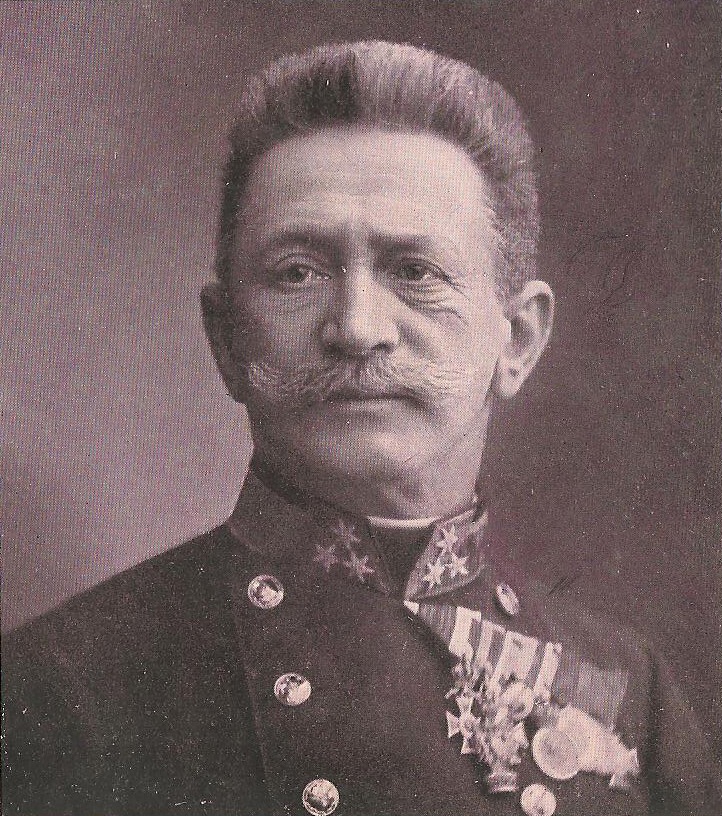
Franz Conrad von Hotzendorf.
In 1897, Theodore Roosevelt, who was a eugenist and avid Nietzsche reader (163), reflected his Nietzschean and Darwinist beliefs when he said:
“All the great masterful races have been fighting races; and the minute that a race loses the hard fighting virtues, then… it has lost its proud right to stand as the equal of the best.”
Roosevelt’s speech was reprinted in full and distributed throughout the United States, and its collective approval indicated the desire for war and chaos in the American populace.
As A.J.P. Taylor writes of that era:
“Men wanted violence for its own sake; they welcomed war as a relief from materialism. European civilization was, in fact, breaking down even before war destroyed it.”
The degeneracy of this society was a result of centuries of anti-Catholicism, and the embracing of a god who dies. What do we mean by this? There is a continuity within German thought, from Luther, to Hegel, to Nietzsche, for all three believed in a god that dies. Luther taught an incipient form of this doctrine, Hegel elaborated on it, and Nietzsche simply declared that “God is dead.” Luther taught, contrary to Catholic doctrine, that the divinity of Christ died. In his 1540 Disputation on the Divinity and Humanity and Christ, Luther wrote:
“When therefore it is said that “the divinity died,” then it is implied that the Father too and the Holy Spirit have died. But this is not true, for only one person of the divinity, the Son, is born, dies, and suffers, etc. Therefore the divine nature, when it is take for a person, was born, suffered, died, etc., and this is true.”
According to Lutheran scholar, Steven D. Paulson, Luther actually referred to Christ as a “pants-shitter God,” and that this actually inspired the Lutheran hymn writer, Johan von Rist to compose a hymn in 1628, entitled “O darkest woe,” in which it was said:
“O great dread
God himself is dead!
He died upon the cross…”
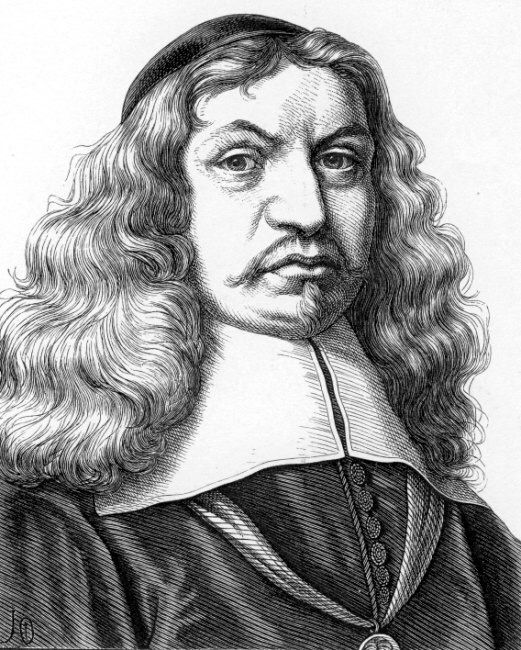
Johan von Rist
Hegel elaborated on this theology, and he concluded that because God — the Truth and the Absolute — died, albeit temporarily, it showed that truth unto itself is not absolute, and that subjectivism was made manifest in the death of the divinity. “God has died,” wrote Hegel, “God is dead — this is the most frightful of all thoughts that everything eternal and true is not, that negation itself is found in God. The deepest anguish, the feeling of complete irretrievability, the annulling of everything that is elevated, are bound up with this thought.”
For Hegel, Christ is merely a representation of the unity between the human self and God. The death of this representation, says Hegel, “is the painful feeling of the unhappy consciousness that God himself has died.”
Luther declared that the Divinity had died, and so successive generations declared the death of God, and from such posterity, did the world behold the rise of German — with souls possessed by chaos — making war upon God Himself, wishing to make their fantasy, a reality. This was witnessed in the First World War, and especially in the Second World War.
A connection between Protestantism and the First World War was made by Alfred Rosenberg, the head ideologue for the National Socialists. Luther was praised by Rosenberg as the one who commenced the battle between German and the Catholic world. He wrote that the Germans, for a long time, were fighting like slaves for Rome, and not for the Teutonic race. It was not until Luther, Rosenberg writes, that the Germans began to finally defy the Catholic powers with their mixed — and not pure — races. In his own words:
“Seen in its broad outlines, the history of Europe is the history of the struggle between this new human type and the forces of Roman racial chaos, which, numbering in the millions, stretched from the Danube to the Rhine. This dark tide carried some glittering values on its surface and catered to some nerve tingling lusts; its waves spoke of a past of once mighty world dominion and of a religion which answered all questions. A considerable number of the Nordics succumbed to the seductive enticements with careless, even childlike, abandon. Thus they became themselves the servants of a kind of dream of ancient Roman grandeur. Too often they fought throughout the world in the cause of a fantasy, and so became, instead of the progenitors they had been, merely the inheritors. Until Martin Luther appeared on the scene, such was the form taken by the struggle between the Teuton and the forces of racial chaos.…Today, those supporters of national rights who yet preach the ideal of a united mankind and laud a single, organised, visible, ecumenical church which is to determine and embrace all public life, all science, all art, all ethics, on the basis of a single dogma, display the end result of those ideas, born of racial chaos, which have poisoned our true nature through the centuries. This is exemplified by the kind of commentator who says: What Austria is striving for, the whole world must attain on a vaster scale. This is racial pollution and spiritual murder elevated to a world political program. Emperor and pope once fought for this universalist and antinational idea; opposed to it were the German kings. Martin Luther created a national political idea as against the papal world monarchy.”
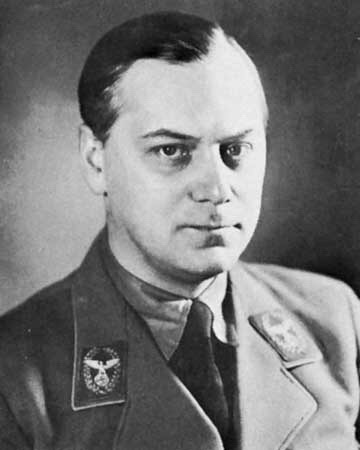
Alfred Rosenberg
Rosenberg affirmed that the new leader of Germany must be a mix of both Martin Luther — the one who rebelled against the Catholic Church — and Helmuth von Moltke the Younger, the mastermind behind pushing Germany to make war against France and Russia.
Rosenburg wrote:
“It is beyond question that it is the Moltke type, during the first period of a future Germany, which will form our league of men—let us call it the German Order. This group must step strongly into the foreground in order to save us in the present chaotic confusion. There is also a need for preachers with Lutherlike natures who hypnotise, and for writers who consciously demagnetise hearts.The Lutherlike leader in the coming Reich must, however, be clear about the fact that he must unconditionally abandon the system of Bismarck after victory. He must transfer the principles of Moltke to politics if he wishes not only to realise himself, but, also, beyond his death, to create a permanent Reich sworn to a highest value. Whatever shape things may take, whether eruptive, or powers creative of form, both must only be of the essence of the Nordic soul.”
The linking between Moltke and the Third Reich sheds light on the conclusion that many hold: that the First and Second World Wars were actually just one single conflict, with a mere armistice taking place between the two parts of the one event. When one studies the times prior to the eruption of the First World War, one will find that it was not too different from our own times. In the times of the 1890s and 1900s, there was a tremendous amount of globalization, conferences on “disarmament,” international congresses, and talks about forming a league of nations. It really was just like now, human nature does not change, the ways of evil do not alter, the only thing that changes is our perspective on the rise of evil; to the masses, past tyrannies have fallen and will not rise up, but to the prudent, as long as evil exists, despotisms will always return.
The First World War, with its horrors and devastations, its innumerable loss of life, and all of the sinister philosophies and heresies that possessed the souls of those involved, was like a dark cloud that flooded the whole earth, becoming to a great degree the most destructive war that humanity had ever experienced. It was fought between the Triple Entente — that is, Great Britain, France and Russia — and the Triple Alliance — Germany and Austria-Hungary. The two alliances clashed, and an ocean of blood filled the earth. Twenty million soldiers perished on the fields of battle, another twenty-one million were wounded, and tens of millions more died of disease. On August 8th, 1914, just four days after Great Britain entered the war, the London publication, the Economist, called the war “perhaps the greatest tragedy of human history.”
The American historian and diplomat, George Kennan, described the war as “the grand seminal catastrophe of this century.” Fritz Stern, one of the leading intellectuals on German affairs and on the rise of the German volkisch movement, referred to the First World War as “the first calamity of the twentieth century, the Great War, from which all other calamities sprang.”
The destruction that the First World War caused went beyond the physical, its consequences were also spiritual. For after the war there was, in the words of Fromkin, “a wide-ranging freedom from restraint,” with deviancy, infidelity and anti-Christianity increased more so than what it was before.
The biggest misconception about the First World War is that it commenced because A Bosnian Serb named Gavrilo Princip murdered the Archduke Franz Ferdinand of Austria, and his wife, Sophie. The idea that that all of this violence, with tens of millions losing their lives in the most bloody and chaotic battlefields, all because of this one incident, is an unrealistic affirmation. Behind the outside outcry over the assassination, was years of German ideological animosity towards it neighbors; calculative plans to invade France and Russia, and Darwinian apocalyptic ideas of war between Teutons and Slavs. The murder of the Archduke and his wife did not cause the war, it provided the justification for a most wanted war on the part of the Germans.
I believe that this thirst for world domination, militarism and despotism, still lives on in Germany, only waiting for that very justification to occur, so that it can reawaken once again. Germany now is peaceful, but this is only a result of restraint and deception. This German maruna (to use the Arabic term for Islamic deception) was reflected by the words of Gustav Stresemann, who served as German Chancellor in 1923:
“It is the tragedy of our policy, that the Prussian and German army no longer exists. The policy of might (machtpolitik) will in the end always be the decisive factor. But while we have no might, we have to fight with the idea. We have a right for a powerful in Germany.”
This was said in the 1920s, after the First World War, when Germany was brought to submission. If the Germans were, at that time, using deception as a distraction to make time for a militarist plan, then what makes us believe that they are not doing the same today?
The great World War will be caused, not by realists, but by fantasizers; with chimerical envisioning, they will drown the whole earth in blood to make their fantasy a reality. But the fantasies of the lovers of destruction never become reality, the only reality that is revealed is that all those who hate God, love death.
 OBLONG MEDIA GLOBAL INTELLIGENCE
Leave a comment