
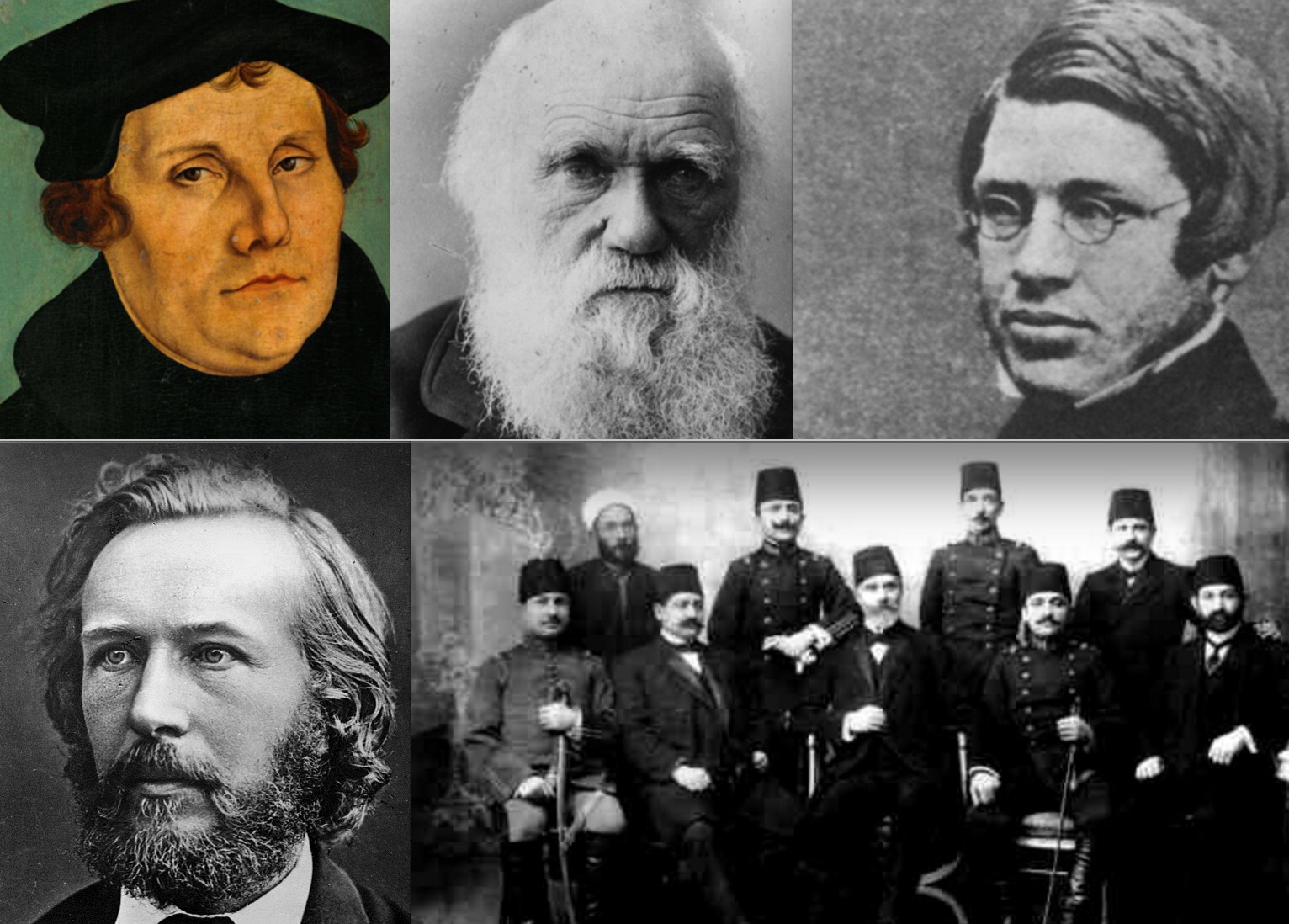
 Protestantism would influence evolutionism, Ernst Haeckel (bottom left), a German evolutionist, was instrumental in influencing the Young Turks (bottom right) on Darwinism. The Young Turks, influenced by Darwinism, would carry out the Armenian Genocide
Ernst Haeckel was deeply influenced by the German religious teacher, Friedrich Daniel Schleiermacher. In 1799 book, On Religion, Schleiermacher taught that true religion was forged deeply into the human heart, and that all rites and dogmas were merely poor expressions of this true religion. Influenced by Protestantism, Haeckel erected a bridge between Luther’s revolt against the Catholic Church, and Darwin’s revolt against the Christian teaching of Creation. In October of 1882, just months after Darwin’s death, Haeckel gave a speech in Eisenach in which he expressed his adulation for Darwin, paralleling him with Luther, who in his words, “with a mighty hand tore asunder the web of lies by the world-dominating Papacy, so in our day, Charles Darwin, with comparable over-powering might, has destroyed the ruling, error-doctrines of the mystical creation dogma and through his reform of development theory has elevated the whole sensibility, thought, and will of mankind onto a higher plane.”
 Friedrich Daniel Schleiermacher
Haeckel said that it was in Italy where he finally came to the realization of the distinct nature of the German and Northern European race, from the Southern European peoples.
In an 1859 letter, writing from Messina, he explained how staying in Italy “stirred up and cultivated” more than anything a “heightened inner love for our incomparable German fatherland.” He wrote how anytime he visited Italy, no matter how beautiful its nature and scenery, he felt compelled to express his reverence for Germany. “It has to be heard over all of Italy and Sicily,” he wrote, “in the majestic environment of Naples, as well as on the glorious plains of Palermo, among the quarries of Syracuse, as well as on the peak of Aetna: Deutschland, Deutschland uber alles, uber alles in der Welt! — Ich bin ein Deutscher, will ein Deutscher sein! [Germany, Germany above all, above everything in the world! I am a German, I will be a German!]’
This superiority of Germany over Italy was really a continuation of what was advocated for by Luther in his mission to sever Germany from Catholic Christendom and the Roman universal Church.
Haeckel travelled through Italy with his friend, the German poet Hermann Allmers, who concluded that Darwin had fulfilled the promise of higher German thought, and that Darwinism was the expression of triumph over the Catholic Church. While the two were in Sorrento, they came across a Norwegian traveller. “The common bond,” Haeckel wrote, “of our German racial nature quickly allowed us to become acquainted with him and we were overjoyed to hear so well expressed… the noble and great ideas of the free German spirit.” He referred to other Germans that they met as “sons of the north” and of the “same great national race.” In another note he wrote: “This experience strengthened anew in me my belief that there exists in our common German nation a healthy embryo which is capable of evolution and it is only because of this that one may hope for a healthy surge in social relations.”
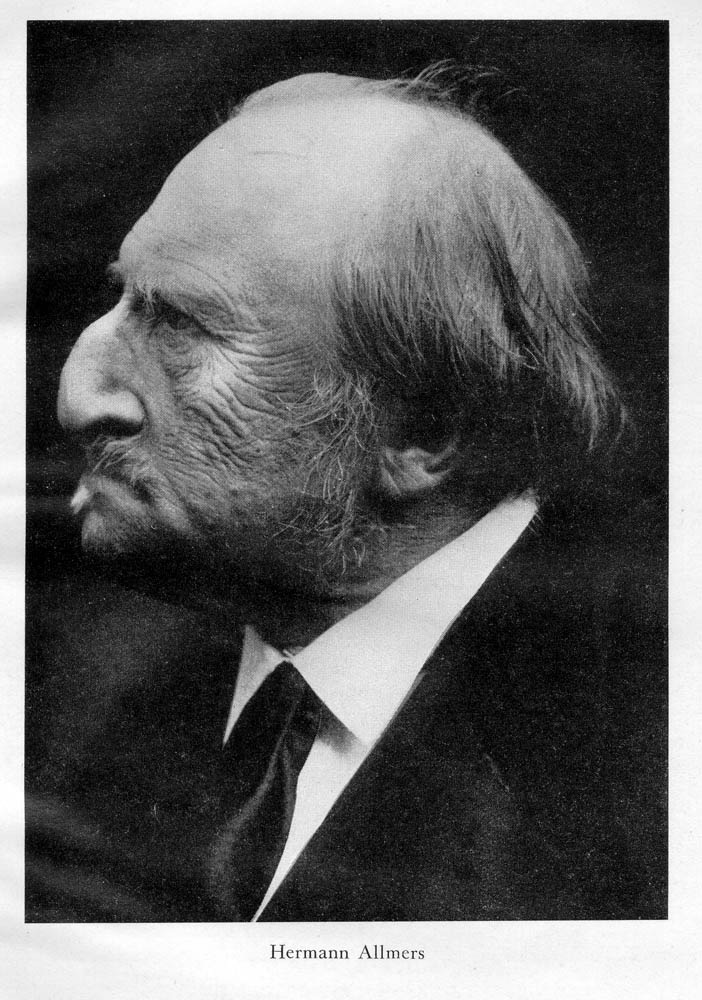 Hermann Allmers
Haeckel esteemed Darwinism and evolutionism as the final stage of the German struggle — starting from Luther — against the Catholic Church. “What the Wartburg was for Martin Luther,” wrote Haeckel, “what Weimar was for the greatest heroes of German literature, Jena will remain in the future; a mighty fortress of free thought, free scholarship, free teaching — a mighty fortress of reason!”
The beliefs of Haeckel would impact all of Western Europe, but it would also find significant influence in the souls of violently anti-Christian, Masonic, Islamic elites: the Young Turks. In 1908, the Turkish secret society, the Committee of Union and Progress, or the Young Turkey Party, commenced a revolution against the Sultan, Abdul Hamid II. The Sultan eventually abdicated his throne and gave it to his brother. But, by 1913, the Young Turks officially took over the empire.
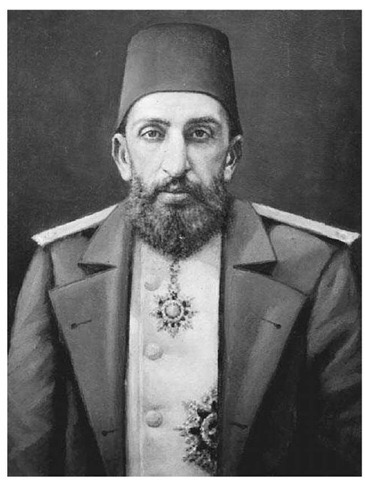 Sultan Abdul Hamid II
Unlike the Sultan, the Young Turks held on to secularism, and believed that through modernization, the Ottoman Empire would be able to stop European expansion into Turkish territory.
In 1871, Germany became an officially unified nation, and soon after its successful unification, Germany formed an alliance with the Ottoman Empire. The Ottoman elites — statesmen, students, officers and bureaucrats — were the ones who had formed the alliance between Germany and the Ottoman Empire. They had lived in Germany where they studied medicine, military science and engineering, and took a strong interest in German philosophy and ideology. One aspect of German thought that the Ottomans dug into enthusiastically, especially after 1909, was the ideology of the racial nation, the “blood and soil” religion (102) that would be enacted in Nazi Germany.
The Ottomans learned this ideology through the teachings of both Haeckel and Herbert Spencer, the one who actually termed the phrase, “survival of the fittest.” Haeckel, alongside his fellow German Darwinists, Max Weber and Paul Von Lilienfeld, applied Social Darwinism to economics, praising the principle of economic competition as the force behind Social Darwinism. From this ideology, militarism and the extinction of those considered as “weaker, primitive races”, was justified in the Social Darwinist construct. This eugenist ideology seeped into Ottoman thought, and greatly inspired the annihilation of the Armenians, alongside the Greek and Assyrian Christians.
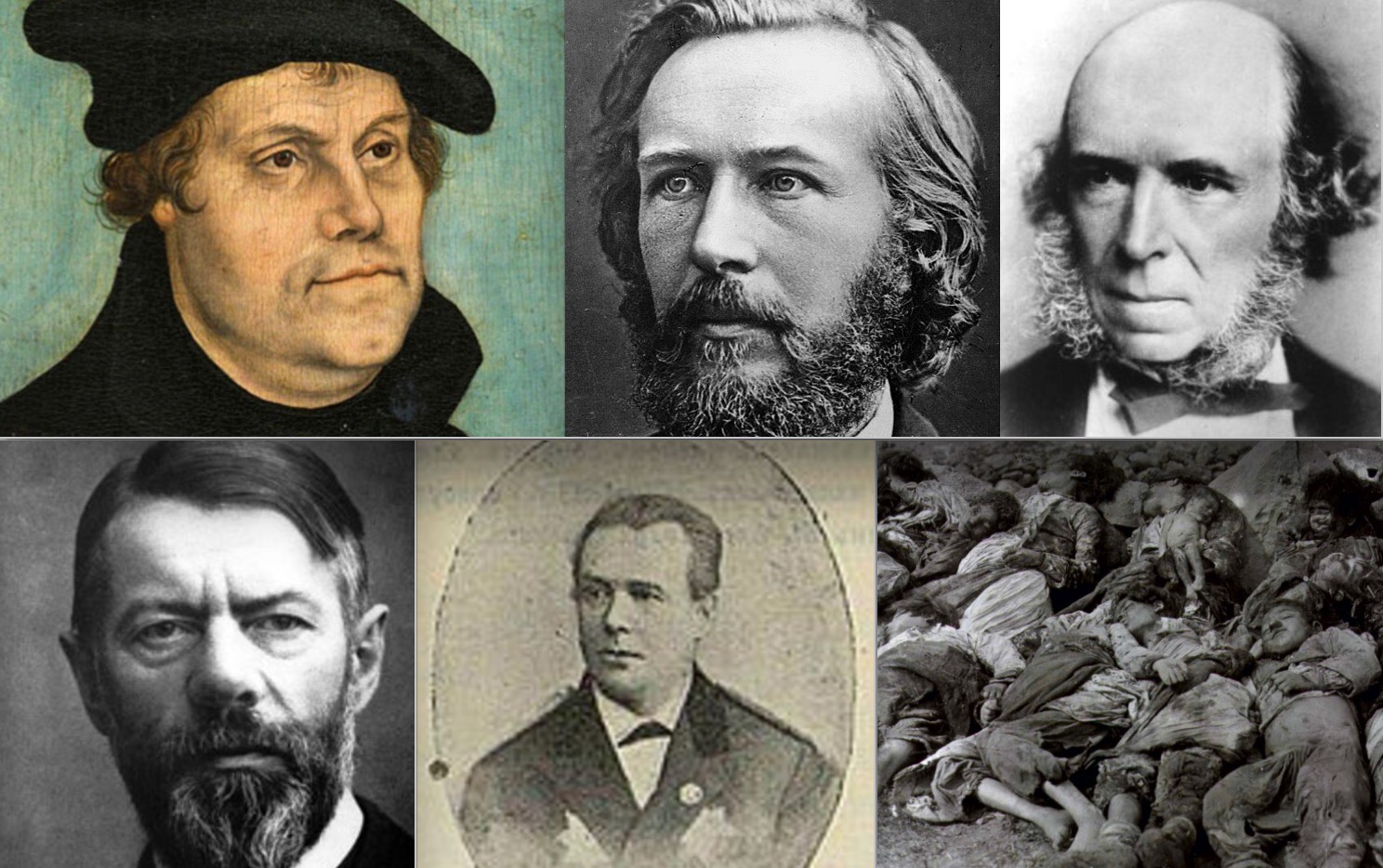 Martin Luther (upper far left corner), influenced Ernst Haeckel (top middle), and alongside Herbert Spencer (top right), Max Weber (bottom far left) and Paul Von Lilienfeld (middle bottom), their work would influence the Young Turks who would go on to exterminate the Armenians
The Ottomans, just like the Identitarians of our day, looked to Japan as a prime example of a racially and religiously unified nation. The Ottomans were ashamed that their own empire was too religiously and ethnically diverse, being filled with Christians of Armenian, Greek and Assyrian descent. The Sultan, Abdulhamid II, himself lamented this, and coveted the nation of Japan. The Sultan wrote in 1917:
“I do not know how appropriate it is to compare Ottoman lands to Japan, to expect success from this Sultan similar to that of the Emperor! Japan is a country of islands, tucked away on one side of the Pacific Ocean; it is a great society, ethnically integrated, uni-religious, uni-national. If there is any region in the world that it does not resemble, it is our wretched country. How could I have reconciled the Kurd and the Armenian, the Greek and the Turk, the Arab and the Bulgar? … Never at any time did Mikado Hatsuhito [sic] come up against such obstacles and never did Japan confront such difficulties.”
It was this desire for an ethnocentric, religiously unified and nationalist state, that resonated into the minds of the Young Turks. Though the Sultan believed in this, he did not completely enact it, but it was done by the Young Turks. When the Japanese defeated the Russians in the Russo-Japanese War, and when they conquered China, the Turks saw this as proof of the superiority of the Asian race over the European race. As one article written in 1904, and published on the Young Turk magazine, Sura-yi Ummet, expressed this view:
“Some Europeans and some Ottomans who imitate what they see without understanding, consider us a race in the lower part of the racial hierarchy. Let us say it in plain Turkish: they regard the Turks as second class human beings. Japanese people, being of the stock of the yellow race, are annihilating the slander against nature with the progress in their country and with their cannons and rifles in Manchuria.”
The Japanese slaughter of the Russians and the Chinese, were viewed as a sign of racial superiority, by the Ottomans. The popular perspective of neo-Nazis and ultra-nationalists is that Japan is a great example of a homogeneous society, one worthy of emulation. This perspective was as well adopted by the Young Turks. The Young Turk magazine,Turk, praised the “homogeneous” society and the fanatic nationalism of Japan:
“…in all [its] natural disposition and knowledge a homogeneous people that from end to end is touched by the same sentiments, pursues the same hopes. They love the homeland, with zeal fall victim for the sake of the homeland, in an instant they sacrifice lives for honor and dignity, lives that they sincerely loved and appreciated. They never fear death.”
The fascination with Japan and its nationalism by the Ottoman Empire will be, I believe, continuing into the future, and will help motivate and facilitate an Ottoman Japanese alliance. The Young Turks revered the Japanese for their barbarism (giving them the title, with pride, of “barbarians”), their callousness while conducting massacres, and also for the love of patriotism. In the Sura-yi Ummet it reads a praise to the Japanese:
“Behold the work of these barbarians … they whose civilization, achieved in half a century, has become superior to European civilization which has fallen into decay; they who do not have to reproach massacres, who do not have to gag any mouths out of which a liberal word came, who do not have to exile or suppress patriots, who do not have to dynamite any human beings under the pretext that their skin was dark and that it constituted a happy pastime!”
The Ottoman military officer, Pertev Bey, praised the Japanese soldiers, and wrote in awe of how they went “one by one, like a machine, emotionless, heartless, spiritless, voiceless” to defend Japan with “patriotic affection”. This talk of patriotism, alongside a reverence for Japan, went in hand in hand with the Ottoman belief in the superiority of the Turanian race. This glorification of the Japanese as a race, overlapped and interconnected with Ottoman universalist religion.
 Armenian beheadings (left); mass beheadings done by Japanese soldiers in China. The brutality and cruelty of the Japanese was admired by the Ottomans.
The Young Turk magazine, Ictihad, praised the Emperor of Japan and even saw the rise of Japan as an awakener of both Muslims and Hindus as well:
“The land of the Rising Sun [Japan] is today neck and neck with foremost nations of the world, intellectually, technologically, scientifically, productively, commercially, agriculturally, politically, socially, militarily … yes, Japan’s rise made the awakening of the East a consequence. In the liberating motion of this [Japanese] ascension are awakened the dormant passions of the Muslim, the Hindu, the Brahmin, the Confucian. …The miraculous transformation Japan showed, from an oppressive feudalism into an elevated and rather progressive constitutional monarchy, is a development owing to His excellency the late Emperor.”
In wanting to be like Japan, the Young Turks desired a homogeneous society, one free of Christians who refused to integrate to the Ottoman society and conform to the Ottomanist ideology. For the Young Turks, to be a Christian, one was likely to also be a Greek, Armenian, or Arab, in short, they were not Turks and thus were a threat to the utopian vision of a racially and religiously homogeneous society. The Young Turks even began replacing the Arab officials within the government, with Turks. This measure was done on ethnic lines.
As the historian, Renee Worringer, points out, the Young Turks’ “affinity with Europe and their increasingly exclusive possession of Ottoman political power caused them to be profoundly attracted to racialized concepts of nationhood that would set them apart from others in the Ottoman Empire. This tendency was reflected in their particular view of a Japanese as a racially distinct and homogeneous nation, and their embrace of this attitude appeared frequently in the Ottoman Turkish literature of the period.”
In order to create a homogeneous society, the empire needed to be purged of Christians. Since the Christians either Armenians, Greeks or Semites, to be a Christian was to be deemed as being amongst the non-Turk and thus, inferior, races. The genocide of the Armenian Christians, and the Christians of Smyrna and other lands, was done under the fixation on a unified Ottoman Empire, without non-Ottomans, or those who would bring disunity to the empire. (111) This violent fixation on unity, on racial and religious lines, was inspired by the view of a “homogeneous” Japan. The Ottoman magazine, Volkan, headed by the Bektashi sufist, Kibrisli Hafiz Dervis Vahdeti, expressed this inspiration from Japan as such:
“Come heroes! Let us unite! Let us assume the strength of character of early Islam, let us be a noble people like the Japanese, who love their governments, their Mikados [emperors], who sacrifice their lives along the way. …Postponing even for a moment what I said will and does cause the homeland to break into pieces.”
Christians were seen as causes of the homeland breaking “into pieces,” and so thus, were exterminated. This envisioning of a unified empire, was inspired by Islam — from the desire for Islamic unity, or the unity of the Umma —, Japanese nationalist ideology, and German nationalism. Yusuf Akcura, a major ideologue for the Young Turks, wrote that “the German interpretation of nationality — one that assumed ethnicity as the basis of nationality … is closer to reality,” and went so far as to put pan-Ottomanism as above pan-Islamism.
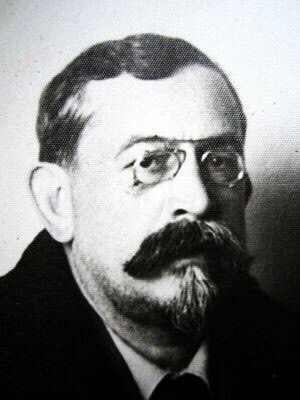 Yusuf Akcura
The Armenian Genocide was influenced by Islam, and the ethnocentric ideologies of Germany and Japan. In summary, Protestant thought would influence Darwinism, and Darwinism would eventually influence the first holocaust of the 20th century, the Genocide done by the Ottoman Empire, and the later Holocaust done by the fatherland of Protestantism — Germany.
 OBLONG MEDIA GLOBAL INTELLIGENCE
Leave a comment