
Nigeria’s 2015 presidential election has come and gone. But the ripple effect of it will continue to resonate for a very long time.
While people like the former Governor of Lagos State, Asiwaju Bola Tinubu, who are well-known for their roles in putting together the All Progressives Congress (APC) as a formidable force in the Nigerian political landscape, are being praised as the brains behind the unprecedented downfall of a sitting president in Nigeria’s history, there are other people who played key roles in plotting Jonathan’s ouster that we may never know about. Surprisingly, there are also other people who played pivotal roles, but for one reason or another, the winners and their supporters do not appear eager to publicly acknowledge their contributions.
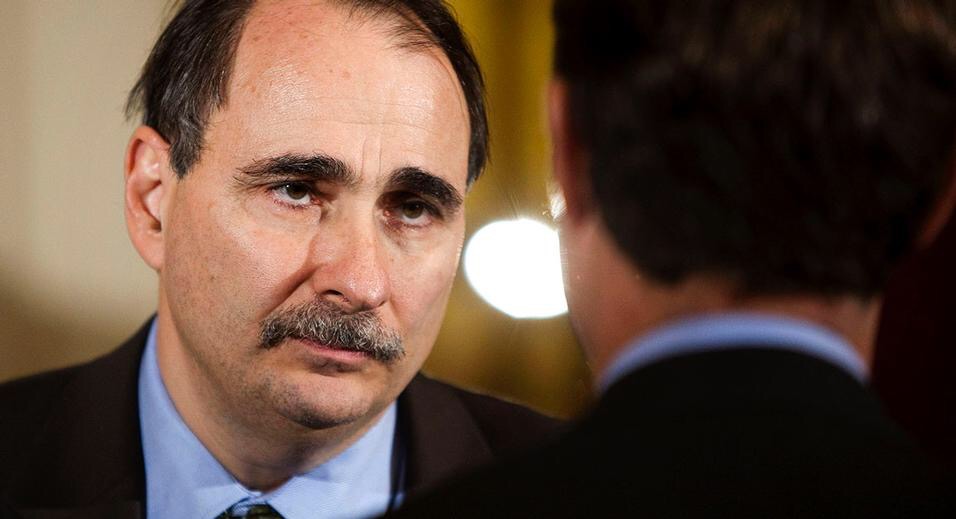
Indeed, David Axelrod is one of those people, who played important roles in the electoral defeat of the incumbent President Goodluck Jonathan, but have not yet received enough commendation and recognition.
David Axelrod is an American political consultant and currently the Director of the Institute of Politics at the University of Chicago. He was once a top advisor to former U.S President Bill Clinton. David Axelrod is a man given a lot of credit for the election of the black president in the United States of America. Axelrod was Obama’s chief campaign advisor during the race to the white house in 2008. When Obama became the president, he was appointed as a senior advisor to the president. In 2011, he resigned his position in the white house to become the Senior Strategist for Obama’s successful re-election campaign in 2012. Axelrod is the founder of AKPD Message and Media.
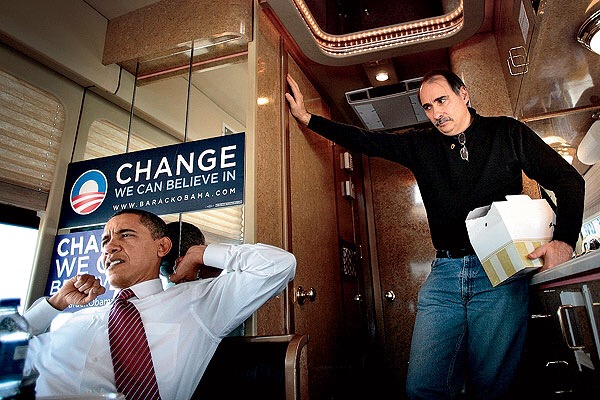 President Barack Obama seen with David Axelrod during a campaign in 2011.
For the fact that the AKPD had helped to put the APC together and had helped to prepare the party as a very formidable opposition, there is no denying the fact that David Axelrod is indeed one of the heroes of Nigeria’s 2015 presidential election. One does not need to be a rocket scientist to know from where Buhari’s slogan of “Change” had come. After all, it’s not very different from the one that helped Obama to conquer the White House in 2008.
AKPD involvement with the APC became known to Nigerians when on 18 February 2014, the then Interim National Publicity Secretary, Alhaji Lai Mohammed, announced in a statement in Lagos that the party had engaged the AKPD Message and Media to boost its electoral chances in the February 2015 elections.
“We have been working closely with AKPD Message and Media over the past few months and we shall leverage on the firm’s skill, experience and expertise throughout the upcoming campaign cycle,” APC said.
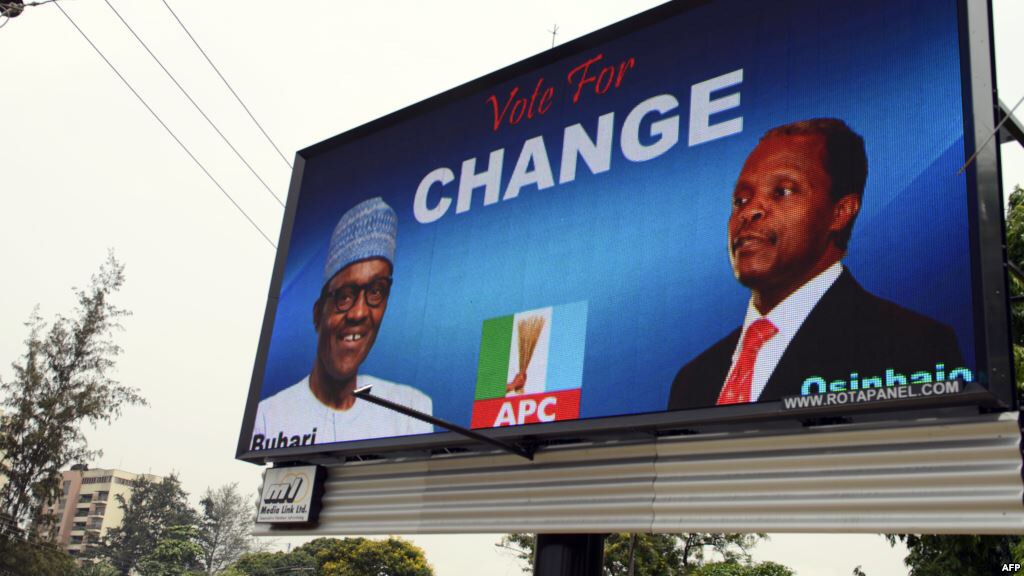
FILE – An electronic billboard displays a campaign poster of All Progressives Congress presidential candidate Mohammadu Buhari and running mate Yemi Osinbajo, who this week won Nigeria’s democratic election.
“As a party destined to bring change and succour to the long suffering people of Nigeria, the APC is proud and excited to work with one of the foremost exponents of change in the world, especially with their track record of success in political climates akin to ours, notably in Kenya, Tanzania and Ghana. With this strategic partnership, the process of change in Nigeria has already begun and it can’t be stopped,” the party concluded.
THE SECRECY OVER AXELROD’S INVOLVEMENT WITH THE APC
While I praise Axelrod for his recent political success, it is important to mention that it is rather strange that the only thing known about Axelrod’s involvement in the campaigns leading up to the election is the announcement made by the APC on 18 February 2014 that they had hired AKPD. After that, there was a total blackout about the activities of the firm in Nigeria.
Besides, there is evidence that the firm had also misled the American public about the true nature of its links with Buhari’s party. When AKPD’s ties to the APC first sparked controversy in March 2014, when Boko Haram’s terror campaign attracted international outrage and shone a spotlight on Nigeria’s problems combatting terrorism. Under pressure from the U.S press and negative attention, the AKPD told reporters in March 2014 that it had ceased its work with the APC. AKPD spokesman Isaac Baker told the Washington Times that “AKPD worked with the APC from December 2013 to March 2014.” According to him, “We helped them as they worked to form a new political opposition party and create a platform in advance of their first national convention. We were no longer working with the APC when the Boko Haram kidnapping of the young girls took place.”
But the Washington Free Beacon later unearthed emails showing that Axelrod and his firm had secretly continued aiding the APC into at least January of this year. The revelation had compelled the publication to press Baker to come clean about AKPD’s involvement in Nigerian politics. Baker then changed the story and admitted to Free Beacon that Axelrod’s firm worked again with the APC in December 2014.
“AKPD worked with APC from December 2013 to March 2014, at which point our contract ended. Nine months later, in December 2014, the APC re-hired AKPD for a 3-week engagement to help the party in organizing announcement events,” Baker told the Free Beacon in an email. “That was our only involvement with the party since we completed work in March,” he wrote.
But going by the internal emails between some top APC leaders that were obtained by the Free Beacon, it’s clear that Baker was not telling the truth when he said that AKPD’s contract with the APC ended in March 2014 before they were re-hired again for three weeks in December 2014. The emails had revealed that AKPD’s involvement with the APC in fact never ended at all. In a series of messages between senior APC officials from September 2014 to late January 2015, AKPD works were recurrently mentioned.
In one email on September 23 to APC leader and former Ekiti State Governor Kayode Fayemi, an APC member Olubunmi Adetunmbi wrote: “The meeting went well and the report well received. [Gov. Rotimi Amaechi] will meet with the AKPD team tomorrow to discuss the facilitation of the event but no dates fixed yet.”
In a separate chain of emails between Buhari’s running mate and now the vice-president-elect, Yemi Osinbajo, and Kayode Fayemi, AKPD’s works were again mentioned.
“I also think the AKPD surveys also clearly showed that the South West is the battle ground for this election,” Osinbajo writes in a discussion about boosting election turnouts for the APC.
A third email chain from 21 January 2015 shows APC leader and Kaduna State governorship candidate, Nasir El-Rufai, discussing an “October 2014 AKPD poll” that he hoped to disseminate to “the team.”
The question is why the AKPD withheld information from the American public if they had nothing to hide. Were they involved in some unseemly affair in Nigeria?
But while the AKPD was busy with its tomfooleries in Nigeria, the U.S. President Barack Obama, who, as has been pointed out, is a close associate of David Axelrod, was also busy pursuing some very questionable policies in Nigeria.
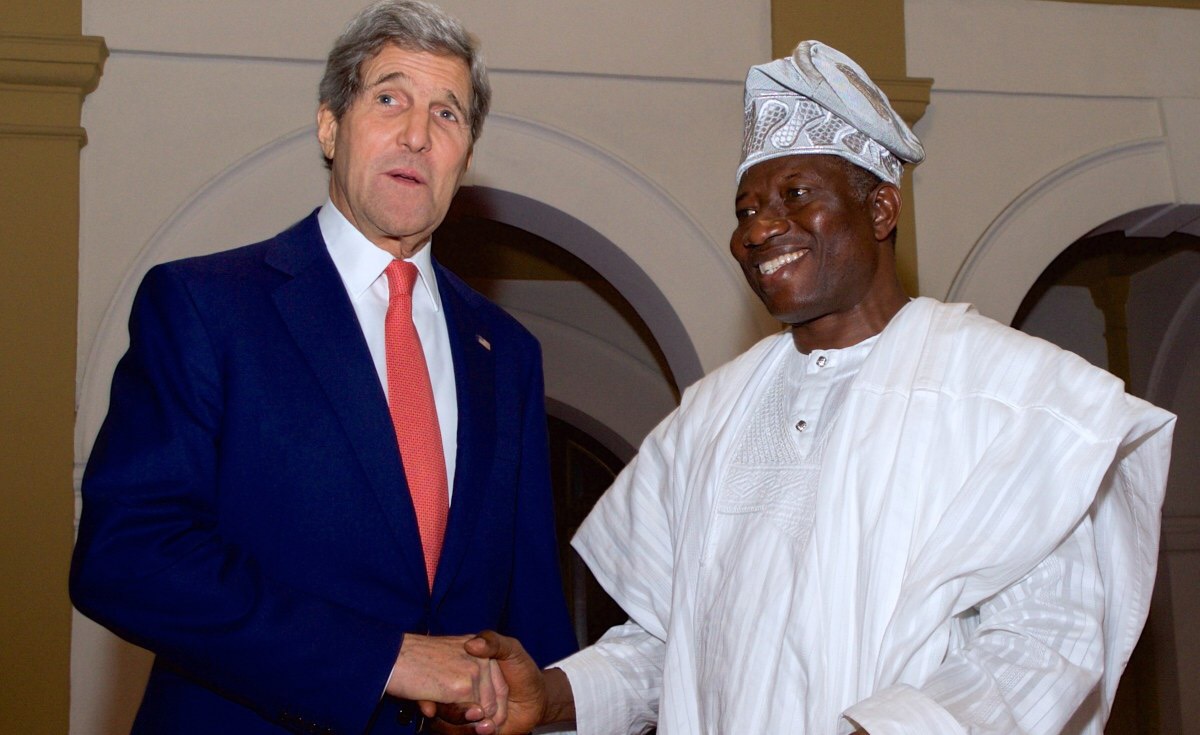 President Goodluck Jonathan meets U.S. Secretary of State John Kerry upon his arrival at the State House in Lagos in January.
When the notorious Islamic terrorist group, Boko Haram, kidnapped 278 school girls from the town of Chibok in northeastern Nigeria last year, U.S. First Lady Michelle Obama began a Twitter hashtag campaign, #BringBackOurGirls. The international outcry that followed the incident had compelled Jonathan’s government to agree to a American offer to send a team of experts to help the country to find the girls.
Secretary of State John Kerry said at the time that the U.S. had been in touch with Nigeria “from day one” of the crisis. But repeated offers of U.S. assistance were ignored until Kerry got on the phone with Jonathan amid growing international concern and outrage over the fate of the girls in the weeks since their abduction.
Kerry had vowed that the U.S. would do “everything possible” to help Nigeria deal with Boko Haram militants.
“Let me be clear. The kidnapping of hundreds of children by Boko Haram is an unconscionable crime,” Kerry said in a policy speech in the Ethiopian capital Addis Ababa.
“We will do everything possible to support the Nigerian government to return these young women to their homes and hold the perpetrators to justice. That is our responsibility and the world’s responsibility,” he said.
The US, he added, was “working to strengthen Nigeria’s institutions and its military to combat Boko Haram’s campaign of terror and violence”.
President Obama also said that the U.S. had long sought to work with Nigeria to contain Boko Haram, but the kidnapping and subsequent outrage over Nigeria’s inability to rescue the girls “may be the event that helps to mobilize the entire international community to finally do something against this horrendous organization that’s perpetrated such a terrible crime.”
But in spite of the foregoing promises by the U.S. Government, it’s not exactly clear how the team of experts has helped to locate the kidnapped girls. Besides, the U.S. pledge to help Nigeria fight Boko Haram was not fulfilled. Obama refused to sell Nigeria arms and supplies critical to the fight, and stepped in to block other Western allies from doing so. Obama’s administration also denied Nigeria intelligence on Boko Haram from drones operating in the area. While Boko Haram was kidnapping school girls, the U.S. cut petroleum purchases from Nigeria to zero, plunging the nation’s economy into turmoil and raising concerns about its ability to fund its battle against the terrorists. As a result, Nigeria responded by cancelling a military training agreement between the two countries.
The situation was so frustrating that at a time, Nigeria’s ambassador to the U.S., Professor Adebowale Adefuye, went public to say that:
“The U.S. government has up till today refused to grant Nigeria’s request to purchase lethal equipment that would have brought down the terrorists within a short time on the basis of the allegations that Nigeria’s defence forces have been violating human rights of Boko Haram suspects when captured or arrested. We find it difficult to understand how and why, in spite of the U.S. presence in Nigeria, with their sophisticated military technology, Boko Haram should be expanding and becoming more deadly.”
It was after Nigeria had turned to Russia, China and the black market to obtain needed arms that the table was turned against Boko Haram. But by that time, the damage had already been done and millions of Nigerians had lost faith in President Jonathan’s ability to ensure their welfare.
The question that many objective-minded analysts and commentators alike have asked is whether Obama’s actions or inaction were meant as an assistance to his friend, David Axelrod, who was working to help Buhari and his party win the 2015 elections. Many others have also wondered whether there was a regime change project involving the U.S. government and some Nigerian politicians from both Jonathan’s PDP and Buhari’s APC.
 OBLONG MEDIA GLOBAL INTELLIGENCE
Leave a comment