
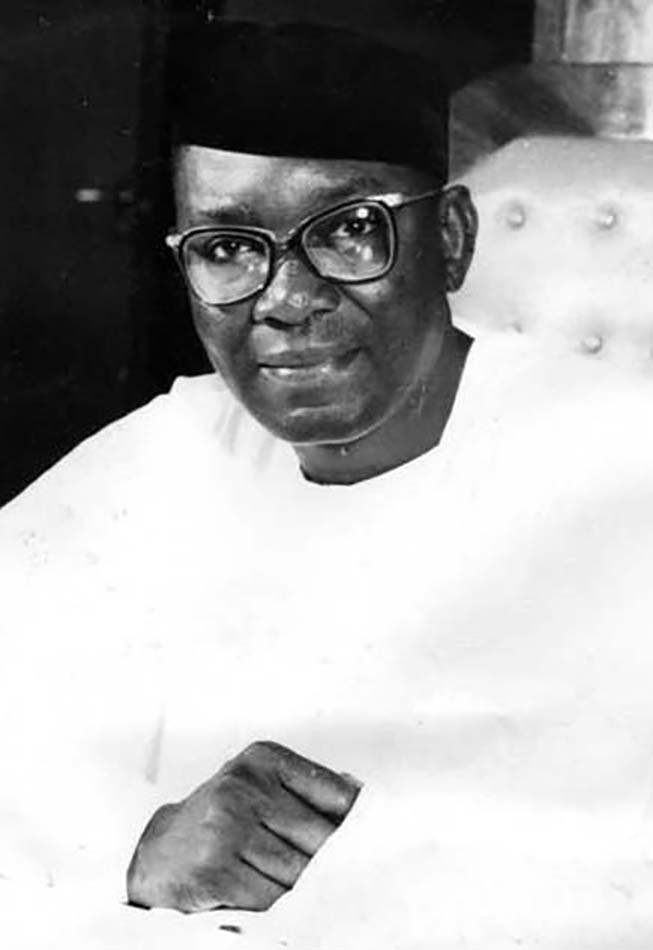
Obviously, the first sign of acute malady in Zik’s idea of One Nigeria was the December 12, 1959 parliamentary elections, staged by the exiting British colonial masters to usher in independence – a new Nigeria.
In the elections, the North refused to change the name of its party from Northern People’s Congress, NPC, to Nigerian or National People’s Congress. That was a serious indication that showed the North was not prepared to be a part of the emerging Nigeria. Yet, the Great Zik ignored such an early dangerous warning, on the grounds that America where he was coming from, suffered such situations in her early days as well but got stronger in due course.
Therefore, in the December 12, 1959 elections, Sir Ahmed Bello outsmarted both Zik and Awo by getting the colonial masters to insert in the electorial guidelines that, since Nigeria was going to operate on a parliamentary system of government, the position of the prime minister would not be based on popular votes cast but on the number of seats secured in the parliament. Recall that the colonial masters had created Nigeria giving more constituencies to the North than the East and West combined.
This was the result of the election, Action Group, AG, had 1, 992364, representing 26 %, winning 73 seats in the parliament. Northern People’s Congress, NPC, garnered 1, 922, 179, representing 25%, winning 134 seats. National Council of Nigeria Citizens, NCNC, polled 2, 594577, representing 34% and securing 81 seats in the parliament. NCNC won most of the popular votes but NPC recorded mire seats in the parliament.
Of the three major political parties, only Zik’s NCNC got substantial votes across all the ethnic lines, others were ethnic lords, although AG had sympathizers among the Eastern Minorities. Yet, Zik and Awo could not form an alliance due to their irreconcilable differences which began way back in 1937 in NYM down to the 1951 cross carpeting Western NCNC members to AG that denied Zik the Western premiership.
As it turned out to be Zik, in view of his frosty relationship with Awo concluded to run with Bello, notwithstanding Awo’s entreaties for both of them to fly. In making that crucial choice, Zik considered a number of factors which must have included his rivalry with Awo, the threat by Bello to pull out of the federation if Zik and Awo would form alliance, and the fact that the North then had lesser educated human capital than the West, so, the East would benefit in terms of appointments and securing jobs in the ministries and parastatals.
So, the first cabinet was formed. Zik was the president and commander in chief of the armed forces (yet a session of the country labeled him a ceremonial president. This is talk for another day), another Igbo, Nwafor Orizu, was the president of senate, Aja Wachuku had just left as the speaker of the fedeal house of representatives, Aguiyi Ironsi, an Igbo ward, was army chief., all of Kingsley Ozumba Mbadiwe, Raymond Njoku, Mbazulike Amaechi, Mbanefo, were all cabinet members and ministers. Almost all the ministerial positions were dominated by NPC and NCNC and majority of them wee Igbo.
The NPC/ NCNC federal government really benefitted the East particularly Ndigbo as it did not marginalize other ethnic groups. According to Achebe, “One of the first signs I saw of an Igbo backlash came in the form of a 1966 publication from Northern Nigeria called The Nigerian Situation: Facts and Background. In it the Igbo were cast as an assertive group that unfairly dominated almost every sector of the Nigerian society… special attention was paid to the manpower distribution within the public service, where 45 per cent of the managers were Igbo and it is threatening to reach 60 per cent by 1968.
“Of particular dismay to the authors of the report were the situations in the Nigerian Railway Corporation, in which over half of the posts were occupied by the Igbo., the Nigeria Ports Authority., and the Nigerian Foreign Service, in which 70 per cent of the posts were held by the Igbo”. THERE WAS A COUNTRY, page 77.
And in the Eastern Region, in the least, Zik, gave Ndigbo Chief Michael Okpara who built the Igbo country to wit: constructed roads, built secondary schools fron 35 to 320, revived the Nkalagu Cement Factory which was about to be sold to a British consortium, established the Asbestos Cement Factory, put in place the Nigergas Factory, established the Pepsi Cola Plants, constructed the textile factory at Onitsha and Adapalm at various towns in the East.
Others included but not limited to: Owerri Shoe Factory, Aba Textile Mill, Golden Guinea Breweries, Modern Ceramics in Umuahia. There was Catering Rest Houses in Onitsha and Owerri that later became Anambra and Imo Hotels, Presidential Hotels in Enugu.
It was Zik that attracted UNN, his government made the Niger Bridge at Onitsha possible and knowing that Ndigbo would be a population factor in Lagos, he came up with UNILAG and Eni Njoku was the first VC. Zik established the African Continental Bank (ACB) which was very vital and helpful providing economic life wire and loans to Ndigbo on a no interest rate, no collateral especially after the war In spite of
all these grand accomplishments, some Igbo will say Zik never did anything for them!
And for the war, the second Biafran Army chief, General Alexander Madiebo, revealed in his comprehensive account of the 1966 coups and civil crises entitled The Nigerian Revolution and the Biafran War, page 93 and given more insights by Achebe on page 91 of his THERE WAS A COUNTY, that it was Zik who led other prominent personalities to inform Ojukwu to pull the East out of Nigeria.
In Madiebo’s account, “On May 27, the Consultative Assembly mandated Colonel Ojukwu to declare, at the earliest practicable date, Eastern Nigeria a free sovereign and independent state by name and title Republic of Biafra”.
Achebe hammered it home that ” It is crucial to note that the decision of an entire people, the Igbo people, to leave Nigeria, did not come from Ojukwu alone but was informed by the desires of the people and mandated by a body
that contained some of the most distinguished Nigerians in history: Dr Nnamdi Azikiwe, Dr. Michael Okpara, Sir Francis Ibiam, Sir Louis Mbanefo. Others included: Dr Alvan Ikoku, Mr. K.O. Mbadiwe, as well as N.U. Akpan, Mr Joseph Echeruo, Ekukinam Bassey, Chief Samuel Mbakwe, Chief Jerome Udoji and Chief Margret Ekpo”.
Also, it was Zik’s poem, The Land of the Rising Sun that Ojukwu used as Biafra’s national anthem. While Ojukwu insisted Zik voluntarily gave it to him, Zik accused Ojukwu of adopting it without his permission.
Now, Zik maintained that he supported Ojukwu on Biafra but disagreed with him on two grounds to wit: confronting Nigeria in an armed struggle and two, since the killings had drastically reduced, there was need for more negotiations, even after Ojukwu had declared Biafra. Ojukwu agreed but Gowon refused Thus Ojukwu sent Zik on foreign missions to African countries to seek for Biafran recognition or to stop the war. Zik used his contacts and secured the heads of government of African countries on the need to look into the Biafra – Nigeria ugly situation in the next OAU meeting billed for Kinshasa, then Zaire, now Congo Democratic.
Sadly, Awo appeared in Kinshasa as a leader of the Federal Government of Nigeria delegation and argued that based on the OAU charter on sovereignty of member nations, the body’s move to place the Biafran issue in the agenda was against its regulations as it amounted to interfering in Nigeria’s domestic affairs. Efforts made by Zik to counter Awo’s submission on humanity and humanitarian values rather than international diplomacy proved abortive. Thus, the OAU backed out of the civil war and the Igbo killings continued.
As that Kinshasa bid failed, Ojukwu mandated Zik to go for recognition and Zik, employing the boast of Gowon that the war would end by March 31, 1968, went back to his friends African leaders and presented the pathetic state in Biafra. Most of them agreed to support Biafra if the war failed to end on that date. Others said they would bring both Ojukwu and Gowon to a round table discussion.
March 31 past and Biafra was even having upper hand and Gowon fearing a repeat of the Aburi conference, refused facing Ojukwu again in a conference. Thus, presidents of Tanzania, Gabon, Zambia and Uganda, Senegal and Ivory agreed to recognize Biafra but Senegal’s Senghor, a Christian, delayed because he was to run an election against a Muslim candidate in a predominantly dominated Islamic country. He later told Zik that his people were seeing Biafra as a Christian agitation.
When Zik saw that Nigerian forces were too brutal on Biafra, with horrifying deaths, starvation, malnutrition and kwashiorkor, Zik ran to Gowon, had breakfast meeting and the pictures were well displayed in the Biafran Republic even as it caused panic, despair and lost hope among Ndigbo. The fighters gave up and Ojukwu escaped to Ivory Coast and the war ended.
…Let me sincerely apologize here on my inability to end this series herein. I am very optimistic that IT MUST SURELY END in the next edition President Tinubu and Igbo glitch factors. Thank you very much for your patience and endurance.
By Ori Martins
 OBLONG MEDIA GLOBAL INTELLIGENCE
Leave a comment