
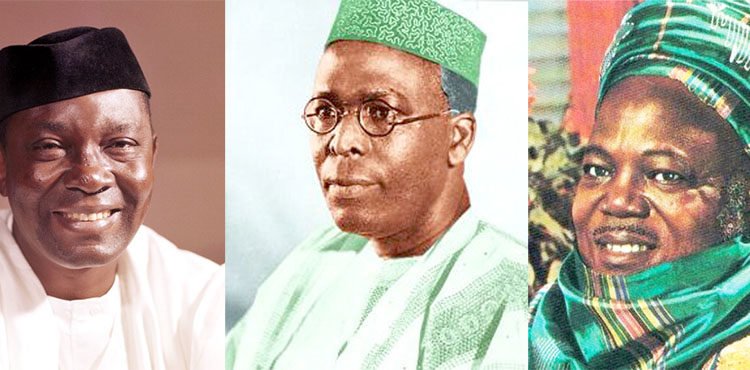
It is an indisputable fact that Zik was the cornerstone upon which Nigeria’s independence was built and established. Achebe even indicated that “The father of African independence was Nnamdi Azikiwe”. “Zik brought new ideas to Nigeria’s independence struggle”, Awo declared. Adamu Ciroma said this about Zik, “He was different from other politicians of his age because no matter your age, he treated you as a friend”.
The late fiery lawyer and human rights activist, Gani Fawehinmi, dismissed Awo as father of tribalism, went against Bellow as Islamic fundamentalist and tackled Zik as a conformist, a compromiser who was always unstable.
Zik defended himself thus “We made some compromises to allow the nation succeed. Without compromise, could this world progress? When two incompatible meet, they coexist by agreeing to agree on some issues and agreeing to disagree on other issues. This has been my guideline all my life”. He admitted toeing the Fabius principle of war anchored in delay tactics (lion style) and then striking the opponent at the most vulnerable time! (Newswatch, November 18, 1996, pages 8, 15).
With the above political philosophy, Zik, a boxer knew how to dodge all politics blows in patience and ultimately deliver a devasting Technical Knockout. As an athlete, he developed the rare ability to always takeoff on time in order to brace the tape ahead of his fellow competitors.
Therefore, when independence was achieved in 1960, Zik was happy and well fulfilled. He saw Nigeria as his child and he the father. All actions he took thereafter were based on his sincere efforts towards nursing the child from cradle/infancy via adolescent to adulthood. In view of this, he cultivated, practised and promoted as well as encouraged politics of forgiveness, accommodation and understanding. It worked wonders for him, his people, associates and followers.
And so, at independence, Zik, having studied the outcome of the December 12, 1959 parliamentary elections, got convinced that the British colonial masters had effectively handed over Nigeria to the North. He automatically abandoned Awo who knocked on his door for partnership, and followed Bello who threatened to quit the union if Zik and Awo teamed up. The reasons Zik ran to Bello in 1960 instead of working with Awo were critically x-rayed in part two of this series.
Expectedly, Zik’s idea of working with the North was rewarding and fruitful. First, it put his arch. rival, Awo, perpetually on the brinks as leader of the opposition at the federal level. Second, it gave his people, the Eastern Region, especially Ndigbo, latitude to appointments in the civil services, ministries and reputable corporations like railway, ports authority, aviation, foreign services, P&T, etc.
This provoked envy even when those engagements were clearly through merit, due process, and completely hinged on qualification via industry standards and practices. In fact, Zik set Ndigbo on a plane that was not only superlative in comparison but also an excellent in delivery. Most of the projects, schemes, policies, institutions and personalities Zik built, established, initiated or inspired were highlighted in the part two of this article.
As a matter of fact, Ndigbo were everywhere and everywhere was Igbo and it sparked off envy and jealousy. Zik, certainly with deep knowledge of his Igbo people, inspired his kith and kin to greatness. Achebe gave insights how this miraculous and magnificent feats were fantastically accomplished.
“The Igbo culture being receptive to change, individualistic, and highly competitive, gave the Igbo man an unquestioned advantage over his compatriots in securing credentials for advancement in Nigerian colonial society. Unlike the Hausa/Fulani he was unhampered by a wary religion, and unlike the Yoruba he was unhampered by traditional hierarchies. This kind of creature, fearing no god or man, was custom – made to grasp the opportunities, such as they were, of the white man’s dispensations. And the Igbo did so with both hands. Although the Yoruba had a huge historical and geographical headstart, the Igbo wiped out their handicap in one fantastic burst of energy in 20 years between 1930 and 1950”, The Trouble with Nigeria., reproduced in THERE WAS A COUNTY, page 74.
The Zik magic touch of the First Republic was commendably borrowed by the NPN lords in the Second Republic of 1979/83. President Shehu Shagari, Fulani, north, chose Alex Ekwueme, Igbo, as his deputy presidential candidate. The pair easily won the election even Igbo wards were accommodated in the federal government of the day.
Besides Ekwueme as the vice president, Chuka Okadigbo was political adviser (when that position was highly respected and carried weight), K O. Mbadiwe Sylvester Ugo, Nwakamma Okoro, Collins Obi, C.C. Onoh, Rowland Njoku and several others were influential members of the party and government officials in various capacities. Zik proved his mettle when he entered into an alliance with Shagari to produce the NPN – NPP Accord that saw Ume Ezuoke as the speaker of the Federal House of Representatives. And Ojukwu was granted a state pardon upon which he returned from Ivory Coast and joined NPN!
With the return of democracy in 1999, the East – North political understanding was still very much alive and kicking. However, the events of 1993 that saw the annulment of June 12 presidential election which would have been won by MKO Abiola, a Yoruba, and its resultant disturbances, compelled the Nigerian oligarchy to go South West and Olusegun Obasanjo emerged. In Lagos, Senator Bola Ahmed Tinubu was elected governor.
Tinubu was among the men that visited late Sani Abacha during the heady days of June 12 crisis for discussions. Periscoping what actually would have stopped Awo and Abiola from ruling Nigeria, Tinubu practically understood that north was the problem. He came to blunt realization that Awo never appealed to the north just as the same north admired and promoted Abiola maliciously pulled him down and I gloriously buried him.
Wearing the garb of a democrat, and belonging to civil rights groups as well as democratic elements like Campaign for Democracy and NADECO, went for a decoy, attacking the north and particularly blamed the ills in Nigeria on northerners especially Shagari, Buhari, Babangida, and Abacha. This way he gained unprecedented acceptability in the south and northern minorities.
Next, Tinubu started calling for resource control, state police, true federalism, fiscal federalism, restructuring and sovereign national conference. He rallied his fellow governors and put in place the Southern Nigeria Governors Conference. He played host the inaugural edition.
Leaving office in 2007, Tinubu started surreptitious and clandestine moves towards his presidential ambition, while still attacking the north as Nigeria’s problem.
The emergence of President Jonathan and his region of unpardonable blunders (notwithstanding his numerous achievements), gave Tinubu the opportunity to strike. Like Zik, he was patient. Like Zik, he made a remarkable compromise. Like Zik, he went north. Like Zik, he struck like a lion – the best of opportunities. Tinubu ran to Buhari as Zik went to Bello, and struck the best political deal of his life and it produced its desired chemistry and results.
Recall that the Zik – Bello understanding produced Balewa and Zik as Nigerian leaders – Balewa the leader of government business and Zik as president and commander in chief of the armed forces. The Buhari – Tinubu also did the same: the former has ruled Nigeria eight years and handed over to the latter! It is Tinubu’s funnest hour irrespective of the fraudulent electoral process that brought him to power.
The Igbo glitch is abandonment of their traditional northern coalition for a solo candidate with competence, character capacity and vision for a better Nigeria, without any known bloc alliance. The glitch, while it lasted, like a uncontrolled speeding automobile, was romantic, alluring and parallaxing, its cruising effects produced fatalities and the car itself most dangerously crushed.
For recuperation and progress, Ndigbo must resurrect Zik’s political mantra of negotiation, and being consistently north in approach, not necessarily method! You know, if you miss your way in the valley you move up. Ndigbo are currently in a valley and looking up here is simply moving up northwards, politically not professionally.
…Concluded!
By Ori Martins
 OBLONG MEDIA GLOBAL INTELLIGENCE
Leave a comment