
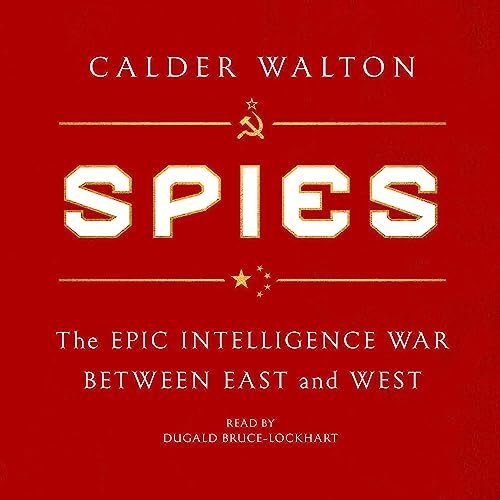
The riveting story of the hundred-year intelligence war between Russia and the West with lessons for our new superpower conflict with China
Espionage, election meddling, disinformation, assassinations, subversion, and sabotage – all attract headlines today about Putin’s dictatorship. But they are far from new. The West has a long-term Russia problem, not a Putin problem. Spies mines hitherto secret archives and exclusive interviews with former agents to tell the history of the war that Russia and the West have been waging for a century. Espionage dark arts were the Kremlin’s means to equalise the imbalance of arms between the East and West before, during and after the Cold War. There was nothing ‘unprecedented’ about Russian meddling in the 2016 US presidential election. It was business as usual, new means for old ends.
The Cold War started long before 1945. Western powers gradually fought back after the Second World War, mounting their own shadow war, deploying propaganda, recruiting intelligence networks and pioneering new spy technologies against the Soviet Union. Spies is an inspiring, engrossing story of the best and worst of mankind: bravery and honour, treachery and betrayal. The narrative shifts across continents and decades, from the freezing streets of St. Petersburg in 1917 to the bloody beaches of Normandy; from coups in faraway lands to present-day Moscow, where troll farms weaponise social media against Western democracies. This fresh reading of history makes Spies a unique and essential addition to the story of the unrolling conflict between Russia, China and the West that will dominate the twenty-first century.
About the Author
Calder Walton is one of the world’s leading intelligence historians. He is editor-in-chief of the Cambridge History of Espionage and Intelligence, to be published by Cambridge University Press in three volumes, which will be a landmark study in the global history of intelligence. Currently the Assistant-Director of the Applied History Project at Harvard’s Kennedy School of Government, Calder holds a PhD in History from Trinity College Cambridge, where he wrote his first, award winning, and widely acclaimed book, Empire of Secrets: British Intelligence, Cold War, and the Twilight of Empire (Harper Press 2013).
While pursuing a PhD and postdoctoral fellowship at Cambridge, Calder was a principal researcher on Christopher Andrew’s unprecedented, authorized, centenary history of the British Security Service, Defence of the Realm (Penguin 2009). This research position provided Calder, for six years, with unique access to British intelligence records. Calder is a regular commentator on intelligence and national security matters in news and media outlets both sides of the Atlantic. Calder is also a qualified English barrister and has worked on several high-profile litigation cases involving defence and security matters, providing him with expertise in the legal issues of intelligence.
In june 1941 Josef Stalin received a warning from the NKVD, the forerunner of the KGB, that a Nazi attack on the Soviet Union was imminent. “You can tell your ‘source’ in German air force headquarters to go fuck himself,” was the Soviet leader’s response. “He’s not a ‘source’, he’s a disinformer.” The invasion came a week later. The anecdote is one of many gems unearthed from the archives in “Spies”, a lucid history of the intelligence contest between America, Britain and Russia.
The author, Calder Walton, is an accomplished historian, having contributed to the authorised history of M15, Britain’s domestic security service. He is also the assistant director of an intelligence programme at Harvard University that attracts current and retired spooks, lending his book both scholarly clout and an insider feel. “Spies” explains how espionage and covert action shaped the cold war, but its enduring message is the folly of failing to realise you are in an intelligence war in the first place.
In December 1917 Vladimir Lenin founded the Cheka, the secret police, to terrorise the enemies of the Bolshevik revolution and steal secrets abroad. It quickly grew to be 100,000-people strong and used news agencies, trade missions and companies to spy across Europe. In the early 1930s Russian spies burrowed deep into Western governments. The most notorious moles were the Cambridge Five, who rose high in mi6. (One of them, Kim Philby, briefly wrote for The Economist.)
Western democracies were often oblivious. In 1929 Henry Stimson, America’s secretary of state, shut down the country’s codebreaking agency on the basis that “gentlemen do not read each other’s mail”.
In 1936 Britain’s ambassador in Moscow refused to allow M16 to open a station in the embassy because “it was liable to cause embarrassment”. On the eve of the second world war, notes Mr Walton, “Soviet intelligence perversely had more graduates of British universities than Britain’s own intelligence services, M15 and M16.”
During the second world war, Britain’s Foreign Office went so far as to ban espionage against its new Soviet ally. British codebreakers at Bletchley Park were not permitted to monitor, let alone decrypt, Soviet communications. When America bought a Soviet code-book from Finnish officers in 1944, the president ordered his spooks to return it to the Soviets.
Stalin, meanwhile, intensified his efforts, placing a higher priority on espionage against his allies than against Nazi Germany. When Stalin met Churchill and Roosevelt at Yalta in 1945 to hash out the post-war European order, his intelligence on them “probably surpassed that of any leader in history”, writes Mr Walton. Remarkably, Stalin knew about both Bletchley Park’s successes and the American atomic-bomb project years before Harry Truman, who learnt of those momentous secrets only on becoming president.
It is hardly news that the Soviet Union spied a lot. But there are few accounts as comprehensive as this one, spanning the Bolshevik revolution to the present day, while weaving in new archival material, some declassified as recently as 2022.
There are also lessons for the present.
The final chapter of “Spies” persuasively draws a comparison between the West’s previous contest and its new one. Mark Kelton, a former head of counter-intelligence at the CIA, suggests that the scale of current Chinese espionage against America’s government at least matches Soviet activity in the 1930s. It may even exceed it. A report published on July 13th by the British Parliament’s intelligence committee said China “almost certainly maintains the largest state intelligence apparatus in the world—dwarfing the uk’s Intelligence Community”.
Much as in the 1930s, America and its allies were lamentably slow to recognise and then blunt the threat. As late as 2017, counter-terrorism, not the risks posed by China or Russia, received the most funds among American intelligence priorities. All that has changed.
In 2020 the FBI said it was opening a new China-related counter-intelligence case every ten hours. In a speech on July 1st, Bill Burns, the director of the cia, said that he had doubled the share of the budget devoted to China-related activity in the previous two years. But recognising a challenge is different from containing it. Mr Walton reckons that American intelligence agencies are unlikely to have penetrated the Chinese leadership as they did that of Vladimir Putin prior to the invasion of Ukraine. More worryingly, some intelligence insiders believe that a Chinese mole might have sabotaged the CIA’s operations in China a decade ago.
America and its European allies insist they do not want a cold war with China. “That, of course, overlooks one of this book’s central conclusions,” argues Mr Walton: “Western powers can be in a cold war irrespective of whether they seek one and before they recognise it.”■
 OBLONG MEDIA GLOBAL INTELLIGENCE
Leave a comment