Why Everything You Know About World War II Is Wrong. PART 2
Question 6: Operation Pike Did England and France plan to attack Russia prior to Hitler’s invasion of that country? Ron Unz—For more than eighty years, one of the single most crucial turning points of World War II has been omitted from nearly every Western history written about that conflict and as a result, virtually no…
This historical reconstruction is strongly supported by much additional material. During this period, Prof. Revilo P. Oliver had held a senior position in Military Intelligence, and when he published his memoirs four decades later, he claimed that FDR had deliberately tricked the Japanese into attacking Pearl Harbor. Knowing that Japan had broken Portugal’s diplomatic codes, FDR informed the latter country’s ambassador of his plans to wait until the Japanese had over-extended themselves, then order the Pacific Fleet to launch a devastating surprise attack against their home islands. According to Oliver, Japan’s subsequent diplomatic cables revealed they had successfully been convinced that FDR planned to suddenly attack them.
Indeed, just a couple of months before Pearl Harbor, Argosy Weekly, one of America’s most popular magazines, carried a fictional cover story describing exactly such a devastating surprise attack on Tokyo in retaliation for a naval incident, with the powerful bombers of our Pacific Fleet inflicting huge damage upon the unprepared Japanese capital. I wonder whether the Roosevelt Administration didn’t have a hand in getting that story published.
As early as May 1940, FDR had ordered the Pacific Fleet relocated from its San Diego home port to Pearl Harbor in Hawaii, a decision strongly opposed as unnecessarily provocative and dangerous by James Richardson, its commanding admiral, who was fired as a result. Moreover:
There was also a very strange domestic incident that immediately followed the Pearl Harbor attack, one which seems to have attracted far too little interest. In that era, films were the most powerful popular media, and although Gentiles constituted 97% of the population, they controlled only one of the major studios; perhaps coincidentally, Walt Disney was also the only high-ranking Hollywood figure perched squarely within the anti-war camp. And the day after the surprise Japanese attack, hundreds of U.S. troops seized control of Disney Studios, allegedly in order to help defend California from Japanese forces located thousands of miles away, with the military occupation continuing for the next eight months. Consider what suspicious minds might have thought if on September 12, 2001, President Bush had immediately ordered his military to seize the CBS network offices, claiming that such a step was necessary to help protect New York City against further Islamicist attacks.
Pearl Harbor was bombed on a Sunday and unless FDR and his top aides were fully aware of the pending Japanese assault, they surely would have been totally preoccupied with the aftermath of the disaster. It seems highly unlikely that the U.S. military would have been ready to seize control of Disney studios early Monday morning following an actual “surprise” attack.
Did England and France plan to attack Russia prior to Hitler’s invasion of that country?
Ron Unz—For more than eighty years, one of the single most crucial turning points of World War II has been omitted from nearly every Western history written about that conflict and as a result, virtually no educated Americans are even aware of it.
It is an undeniable, documented fact that just a few months after the war began, the Western Allies—Britain and France—decided to attack the neutral Soviet Union, which they regarded as militarily weak and a crucial supplier of natural resources for Hitler’s war machine. Based upon their experience in World War I, the Allied leadership believed that there was little chance of any military breakthrough on the Western front, so they felt that their best chance of overcoming Germany was by defeating Germany’s Soviet quasi-ally.
However, the reality was entirely different. The USSR was vastly stronger than they realized at the time and it was ultimately responsible for destroying 80% of Germany’s military formations, with America and the other Allies only accounting for the remaining 20%. Therefore, a 1940 Allied attack on the Soviets would have brought them directly into the war as Hitler’s full military ally, and the combination of Germany’s industrial strength and Russia’s natural resources would have been nearly invincible, almost certainly reversing the outcome of the war.
From the earliest days of the Bolshevik Revolution, the Allies had been intensely hostile to the Soviet Union and became even more so after Stalin attacked Finland in late 1939. That Winter War went badly as the heavily outnumbered Finns very effectively resisted the Soviet forces leading to an Allied plan to send several divisions to fight alongside the Finns. According to Sean McMeekin’s ground-breaking 2021 book Stalin’s War, the Soviet dictator became aware of this dangerous military threat, and his concerns over looming Allied intervention persuaded him to quickly settle the war with Finland on relatively generous terms.
Despite this, the Allied plans to attack the USSR continued, now shifting to Operation Pike, the idea of using their bomber squadrons based in Syria and Iraq to destroy the Baku oilfields in the Soviet Caucasus, while also trying to enlist Turkey and Iran into their planned attack against Stalin. By this date, Soviet agriculture had become heavily mechanized and dependent upon oil, and Allied strategists believed that the successful destruction of the Soviet oilfields would eliminate much of that country’s fuel supply, thereby possibly producing a famine that might bring down the distasteful Communist regime.
Yet virtually all of these Allied assumptions were completely incorrect. Only a small fraction of Germany’s oil came from the Soviets, so its elimination would have little impact upon the German war effort. As subsequent events soon proved, the USSR was enormously strong in military terms rather than weak. The Allies believed that just a few weeks of attacks by dozens of existing bombers would totally devastate the oil fields, but later in the war vastly larger aerial attacks had only limited impact upon oil production elsewhere.
Successful or not, the planned Allied attack against the USSR would have represented the largest strategic bombing offensive in world history to that date, and it had been scheduled and rescheduled during the early months of 1940, only finally abandoned after Germany’s armies crossed the French border, surrounded and defeated the Allied ground forces, and knocked France out of the war.
The victorious Germans were fortunate enough to capture all the secret documents regarding Operation Pike, and they achieved a major propaganda coup by publishing them in facsimile and translation, so that all knowledgeable individuals soon knew that the Allies had been on the verge of attacking the Soviets. This missing fact helps to explain why Stalin remained so distrustful of Churchill’s diplomatic efforts prior to the Hitler’s Barbarossa attack a year later.
However, for more than three generations the remarkable story of how the Allies came so close to losing the war by attacking the USSR has been totally excluded from virtually all Western histories. Therefore, when I discovered these facts in the 1952 memoirs of Sisley Huddleston, a leading Anglo-French journalist, I initially assumed he must have been delusional:
The notion that the Allies were preparing to launch a major bombing offensive against the Soviet Union just a few months after the outbreak of World War II was obviously absurd, so ridiculous a notion that not a hint of that long-debunked rumor had ever gotten into the standard history texts I had read on the European conflict. But for Huddleston to have still clung to such nonsensical beliefs even several years after the end of the war raised large questions about his gullibility or even his sanity. I wondered whether I could trust even a single word he said about anything else.
However, not long afterward I encountered quite a surprise in a 2017 article published in The National Interest, an eminently respectable periodical. The short piece carried the descriptive headline “In the Early Days of World War II, Britain and France Planned to Bomb Russia.” The contents absolutely flabbergasted me, and with Huddleston’s credibility now fully established—and the credibility of my standard history textbooks equally demolished—I went ahead and substantially drew upon his account for my long article “American Pravda: Post-War France and Post-War Germany.”
If all our World War II history books can exclude a fully-documented story of such enormous importance, they obviously cannot be trusted about anything else.
What is the truth about the Holocaust? You have apparently done a fair amount of research on the topic and may have an opinion about what actually took place. Can we say with certainty how many Jews were killed or verify the manner in which they were killed? In your opinion, do the historical facts about the Holocaust align the narrative that is backed by powerful Jewish organizations or are there major discrepancies?
Ron Unz—For most Americans and other Westerners, the Jewish Holocaust ranks as one of the most important and monumental events of the twentieth century, probably today greater in its visibility than any other aspect of World War II, during which it occurred.
The mere mention of the iconic number of “Six Million” is immediately understood, and in recent decades many Western countries have legally protected the status of that particular historical event by mandating stiff fines or prison sentences for anyone who disputes or minimizes it, the modern equivalent of old-fashioned blasphemy laws.
As someone who was educated in the American school system and then spent a lifetime absorbing information from our media and popular culture, I’d certainly always been aware of the Holocaust, though I’d never had much explored its details. With the growth of the Internet over the last couple of decades, I’d occasionally come across individuals who challenged that narrative, but the world is filled with all sorts of cranks and crackpots, and I usually didn’t pay much attention to their arguments.
Then eight or nine years ago, a major controversy erupted regarding Reason magazine, the flagship publication of the libertarian movement. Apparently during the mid-1970s, Reason had actively published and promoted the work of America’s leading Holocaust Deniers, a rather shocking revelation. During the 1990s I’d become a little friendly with the Reason people and although they could sometimes be dogmatic on certain ideological issues, they otherwise seemed rather sensible. I couldn’t understand why they would have denied the reality of the Holocaust, especially since so many of them were themselves Jewish. So later when I had some time, I decided to investigate the controversy more carefully.
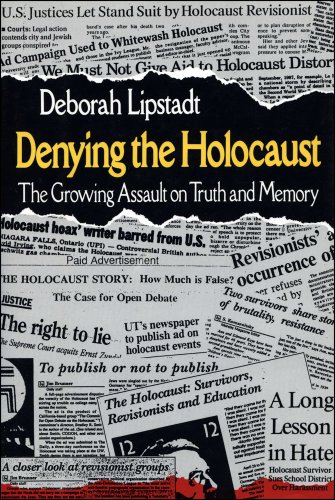
Most of the articles by Holocaust Deniers that Reason published had actually dealt with other historical controversies, but all these pieces seemed extremely solid and well-done. So I decided to read the books by Deborah Lipstadt, one of the world’s foremost critics of Holocaust Denial, who had been heavily quoted in the articles attacking Reason. Lipstadt’s name was already slightly familiar to me from her rancorous late 1990s legal battle against British historian David Irving.
In reading Lipstadt’s books, I was very surprised to discover that during the Second World War itself, few mainstream individuals in the political or media worlds had apparently believed in the reality of the ongoing Holocaust, mostly regarding the widespread stories being promoted by Jewish activists and Allied governments as merely dishonest wartime propaganda, much like the ridiculous World War I atrocity stories of Germans raping Belgian nuns or eating Belgian children. And indeed, many of the Holocaust stories Lipstadt condemns the media for ignoring were totally ridiculous, such as the Germans killing over a million Jews by individually injecting them in the heart with a poison compound. As I wrote:
Lipstadt entitled her first book “Beyond Belief,” and I think that all of us can agree that the historical event she and so many others in academia and Hollywood have made the centerpiece of their lives and careers is certainly one of the most extremely remarkable occurrences in all of human history. Indeed, perhaps only a Martian Invasion would have been more worthy of historical study, but Orson Welles’s famous War of the Worlds radio-play which terrified so many millions of Americans in 1938 turned out to be a hoax rather than real.
The six million Jews who died in the Holocaust certainly constituted a very substantial fraction of all the wartime casualties in the European Theater, outnumbering by a factor of 100 all the British who died during the Blitz, and being dozens of times more numerous than all the Americans who fell there in battle. Furthermore, the sheer monstrosity of the crime against innocent civilians would surely have provided the best possible justification for the Allied war effort. Yet for many, many years after the war, a very strange sort of amnesia seems to have gripped most of the leading political protagonists in that regard.
Robert Faurisson, a French academic who became a prominent Holocaust Denier in the 1970s, once made an extremely interesting observation regarding the memoirs of Eisenhower, Churchill, and De Gaulle:
Three of the best known works on the Second World War are General Eisenhower’s Crusade in Europe (New York: Doubleday [Country Life Press], 1948), Winston Churchill’s The Second World War (London: Cassell, 6 vols., 1948-1954), and the Mémoires de guerre of General de Gaulle (Paris: Plon, 3 vols., 1954-1959). In these three works not the least mention of Nazi gas chambers is to be found.
Eisenhower’s Crusade in Europe is a book of 559 pages; the six volumes of Churchill’s Second World War total 4,448 pages; and de Gaulle’s three-volume Mémoires de guerre is 2,054 pages. In this mass of writing, which altogether totals 7,061 pages (not including the introductory parts), published from 1948 to 1959, one will find no mention either of Nazi “gas chambers,” a “genocide” of the Jews, or of “six million” Jewish victims of the war.
Given that the Holocaust would reasonably rank as the single most remarkable episode of the Second World War, such striking omissions must almost force us to place Eisenhower, Churchill, and De Gaulle among the ranks of “implicit Holocaust Deniers.”
The books by Lipstadt and other prominent Holocaust historians such as Lucy Dawidowicz had fiercely condemned a long list of America’s leading historians and other academic scholars as implicit or explicit Holocaust Deniers, claiming that they continued to ignore or dispute the reality of the Holocaust even years after the war had ended.
Even more remarkable was the fact that influential Jewish groups such as the ADL seemed unwilling to challenge or criticize even the most explicit Holocaust Denial during the years after World War II. In my research, I discovered a particularly striking example of this:
Some years ago, I came across a totally obscure 1951 book entitled Iron Curtain Over America by John Beaty, a well-regarded university professor. Beaty had spent his wartime years in Military Intelligence, being tasked with preparing the daily briefing reports distributed to all top American officials summarizing available intelligence information acquired during the previous 24 hours, which was obviously a position of considerable responsibility.
As a zealous anti-Communist, he regarded much of America’s Jewish population as deeply implicated in subversive activity, therefore constituting a serious threat to traditional American freedoms. In particular, the growing Jewish stranglehold over publishing and the media was making it increasingly difficult for discordant views to reach the American people, with this regime of censorship constituting the “Iron Curtain” described in his title. He blamed Jewish interests for the totally unnecessary war with Hitler’s Germany, which had long sought good relations with America, but instead had suffered total destruction for its strong opposition to Europe’s Jewish-backed Communist menace.
Beaty also sharply denounced American support for the new state of Israel, which was potentially costing us the goodwill of so many millions of Muslims and Arabs. And as a very minor aside, he also criticized the Israelis for continuing to claim that Hitler had killed six million Jews, a highly implausible accusation that had no apparent basis in reality and seemed to be just a fraud concocted by Jews and Communists, aimed at poisoning our relations with postwar Germany and extracting money for the Jewish State from the long-suffering German people.
Furthermore, he was scathing toward the Nuremberg Trials, which he described as a “major indelible blot” upon America and “a travesty of justice.” According to him, the proceedings were dominated by vengeful German Jews, many of whom engaged in falsification of testimony or even had criminal backgrounds. As a result, this “foul fiasco” merely taught Germans that “our government had no sense of justice.” Sen. Robert Taft, the Republican leader of the immediate postwar era took a very similar position, which later won him the praise of John F. Kennedy in Profiles in Courage. The fact that the chief Soviet prosecutor at Nuremberg had played the same role during the notorious Stalinist show trials of the late 1930s, during which numerous Old Bolsheviks confessed to all sorts of absurd and ridiculous things, hardly enhanced the credibility of the proceedings to many outside observers.
Then as now, a book taking such controversial positions stood little chance of finding a mainstream New York publisher, but it was soon released by a small Dallas firm, and then became enormously successful, going through some seventeen printings over the next few years. According to Scott McConnell, founding editor of The American Conservative, Beaty’s book became the second most popular conservative text of the 1950s, ranking only behind Russell Kirk’s iconic classic, The Conservative Mind.
Moreover, although Jewish groups including the ADL harshly condemned the book, especially in their private lobbying, those efforts provoked a backlash, and numerous top American generals, both serving and retired, wholeheartedly endorsed Beaty’s work, denouncing the ADL efforts at censorship and urging all Americans to read the volume. Although Beaty’s quite explicit Holocaust Denial might shock tender modern sensibilities, at the time it seems to have caused barely a ripple of concern and was almost totally ignored even by the vocal Jewish critics of the work.
Beaty’s huge national bestseller attracted enormous attention as well as massive criticism from Jews and liberals, yet although they energetically attacked him on every other issue, none of them challenged him when he dismissed the Holocaust as merely a notorious wartime propaganda-hoax that few still believed. Furthermore, a long list of our top World War II military commanders strongly endorsed Beaty’s book making that claim.
Our modern understanding of the Holocaust can almost entirely be traced back to a seminal 1961 book by historian Raul Hilberg. He had been a child when his family of Jewish refugees arrived in America at the beginning of the war and became outraged that the entire American media was ignoring the extermination of the European Jews as claimed by Jewish activists. Years later, when he attended college, he was further outraged that his history professor—a fellow German-Jewish refugee—seemed not to accept the reality of the Holocaust, so Hilberg decided to make that topic the focus of his doctoral research.
Despite this considerable repression, a large body of scholarly literature has been produced over the decades that raises enormous doubts about the officially-established Holocaust narrative, which seems largely to have been created by Hollywood. Indeed, the first such comprehensive analysis, by a seemingly apolitical professor of Electrical Engineering named Arthur R. Butz, had appeared nearly a half-century ago, probably prompting the interest of Reason magazine that same year, and although banned a few years ago by Amazon, Butz’s work still remains a very effective summation of the basic case.
The Hoax of the Twentieth Century The Case Against the Presumed Extermination of European Jewry Arthur R. Butz • 1976/2015 • 225,000 Words
After reading it and nearly a dozen other books on both sides of the contentious issue, I closed my long article with the following verdict:
Any conclusions I have drawn are obviously preliminary ones, and the weight others should attach to these must absolutely reflect my strictly amateur status. However, as an outsider exploring this contentious topic I think it far more likely than not that the standard Holocaust narrative is at least substantially false, and quite possibly, almost entirely so.
Despite this situation, the powerful media focus in support of the Holocaust over the last few decades has elevated it to a central position in Western culture. I wouldn’t be surprised if it currently occupies a larger place in the minds of most ordinary folk than does the Second World War that encompassed it, and therefore possesses greater apparent reality.
However, some forms of shared beliefs may be a mile wide but an inch deep, and the casual assumptions of individuals who have never actually investigated a given subject may rapidly change. Also, the popular strength of doctrines that have long been maintained in place by severe social and economic sanctions, often backed by criminal penalties, may possibly be much weaker than anyone realizes.
Until thirty years ago, Communist rule over the USSR and its Warsaw Pact allies seemed absolutely permanent and unshakeable, but the roots of that belief had totally rotted away, leaving behind nothing more than a hollow facade. Then one day, a gust of wind came along, and the entire gigantic structure collapsed. I wouldn’t be surprised if our current Holocaust narrative eventually suffers that same fate, perhaps with unfortunate consequences for those too closely associated with having maintained it.
On page 202, you made the following statement which helps to underscore the grave importance of historical accuracy:
“We must also recognize that many of the fundamental ideas that dominate our present-day world were founded upon a particular understanding of that wartime history, and if there seems good reason to believe that narrative is substantially false, perhaps we should begin questioning the framework of beliefs erected upon it.”
This is a thought-provoking statement that makes me wonder whether the last 80 years of bloody US interventions can all be attributed to our “particular understanding” of WW2. It seems to me that our leaders have used this idealized myth of the ‘”Good War” in which the “exceptional” American people fight the evil of fascism’, to promote their warlike agenda and to justify their relentless pursuit of global hegemony.
In your opinion, what is the greatest danger of erecting a “framework of beliefs” on a false understanding of history?
Ron Unz—The Hollywood-constructed image of our great global triumph in the heroic war against Hitler and Nazi Germany has inspired a legacy of colossal American arrogance, now leading us towards an enormously reckless confrontation with Russia over Ukraine and with China over Taiwan, the sort of geopolitical hubris that often leads to nemesis, perhaps even nemesis of an extreme form given the nuclear arsenals of those rival states. As I wrote soon after the outbreak of the Ukraine War:
For years the eminent Russia scholar Stephen Cohen had ranked President Vladimir Putin of the Russian Republic as the most consequential world leader of the early twenty-first century. He praised the man’s enormous success in reviving his country after the chaos and destitution of the Yeltsin years and emphasized his desire for friendly relations with America, but increasingly feared that we were entering into a new Cold War, even more dangerous than the last.
As far back as 2017, the late Prof. Cohen argued that no foreign leader had been as greatly vilified in recent American history as Putin, and Russia’s invasion of Ukraine two weeks ago has exponentially raised the intensity of such media denunciations, almost matching the hysteria our country experienced two decades ago after the 9/11 attack on New York City. Larry Romanoff has provided a useful catalog of some examples.
Until recently, this extreme demonization of Putin was largely confined to Democrats and centrists, whose bizarre Russiagate narrative had accused him of installing Donald Trump in the White House. But the reaction has now become entirely bipartisan, with enthusiastic Trump-backer Sean Hannity recently using his prime-time FoxNews show to call for Putin’s death, a cry soon joined by Sen. Lindsey Graham, the ranking Republican on the Senate Judiciary Committee. These are astonishing threats to make against a man whose nuclear arsenal could quickly annihilate the bulk of the American population, and the rhetoric seems unprecedented in our postwar history. Even in the darkest days of the Cold War, I don’t recall such public sentiments ever being directed towards the USSR or its top Communist leadership.
In many respects the Western reaction to Russia’s attack has been closer to a declaration of war than merely a return to Cold War confrontation. Russia’s massive foreign reserves held abroad have been seized and frozen, its civilian airlines excluded from Western skies, and its leading banks disconnected from global financial networks. Wealthy Russian private citizens have had their properties confiscated, the national soccer team has been banned from the World Cup, and the longtime Russian conductor of the Munich Philharmonic was fired for refusing to denounce his own country…
Indeed, the closest parallel that comes to mind would be the American hostility directed against Adolf Hitler and Nazi Germany after the outbreak of World War II, as indicated by the widespread comparisons between Putin’s invasion of Ukraine and Hitler’s 1939 attack on Poland. A simple Google search for “Putin and Hitler” returns tens of millions of webpages, with the top results ranging from the headline of a Washington Post article to the Tweets of pop music star Stevie Nicks. As far back as 2014, Andrew Anglin of the Daily Stormer had documented the emerging meme “Putin is the new Hitler.”
I went on to discuss the extremely dangerous implications of our hysterical anti-Russia policy.
In the wake of the 9/11 Attacks, the Jewish Neocons stampeded America towards the disastrous Iraq War and the resulting destruction of the Middle East, with the talking heads on our television sets endlessly claiming that “Saddam Hussein is another Hitler.” Since then, we have regularly heard the same tag-line repeated in various modified versions, being told that “Muammar Gaddafi is another Hitler” or “Mahmoud Ahmadinejad is another Hitler” or “Vladimir Putin is another Hitler” or even “Hugo Chavez is another Hitler.” For the last couple of years, our American media has been relentlessly filled with the claim that “Donald Trump is another Hitler.”
During the early 2000s, I obviously recognized that Iraq’s ruler was a harsh tyrant, but snickered at the absurd media propaganda, knowing perfectly well that Saddam Hussein was no Adolf Hitler. But with the steady growth of the Internet and the availability of the millions of pages of periodicals provided by my digitization project, I’ve been quite surprised to gradually also discover that Adolf Hitler was no Adolf Hitler.
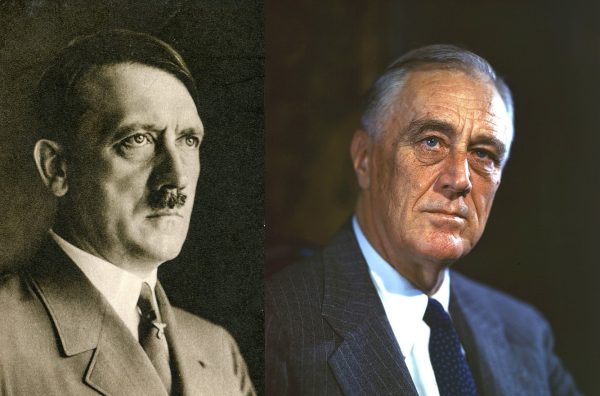
It might not be entirely correct to claim that the story of World War II was that Franklin Roosevelt sought to escape his domestic difficulties by orchestrating a major European war against the prosperous, peace-loving Nazi Germany of Adolf Hitler. But I do think that picture is probably somewhat closer to the actual historical reality than the inverted image more commonly found in our textbooks.





 OBLONG MEDIA GLOBAL INTELLIGENCE


Leave a comment