
Owerri and Asaba are two Igbo cities notable today for a booming hospitality industry and the high surge of real estate development. Both cities have histories of being centres of Administration during the colonial days.
While Owerri is situated at the Southern part of the Igbo geographical centre, Asaba is situated at the West Bank of the River Niger, opposite Onitsha, one of the largest Igbo urban areas.
Owerri is the anglicized spelling and pronunciation of Owere. Asaba is believed by many to be an anglicization of the original Ahaba or Azagba, although Asaba is also an Igbo dialectal version of Ahaba. There are other communities in the Igbo speaking region with the name “Asaba”.
One thing that binds Owere and Ahaba together, is the similarity
in their most popular traditions of origins. The words from which both towns were named, are regular Igbo words referring to specific things.
However, the most popular traditions of origins among both groups, hold that the names of their towns were not referring to those particular things, but were abridged forms of statements.
Owere, is an old Igbo word that means “backyard”, “Periphery”, “hindquarters”, outskirts, exterior. There are a lot of clans in the Igbo speaking region from Ika in today’s Delta State to Abịa State, with the Owere affix in their names.
Examples are: Owere-Olubor, Ute-Owere in Ika North-East LGA of Delta State, Owere-Ezeọba in Enugu State, Osu-Owere and Oko-Owere in Mbanọ, Imo State, Owere Ezukala in Anambra State, Owere-Akokwa in Ideato area of Imo State, Owere Ebeiri and Ihite-Owere in Orlu, Imo State; Owerenta in Isiala Ngwa area of Abia State.
Mbieri in Imo State was atimes referred to as “Owere Isu” because it is at the outskirts of the Isu area.
One would readily think the name of the Owere town had the same meaning with the other Òwèrè named above,
but the most popular oral tradition about the founding of the Owerri town, has it that the name of the town was short for “Owerela nke mara ya aka”, a statement made by Arugo Ekwem Ọha the founder of Owerri, who fled from Oratta.
Similarly, there are many places across Igbo land called Ahaba or by the dialectal versions Araba and Asaba.
Ahaba/Araba/Asaba refers to a tree whose botanical name is given as Aciao Barteri. It is a wild tree that grows across Igbo land.
Many villages in Igboland were named after trees such as Ngwu, Ọ́ji, Ụbụrụ/Ụbụlụ, etc.
The communities in Igbo land named after the Ahaba/Araba/Asaba trees, had the trees in abundance There are Ahaba-Imenyi in Isuikwuato LGA, Ahaba in Ikwuano LGA and Ahaba in Ngwa, all in Abia State; Ahaba-Orodo and Ahaba-Ohukabia in Imo State , Asaba in Ụzọ-ụwanị LGA in Enugu State, Asaba-ase in Ndokwa area of Delta State, Araba Umuzocha in Awka, Anambra State, among others.
Coincidentally, the Silk cotton tree, known as Akpụ in Igbo, is known in Yoruba as Àràba. Àràbà is a variant of Ahaba. Similarly, there are places or people in Yoruba land whose names contain “Àràbà”. Example: Ìdí-Àràbà.
However, the most accepted oral tradition of the founding of Asaba city in Delta State, holds that the term “Ahaba” was derived from “Ahabago m”, a statement made by Nnebisi, believed to be the father of the town who had fled from Nteje in present day Oyi LGA of Anambra State.
These facts are historical similarities between Òwèrè city and Ahaba. However, the Ahaba trees are going extinct today due to human cruelty to forest life.
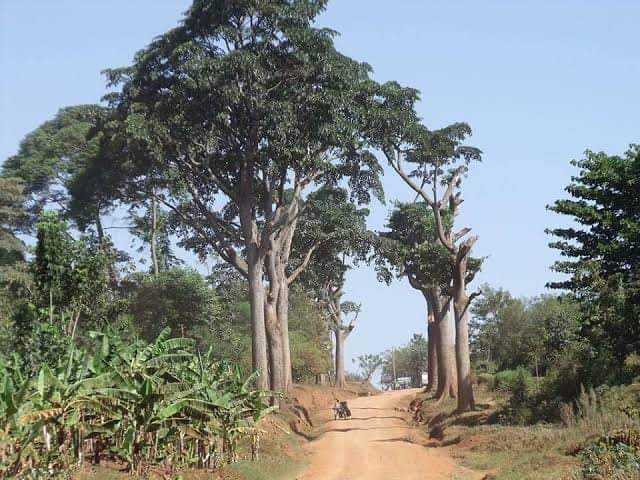
Above after the caption is a picture of Ahaba trees at the outskirts (òwéré) of Ahaba-Imenyi community in Abia State. When you have Ahaba trees at the outskirts of a community, the phenomenon would be described as “Ahaba-Owere” or “Owere-Ahaba” in Igbo.
© Akachukwu Vitalis
 OBLONG MEDIA GLOBAL INTELLIGENCE
Leave a comment