
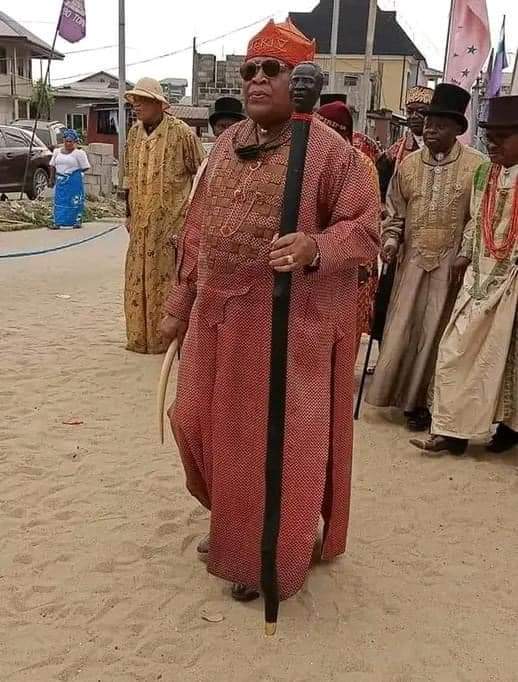
“Amanyanabo” is the title for the traditional leader in the Kalabari, Opubo-ama and Okrika kingdoms of the Eastern Delta.
These three kingdoms have a long period of relationship with the Igbo people, especially in trade. There were also huge Igbo migration to these areas, even as many Igbo women were married to their men and women !.
The Amanyanabo title is an Ijaw expression that means the same thing as the Igbo title “Onye-nwe-ali”. “Ama” means clan or Community and in some context, land. “Nyana” means “own”, while the “Bọ” suffix means person.
When put together, it translates loosely as “clan own person”.
The Onye-nwe-ali title possibly stems from the land tenureship customs in Southern Igbo land where the leader is regarded as the custodian of the territory.
The title is prominent in Ndọki land and among the Ikwerre tribe with the dialectal variants “Nye-nwe-ali/Nye-nwe-eli”.
The Kalabari, who according to documented history had first settled at Obu-Amafa near present day Emohua and Isiokpo, live to the South of Ikwerre land and had centuries of relationship with
the Ikwerre tribe.
The Okrika on the other hand, also have relationship with the Igbo, with a good number of them having many mothers of Igbo descent and some others, descendants of Igbo migrants, traders and ex-slaves who have been assimilated into the Okrika society. The matrilineal culture of the Ijaw also allowed for Children of Igbo fathers to bear names of the families of their Ijaw mothers.
Also, British anthropologist, Arthur Leonard had documented a tradition of origin that linked the Okrika to the Afam-Ndọki area of Southern Igbo land.
The Bonny and Opobo People on the other hand have centuries of relationship with the Ndoki tribe, especially the Azumini, Ọhambele and Umuagbai clans.
Apart from theories of origin, precolonially documented, that links the early settlers of Bonny to Ndoki and Ngwa land, the form of Igbo spoken in Bonny and Opobo, is heavily based on the Ndọ̀ki dialect.
This is added to the diffusion of cultural practices with Ndoki/Igbo origins between the groups such as Nwaọtam, Ogele-mkpa, Atụ-Ọkọnkọ, Ụwa-wu-nke-Onye Cultural movement, Ọfọ-na-ogu, Ọnụ-obu system, Agaba, etc..
The slave markets at Ndoki, supplied slaves to the Slave terminal at Bonny during the slave trade. After the abolition of the slave trade and the dawn of legitimate trade in the mid 19th century, the rich palm belt of Ndoki land supplied and enriched the Opobo and Bonny export markets.
This flourishing trade, had triggered counter migrations from the Bonny/Opobo areas, up the Imo river to the Palm Oil rich towns of Ọhambele and Azumini, which were under the influence of Jaja (Ọkwara Mbanasọ), the king of Opobo.
The Ọdụm-egege legend told among the Ndọkị, attests to the influence of Opobo over the hinterland palm oil rich belts.
At the course of the trade, Ndọkị towns, especially Ọhambele and Azumini witnessed an influx of some people of Ijoid ancestry from the Bonny-Opobo region.
It should be noted that the Ijaw sections of Bonny traces origin to the Kolokuma area of today’s Bayelsa State. A theory of origin in Bakana, in the Kalabari country, as recorded by Arthur Leonard, holds that the ancestors of the Ijaw stock of the three “Eastern Ijaw” clan had migrated from the Kolokuma Central Delta, after a dispute over the sharing of games from a hunting expedition. They moved Eastwards where they were said to have met and assimilated preexisting peoples at their current locations.
Today, these Ijaw people in Ọhambele and Azumini have been assimilated into the Ndoki tribe although, their families are still found with their Ijaw names such as Waribo, Taribo, Ogolo, Gogo, etc.. Intermarriages has still continued between the Ndoki and the Opobo. Sim Fubara, the Rivers PDP flagbearer for instance, has his two grandmothers from Ndoki land.
Today, these Ijaw families settled in Ndọkị firmly assert a strong Ijaw identity and identify as Ibani Ijaw. They have become members of the Ijaw National Council.
However, these Ijaw settlers being very vocal, now erroneously extend their Ijaw identity to the majority aboriginal Ndoki who had settled there centuries before they came up from the Delta area.
This has continued so much that the Ndoki history has been rewritten by them and Ndoki is traced directly to Nembe and Kolokuma in present day Bayelsa! . The erroneous theories have fast been gaining grounds in Ndoki as the majority aboriginal Ndoki who are kins with the Ngwa, Asa and possibly some Olu Igbo, have remained quiet while more recent settlers rewrite and redefine them!
With the developments spreading quick, there may soon be an Amanyanabo of Azumini or Ọhambele in Abia State instead of an Onye-nwe-ali, just as there is an Amanyanabo of Opobo, an Igbo speaking town!.
Book References:
. Arthur Leonard, “The Lower Niger and Its Tribes, (London: MacMillan, 1906)
G.I Jones, “The Trading states of the Oil Rivers: A Study of Political Development in Eastern Nigeria”, (London: Oxford University Press, 1963
By vitalis Akachukwu
BLACK TRUTH
Ijaw History In Pictures
HISTORY VILLAGE – Pre And Post Colonial History Of Nigeria
This Is Nigeria
 OBLONG MEDIA GLOBAL INTELLIGENCE
Leave a comment