
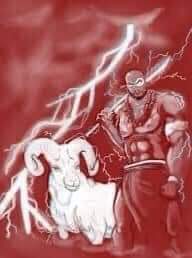
The word Amadiọha is principally made up of two words, amadi and ọha. Amadi, used for the freeborn; but also connotes nobility and princely disposition. So, an amadi is a prince; as in nobility, status and rank not monarchy. Ọha, on the other hand, means the people. So, Amadiọha would mean the Noble or Prince of the People.
Now, some translate Amadioha as man of the people; but that translation is inadequate considering that other translations of man like nwoke or onye or mmadụ do not yield the same connotation as amadi. Onye ọha, mmadụ ọha or nwoke ọha do not connote same in the Igbo psyche as amadi ọha. So, Amadiọha as Prince of the People is a better translation than just man of the people. Remember, by prince we do not mean monarchy!
In tagging a spiritual entity as Prince of the People, the Igbo exhibits an uncanny awareness of Bible reality. The Bible tells us that different nations had spiritual entities which they were assigned to. These spiritual entities were known as the Prince of such nation.
“The prince of the kingdom of Persia opposed me [Gabriel] for twenty-one days. Then Michael, one of the chief princes, came to help me after I had been left there with the kings of Persia.” (Daniel 10:13)
“I must return at once to fight against the prince of Persia, and when I leave, the prince of Greece will come. However, I will tell you what is recorded in the book of truth. (No one has the courage to support me against those princes except Michael, your prince.” (Daniel 10:20-21)
“At that time Michael, the great prince who stands watch over your people, will rise up.” (Daniel 12:1)
“You shall not speak ill of the gods, and the prince of your people you shall not curse.” (Exodus 22:28)
So, the Igbo denoting a particular spirit being as the Prince of the People captures this Bible phenomenon. Mind you, not all these princes are aligned with the will of God; the Prince of Persia depicts this well, but he is not alone in this as we can see from God’s rebuke of princes in Psalm 82.
“God stands in the divine assembly; He judges among the gods (divine beings). “How long will you judge unjustly and show partiality to the wicked? Selah. Vindicate the weak and fatherless; do justice and maintain the rights of the afflicted and destitute. Rescue the weak and needy; rescue them from the hand of the wicked.” The rulers do not know nor do they understand; they walk on in the darkness [of complacent satisfaction]; all the foundations of the earth [the fundamental principles of the administration of justice] are shaken. I said, “You are gods; indeed, all of you are sons of the Most High. Nevertheless you will die like men and fall like any one of the princes.” Arise, O God, judge the earth! For to You belong all the nations. (Psalm 82 -Amplified Version)
We can see that a people’s prince can be a rogue prince. So, who exactly is Amadioha? Can a people have two such princes? If no, what is the implication in the case of an Israelites-descended Igbo? Could the person the Igbo call “The Prince of the People” be the same person identified as the Prince of Israel in the Bible? It is already instructive enough that the Igbo captured the concept of a Prince of the People.
We will of a necessity need to examine Amadiọha using what the Igbo say of him and compare it with that which is said of Michael. Michael is believed to be that angel who comes with the appellation, “The Angel of the Lord”. This angel of the Lord introduced himself as “Captain of the Lord’s host”. It was he that led the patriarchs and led Israel from Egypt through the wilderness into Canaan. So, we see Michael exuding much of the paraphernalia Yahweh Himself is known for. So, in investigating Amadioha, we will look to see if he exudes such paraphernalia as attributable to Michael and/or Yahweh.
1)
AMADIOHA: Amadioha is believed to be an agbara of thunder, lightning and tempests who strikes the wicked (men and spirits) with thunder bolts; and who speaks by thunder.
MICHAEL/YAHWEH: The LORD also thundered in the heavens, and the Highest gave his voice; hail stones and coals of fire. Yea, he sent out his arrows, and scattered them; and he shot out lightning, and discomfited them (Psalm 18:13-14).
2)
AMADIOHA: Amadioha is associated with the sun.
MICHAEL/YAHWEH: But unto you that fear My name shall the Sun of righteousness arise with healing in His wings; and you will go forth, and grow up as calves of the stall (Malachi. 4:2).
3)
AMADIOHA: Atonement is made to Amadioha by the scapegoat phenomenon; that is, curses transferred to a live goat that is let loose outside the borders of the community.
MICHAEL/YAHWEH: But the goat, on which the lot fell to be the scapegoat, shall be presented alive before the LORD, to make an atonement with him, and to let him go for a scapegoat into the wilderness (Lev. 16:10).
4)
AMADIOHA: Those struck dead by Amadioha are not mourned.
MICHAEL/YAHWEH: Moses then said to Aaron and his remaining sons, Eleazar and Ithamar, “No mourning rituals for you –unkempt hair, torn clothes– or you’ll also die and GOD will be angry with the whole congregation. Your relatives –all the People of Israel, in fact– will do the mourning over those GOD has destroyed by fire (Leviticus 10:6 –The Message Bible).
5)
AMADIOHA: He is seen as a messiah who comes to the rescue of those in critical situations
MICHAEL/YAHWEH: God is our refuge and strength, a very present help in trouble (Psalm 46:1).
6)
AMADIOHA: Amadioha is the enforcer and protector of the law.
MICHAEL/YAHWEH: Yea, they made their hearts as an adamant stone, lest they should hear the law, and the words which the LORD of hosts has sent in his spirit by the former prophets: therefore came a great wrath from the LORD of hosts (Zech. 7: 12).
7)
AMADIOHA: He is also seen as cool tempered, kind, loving and giver of wealth.
MICHAEL/YAHWEH: The LORD is gracious, and full of compassion; slow to anger, and of great mercy (Ps. 145:8).
8 )
AMADIOHA: Amadioha is believed to have taken part in creation.
MICHAEL/YAHWEH: Michael is believed, by some schools of thought, to have taken part in creation.
9)
AMADIOHA: Amadiọha is known as “O bi n’igwe”; that is, “He who dwells in the heavens.”
MICHAEL/YAHWEH: But will God indeed dwell on the earth? Behold, heaven and the highest heaven cannot contain You, how much less this house which I have built! (1 Kings 8:27)
10)
AMADIOHA: Amadiọha is noted for his choice of the ram for sacrifice.
MICHAEL/YAHWEH: The angel of the Lord called out to him from heaven, “Abraham! Abraham!”.. Abraham looked up and there in a thicket he saw a ram caught by its horns. He went over and took the ram and sacrificed it as a burnt offering instead of his son. So Abraham called that place “The Lord Will Provide.” [Remember also, that we hear much about “the lamb of God”]
11)
AMADIOHA: Amadiọha is said to be the husband of Ala (the land).
MICHAEL/YAHWEH: Yahweh severally have been said to be the husband of the land of Israel.
12)
AMADIOHA: Amadiọha is said to appear in red apparels.
MICHAEL/YAHWEH: Who is this who comes from Edom, with dyed garments from Bozrah… Why is Your apparel red, and Your garments like one who treads in the winepress? (Isaiah 63:1-2)
He was clothed with a robe dipped in blood, and His name is called The Word of God. (Revelation 19:13)
So, is Kalu, Kamalu, Michael one and same? Kalu, Kamalu are other names for Amadiọha. For the personality identified as Prince of the People by a people that have been severally said in many quarters to be descended from ancient Israelites to have this mirror image with the personality said to be the Prince of Israel is remarkably striking. To think that, while I was reading up for this, I saw comparisons being done of Michael and the Christ, and to stumble upon such comparisons also being done of Amadiọha and the Christ!
To imagine that there were no angels, but just evil spirits, in Alaigbo would be unfortunate. That you do not recognize the angels by their biblical names does not argue in anyway against their presence here. We believe that Chukwu is Yahweh even though we call Him Chukwu and not Yahweh. We approximate Ekwensu as Satan even though we call him Ekwensu and not Satan. So, why do we think Michael, Gabriel and other angels -good and bad- will not have Igbo identification? If as we believe Chukwu is Yahweh, why do you think that He will operate in Alaigbo without His heavenly host who will be interacting with Ndị Igbo?
The Bible told us that angels interface with men on behalf of the Most High, passages like the one we read in Psalm 82 confirms it. Other passages that say same are…
“You who received THE LAW AS IT WAS ORDAINED BY ANGELS, and kept it not…” (Acts 7:53 -ERV)
“Why then the law? It was added because of transgressions, until the offspring should come to whom the promise had been made, and IT [THE LAW] WAS PUT IN PLACE THROUGH ANGELS by an intermediary.” (Galatians 3:19)
“THE WORD SPOKEN BY ANGELS WAS STEDFAST, and every transgression and disobedience received a just recompence of reward…” (Hebrew 2:2)
“Moses was with our ancestors, the assembly of God’s people in the wilderness, when THE ANGEL SPOKE TO HIM AT MOUNT SINAI. AND THERE MOSES RECEIVED LIFE-GIVING WORDS TO PASS ON TO US.” (Acts 7:38)
While we do not have the word angel in the Igbo lexicon, the Igbo word for this same spiritual entities who interface with men on behalf of the Supreme Being is Agbara; this translates roughly as Mighty One(s). For the Igbo, Gabriel, Michael and all other angels will simply be described as Agbara.
Some may query why Amadiọha did not lead us to Christ. Neither Michael, Gabriel nor any other angel led anyone to Christ; men are called to lead other men to Christ not angels. Some others may query why sacrifices were made to Amadiọha. The Igbo would reply that all sacrifices are meant for Chukwu, that the agbara is only a messanger to Chukwu. We should know that there was a dispensation of angels where angels acted as intermediaries to the Most High, and the Igbo were part of this dispensation; but, today, we are in the dispensation of the Son.
Now, if the Prince of the People, Amadiọha, has been identified as the same person as the Prince of Israel, Michael, you can go ahead and refer to your Saint Michael’s Gospel Church as Saint Amadiọha’s Gospel Church… nothing spoil! An African name does not turn a holy angel to a demon!
By Ike Chi-ukwu Eluigwe
 OBLONG MEDIA GLOBAL INTELLIGENCE
Leave a comment