
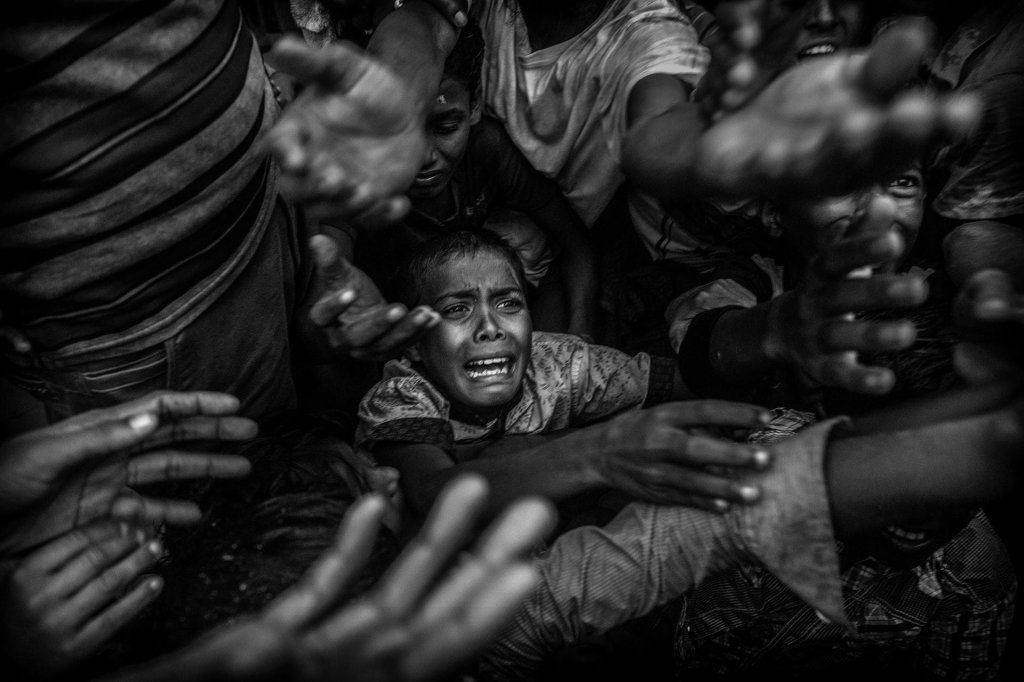
The author’s exclusive interviews with scores of the participants in the decision-making, together with her analysis of newly declassified documents, yield a chilling narrative of self-serving caution and flaccid will—and countless missed opportunities to mitigate a colossal crime
I. People Sitting in Offices
In the course of a hundred days in 1994 the Hutu government of Rwanda and its extremist allies very nearly succeeded in exterminating the country’s Tutsi minority. Using firearms, machetes, and a variety of garden implements, Hutu militiamen, soldiers, and ordinary citizens murdered some 800,000 Tutsi and politically moderate Hutu. It was the fastest, most efficient killing spree of the twentieth century.
A few years later, in a series in The New Yorker, Philip Gourevitch recounted in horrific detail the story of the genocide and the world’s failure to stop it. President Bill Clinton, a famously avid reader, expressed shock. He sent copies of Gourevitch’s articles to his second-term national-security adviser, Sandy Berger. The articles bore confused, angry, searching queries in the margins. “Is what he’s saying true?” Clinton wrote with a thick black felt-tip pen beside heavily underlined paragraphs. “How did this happen?” he asked, adding, “I want to get to the bottom of this.” The President’s urgency and outrage were oddly timed. As the terror in Rwanda had unfolded, Clinton had shown virtually no interest in stopping the genocide, and his Administration had stood by as the death toll rose into the hundreds of thousands.
Why did the United States not do more for the Rwandans at the time of the killings? Did the President really not know about the genocide, as his marginalia suggested? Who were the people in his Administration who made the life-and-death decisions that dictated U.S. policy? Why did they decide (or decide not to decide) as they did? Were any voices inside or outside the U.S. government demanding that the United States do more? If so, why weren’t they heeded? And most crucial, what could the United States have done to save lives?
So far people have explained the U.S. failure to respond to the Rwandan genocide by claiming that the United States didn’t know what was happening, that it knew but didn’t care, or that regardless of what it knew there was nothing useful to be done. The account that follows is based on a three-year investigation involving sixty interviews with senior, mid-level, and junior State Department, Defense Department, and National Security Council officials who helped to shape or inform U.S. policy. It also reflects dozens of interviews with Rwandan, European, and United Nations officials and with peacekeepers, journalists, and nongovernmental workers in Rwanda. Thanks to the National Security Archive (www.nsarchive.org), a nonprofit organization that uses the Freedom of Information Act to secure the release of classified U.S. documents, this account also draws on hundreds of pages of newly available government records. This material provides a clearer picture than was previously possible of the interplay among people, motives, and events. It reveals that the U.S. government knew enough about the genocide early on to save lives, but passed up countless opportunities to intervene.
In March of 1998, on a visit to Rwanda, President Clinton issued what would later be known as the “Clinton apology,” which was actually a carefully hedged acknowledgment. He spoke to the crowd assembled on the tarmac at Kigali Airport: “We come here today partly in recognition of the fact that we in the United States and the world community did not do as much as we could have and should have done to try to limit what occurred” in Rwanda.
This implied that the United States had done a good deal but not quite enough. In reality the United States did much more than fail to send troops. It led a successful effort to remove most of the UN peacekeepers who were already in Rwanda. It aggressively worked to block the subsequent authorization of UN reinforcements. It refused to use its technology to jam radio broadcasts that were a crucial instrument in the coordination and perpetuation of the genocide. And even as, on average, 8,000 Rwandans were being butchered each day, U.S. officials shunned the term “genocide,” for fear of being obliged to act. The United States in fact did virtually nothing “to try to limit what occurred.” Indeed, staying out of Rwanda was an explicit U.S. policy objective.
With the grace of one grown practiced at public remorse, the President gripped the lectern with both hands and looked across the dais at the Rwandan officials and survivors who surrounded him. Making eye contact and shaking his head, he explained, “It may seem strange to you here, especially the many of you who lost members of your family, but all over the world there were people like me sitting in offices, day after day after day, who did not fully appreciate [pause] the depth [pause] and the speed [pause] with which you were being engulfed by this unimaginable terror.”
Clinton chose his words with characteristic care. It was true that although top U.S. officials could not help knowing the basic facts—thousands of Rwandans were dying every day—that were being reported in the morning papers, many did not “fully appreciate” the meaning. In the first three weeks of the genocide the most influential American policymakers portrayed (and, they insist, perceived) the deaths not as atrocities or the components and symptoms of genocide but as wartime “casualties”—the deaths of combatants or those caught between them in a civil war.
Yet this formulation avoids the critical issue of whether Clinton and his close advisers might reasonably have been expected to “fully appreciate” the true dimensions and nature of the massacres. During the first three days of the killings U.S. diplomats in Rwanda reported back to Washington that well-armed extremists were intent on eliminating the Tutsi. And the American press spoke of the door-to-door hunting of unarmed civilians. By the end of the second week informed nongovernmental groups had already begun to call on the Administration to use the term “genocide,” causing diplomats and lawyers at the State Department to begin debating the word’s applicability soon thereafter. In order not to appreciate that genocide or something close to it was under way, U.S. officials had to ignore public reports and internal intelligence and debate.
The story of U.S. policy during the genocide in Rwanda is not a story of willful complicity with evil. U.S. officials did not sit around and conspire to allow genocide to happen. But whatever their convictions about “never again,” many of them did sit around, and they most certainly did allow genocide to happen. In examining how and why the United States failed Rwanda, we see that without strong leadership the system will incline toward risk-averse policy choices. We also see that with the possibility of deploying U.S. troops to Rwanda taken off the table early on—and with crises elsewhere in the world unfolding—the slaughter never received the top-level attention it deserved. Domestic political forces that might have pressed for action were absent. And most U.S. officials opposed to American involvement in Rwanda were firmly convinced that they were doing all they could—and, most important, all they should—in light of competing American interests and a highly circumscribed understanding of what was “possible” for the United States to do.
One of the most thoughtful analyses of how the American system can remain predicated on the noblest of values while allowing the vilest of crimes was offered in 1971 by a brilliant and earnest young foreign-service officer who had just resigned from the National Security Council to protest the 1970 U.S. invasion of Cambodia. In an article in Foreign Policy, “The Human Reality of Realpolitik,” he and a colleague analyzed the process whereby American policymakers with moral sensibilities could have waged a war of such immoral consequence as the one in Vietnam. They wrote,
The answer to that question begins with a basic intellectual approach which views foreign policy as a lifeless, bloodless set of abstractions. “Nations,” “interests,” “influence,” “prestige”—all are disembodied and dehumanized terms which encourage easy inattention to the real people whose lives our decisions affect or even end.
Policy analysis excluded discussion of human consequences. “It simply is not done,” the authors wrote. “Policy—good, steady policy—is made by the ‘tough-minded.’ To talk of suffering is to lose ‘effectiveness,’ almost to lose one’s grip. It is seen as a sign that one’s ‘rational’ arguments are weak.”
In 1994, fifty years after the Holocaust and twenty years after America’s retreat from Vietnam, it was possible to believe that the system had changed and that talk of human consequences had become admissible. Indeed, when the machetes were raised in Central Africa, the White House official primarily responsible for the shaping of U.S. foreign policy was one of the authors of that 1971 critique: Anthony Lake, President Clinton’s first-term national-security adviser. The genocide in Rwanda presented Lake and the rest of the Clinton team with an opportunity to prove that “good, steady policy” could be made in the interest of saving lives.
II. The Peacekeepers
Rwanda was a test for another man as well: Romeo Dallaire, then a major general in the Canadian army who at the time of the genocide was the commander of the UN Assistance Mission in Rwanda. If ever there was a peacekeeper who believed wholeheartedly in the promise of humanitarian action, it was Dallaire. A broad-shouldered French-Canadian with deep-set sky-blue eyes, Dallaire has the thick, calloused hands of one brought up in a culture that prizes soldiering, service, and sacrifice. He saw the United Nations as the embodiment of all three.
Before his posting to Rwanda Dallaire had served as the commandant of an army brigade that sent peacekeeping battalions to Cambodia and Bosnia, but he had never seen actual combat himself. “I was like a fireman who has never been to a fire, but has dreamed for years about how he would fare when the fire came,” the fifty-five-year-old Dallaire recalls. When, in the summer of 1993, he received the phone call from UN headquarters offering him the Rwanda posting, he was ecstatic. “It was answering the aim of my life,” he says. “It’s all you’ve been waiting for.”
Dallaire was sent to command a UN force that would help to keep the peace in Rwanda, a nation the size of Vermont, which was known as “the land of a thousand hills” for its rolling terrain. Before Rwanda achieved independence from Belgium, in 1962, the Tutsi, who made up 15 percent of the populace, had enjoyed a privileged status. But independence ushered in three decades of Hutu rule, under which Tutsi were systematically discriminated against and periodically subjected to waves of killing and ethnic cleansing. In 1990 a group of armed exiles, mainly Tutsi, who had been clustered on the Ugandan border, invaded Rwanda. Over the next several years the rebels, known as the Rwandan Patriotic Front, gained ground against Hutu government forces. In 1993 Tanzania brokered peace talks, which resulted in a power-sharing agreement known as the Arusha Accords. Under its terms the Rwandan government agreed to share power with Hutu opposition parties and the Tutsi minority. UN peacekeepers would be deployed to patrol a cease-fire and assist in demilitarization and demobilization as well as to help provide a secure environment, so that exiled Tutsi could return. The hope among moderate Rwandans and Western observers was that Hutu and Tutsi would at last be able to coexist in harmony.
Hutu extremists rejected these terms and set out to terrorize Tutsi and also those Hutu politicians supportive of the peace process. In 1993 several thousand Rwandans were killed, and some 9,000 were detained. Guns, grenades, and machetes began arriving by the planeload. A pair of international commissions—one sent by the United Nations, the other by an independent collection of human-rights organizations—warned explicitly of a possible genocide.
But Dallaire knew nothing of the precariousness of the Arusha Accords. When he made a preliminary reconnaissance trip to Rwanda, in August of 1993, he was told that the country was committed to peace and that a UN presence was essential. A visit with extremists, who preferred to eradicate Tutsi rather than cede power, was not on Dallaire’s itinerary. Remarkably, no UN officials in New York thought to give Dallaire copies of the alarming reports from the international investigators.
The sum total of Dallaire’s intelligence data before that first trip to Rwanda consisted of one encyclopedia’s summary of Rwandan history, which Major Brent Beardsley, Dallaire’s executive assistant, had snatched at the last minute from his local public library. Beardsley says, “We flew to Rwanda with a Michelin road map, a copy of the Arusha agreement, and that was it. We were under the impression that the situation was quite straightforward: there was one cohesive government side and one cohesive rebel side, and they had come together to sign the peace agreement and had then requested that we come in to help them implement it.”
Though Dallaire gravely underestimated the tensions brewing in Rwanda, he still felt that he would need a force of 5,000 to help the parties implement the terms of the Arusha Accords. But when his superiors warned him that the United States would never agree to pay for such a large deployment, Dallaire reluctantly trimmed his written request to 2,500. He remembers, “I was told, ‘Don’t ask for a brigade, because it ain’t there.’”
Once he was actually posted to Rwanda, in October of 1993, Dallaire lacked not merely intelligence data and manpower but also institutional support. The small Department of Peacekeeping Operations in New York, run by the Ghanaian diplomat Kofi Annan, now the UN secretary general, was overwhelmed. Madeleine Albright, then the U.S. ambassador to the UN, recalls, “The global nine-one-one was always either busy or nobody was there.” At the time of the Rwanda deployment, with a staff of a few hundred, the UN was posting 70,000 peacekeepers on seventeen missions around the world. Amid these widespread crises and logistical headaches the Rwanda mission had a very low status.
Life was not made easier for Dallaire or the UN peacekeeping office by the fact that American patience for peacekeeping was thinning. Congress owed half a billion dollars in UN dues and peacekeeping costs. It had tired of its obligation to foot a third of the bill for what had come to feel like an insatiable global appetite for mischief and an equally insatiable UN appetite for missions. The Clinton Administration had taken office better disposed toward peacekeeping than any other Administration in U.S. history. But it felt that the Department of Peacekeeping Operations needed fixing and demanded that the UN “learn to say no” to chancy or costly missions.
Every aspect of the UN Assistance Mission in Rwanda was run on a shoestring. UNAMIR (the acronym by which it was known) was equipped with hand-me-down vehicles from the UN’s Cambodia mission, and only eighty of the 300 that turned up were usable. When the medical supplies ran out, in March of 1994, New York said there was no cash for resupply. Very little could be procured locally, given that Rwanda was one of Africa’s poorest nations. Replacement spare parts, batteries, and even ammunition could rarely be found. Dallaire spent some 70 percent of his time battling UN logistics.
Dallaire had major problems with his personnel, as well. He commanded troops, military observers, and civilian personnel from twenty-six countries. Though multinationality is meant to be a virtue of UN missions, the diversity yielded grave discrepancies in resources. Whereas Belgian troops turned up well armed and ready to perform the tasks assigned to them, the poorer contingents showed up “bare-assed,” in Dallaire’s words, and demanded that the United Nations suit them up. “Since nobody else was offering to send troops, we had to take what we could get,” he says. When Dallaire expressed concern, he was instructed by a senior UN official to lower his expectations. He recalls, “I was told, ‘Listen, General, you are NATO-trained. This is not NATO.’” Although some 2,500 UNAMIR personnel had arrived by early April of 1994, few of the soldiers had the kit they needed to perform even basic tasks.
The signs of militarization in Rwanda were so widespread that even without much of an intelligence-gathering capacity, Dallaire was able to learn of the extremists’ sinister intentions. In January of 1994 an anonymous Hutu informant, said to be high up in the inner circles of the Rwandan government, had come forward to describe the rapid arming and training of local militias. In what is now referred to as the “Dallaire fax,” Dallaire relayed to New York the informant’s claim that Hutu extremists “had been ordered to register all the Tutsi in Kigali.” “He suspects it is for their extermination,” Dallaire wrote. “Example he gave was that in 20 minutes his personnel could kill up to 1000 Tutsis.” “Jean-Pierre,” as the informant became known, had said that the militia planned first to provoke and murder a number of Belgian peacekeepers, to “thus guarantee Belgian withdrawal from Rwanda.” When Dallaire notified Kofi Annan’s office that UNAMIR was poised to raid Hutu arms caches, Annan’s deputy forbade him to do so. Instead Dallaire was instructed to notify the Rwandan President, Juvénal Habyarimana, and the Western ambassadors of the informant’s claims. Though Dallaire battled by phone with New York, and confirmed the reliability of the informant, his political masters told him plainly and consistently that the United States in particular would not support aggressive peacekeeping. (A request by the Belgians for reinforcements was also turned down.) In Washington, Dallaire’s alarm was discounted. Lieutenant Colonel Tony Marley, the U.S. military liaison to the Arusha process, respected Dallaire but knew he was operating in Africa for the first time. “I thought that the neophyte meant well, but I questioned whether he knew what he was talking about,” Marley recalls.
III. The Early Killings
On the evening of April 6, 1994, Romeo Dallaire was sitting on the couch in his bungalow residence in Kigali, watching CNN with Brent Beardsley. Beardsley was preparing plans for a national Sports Day that would match Tutsi rebel soldiers against Hutu government soldiers in a soccer game. Dallaire said, “You know, Brent, if the shit ever hit the fan here, none of this stuff would really matter, would it?” The next instant the phone rang. Rwandan President Habyarimana’s Mystère Falcon jet, a gift from French President François Mitterrand, had just been shot down, with Habyarimana and Burundian President Cyprien Ntaryamira aboard. Dallaire and Beardsley raced in their UN jeep to Rwandan army headquarters, where a crisis meeting was under way.
Back in Washington, Kevin Aiston, the Rwanda desk officer, knocked on the door of Deputy Assistant Secretary of State Prudence Bushnell and told her that the Presidents of Rwanda and Burundi had gone down in a plane crash. “Oh, shit,” she said. “Are you sure?” In fact nobody was sure at first, but Dallaire’s forces supplied confirmation within the hour. The Rwandan authorities quickly announced a curfew, and Hutu militias and government soldiers erected roadblocks around the capital.
Bushnell drafted an urgent memo to Secretary of State Warren Christopher. She was concerned about a probable outbreak of killing in both Rwanda and its neighbor Burundi. The memo read,
If, as it appears, both Presidents have been killed, there is a strong likelihood that widespread violence could break out in either or both countries, particularly if it is confirmed that the plane was shot down. Our strategy is to appeal for calm in both countries, both through public statements and in other ways.
A few public statements proved to be virtually the only strategy that Washington would muster in the weeks ahead.
Lieutenant General Wesley Clark, who later commanded the NATO air war in Kosovo, was the director of strategic plans and policy for the Joint Chiefs of Staff at the Pentagon. On learning of the crash, Clark remembers, staff officers asked, “Is it Hutu and Tutsi or Tutu and Hutsi?” He frantically called for insight into the ethnic dimension of events in Rwanda. Unfortunately, Rwanda had never been of more than marginal concern to Washington’s most influential planners.
America’s best-informed Rwanda observer was not a government official but a private citizen, Alison Des Forges, a historian and a board member of Human Rights Watch, who lived in Buffalo, New York. Des Forges had been visiting Rwanda since 1963. She had received a Ph.D. from Yale in African history, specializing in Rwanda, and she could speak the Rwandan language, Kinyarwanda. Half an hour after the plane crash Des Forges got a phone call from a close friend in Kigali, the human-rights activist Monique Mujawamariya. Des Forges had been worried about Mujawamariya for weeks, because the Hutu extremist radio station, Radio Mille Collines, had branded her “a bad patriot who deserves to die.” Mujawamariya had sent Human Rights Watch a chilling warning a week earlier: “For the last two weeks, all of Kigali has lived under the threat of an instantaneous, carefully prepared operation to eliminate all those who give trouble to President Habyarimana.”
Now Habyarimana was dead, and Mujawamariya knew instantly that the hard-line Hutu would use the crash as a pretext to begin mass killing. “This is it,” she told Des Forges on the phone. For the next twenty-four hours Des Forges called her friend’s home every half hour. With each conversation Des Forges could hear the gunfire grow louder as the militia drew closer. Finally the gunmen entered Mujawamariya’s home. “I don’t want you to hear this,” Mujawamariya said softly. “Take care of my children.” She hung up the phone.
Mujawamariya’s instincts were correct. Within hours of the plane crash Hutu militiamen took command of the streets of Kigali. Dallaire quickly grasped that supporters of the Arusha peace process were being targeted. His phone at UNAMIR headquarters rang constantly as Rwandans around the capital pleaded for help. Dallaire was especially concerned about Prime Minister Agathe Uwilingiyimana, a reformer who with the President’s death had become the titular head of state. Just after dawn on April 7 five Ghanaian and ten Belgian peacekeepers arrived at the Prime Minister’s home in order to deliver her to Radio Rwanda, so that she could broadcast an emergency appeal for calm.
Joyce Leader, the second-in-command at the U.S. embassy, lived next door to Uwilingiyimana. She spent the early hours of the morning behind the steel-barred gates of her embassy-owned house as Hutu killers hunted and dispatched their first victims. Leader’s phone rang. Uwilingiyimana was on the other end. “Please hide me,” she begged.
Minutes after the phone call a UN peacekeeper attempted to hike the Prime Minister over the wall separating their compounds. When Leader heard shots fired, she urged the peacekeeper to abandon the effort. “They can see you!” she shouted. Uwilingiyimana managed to slip with her husband and children into another compound, which was occupied by the UN Development Program. But the militiamen hunted them down in the yard, where the couple surrendered. There were more shots. Leader recalls, “We heard her screaming and then, suddenly, after the gunfire the screaming stopped, and we heard people cheering.” Hutu gunmen in the Presidential Guard that day systematically tracked down and eliminated Rwanda’s moderate leadership.
The raid on Uwilingiyimana’s compound not only cost Rwanda a prominent supporter of the Arusha Accords; it also triggered the collapse of Dallaire’s mission. In keeping with the plan to target the Belgians which the informant Jean-Pierre had relayed to UNAMIR in January, Hutu soldiers rounded up the peacekeepers at Uwilingiyimana’s home, took them to a military camp, led the Ghanaians to safety, and then killed and savagely mutilated the ten Belgians. In Belgium the cry for either expanding UNAMIR’s mandate or immediately withdrawing was prompt and loud.
In response to the initial killings by the Hutu government, Tutsi rebels of the Rwandan Patriotic Front—stationed in Kigali under the terms of the Arusha Accords—surged out of their barracks and resumed their civil war against the Hutu regime. But under the cover of that war were early and strong indications that systematic genocide was taking place. From April 7 onward the Hutu-controlled army, the gendarmerie, and the militias worked together to wipe out Rwanda’s Tutsi. Many of the early Tutsi victims found themselves specifically, not spontaneously, pursued: lists of targets had been prepared in advance, and Radio Mille Collines broadcast names, addresses, and even license-plate numbers. Killers often carried a machete in one hand and a transistor radio in the other. Tens of thousands of Tutsi fled their homes in panic and were snared and butchered at checkpoints. Little care was given to their disposal. Some were shoveled into landfills. Human flesh rotted in the sunshine. In churches bodies mingled with scattered hosts. If the killers had taken the time to tend to sanitation, it would have slowed their “sanitization” campaign.
IV. The “Last War”
The two tracks of events in Rwanda—simultaneous war and genocide—confused policymakers who had scant prior understanding of the country. Atrocities are often carried out in places that are not commonly visited, where outside expertise is limited. When country-specific knowledge is lacking, foreign governments become all the more likely to employ faulty analogies and to “fight the last war.” The analogy employed by many of those who confronted the outbreak of killing in Rwanda was a peacekeeping intervention that had gone horribly wrong in Somalia.
On October 3, 1993, ten months after President Bush had sent U.S. troops to Somalia as part of what had seemed a low-risk humanitarian mission, U.S. Army Rangers and Delta special forces in Somalia attempted to seize several top advisers to the warlord Mohammed Farah Aideed. Aideed’s faction had ambushed and killed two dozen Pakistani peacekeepers, and the United States was striking back. But in the firefight that ensued the Somali militia killed eighteen Americans, wounded seventy-three, and captured one Black Hawk helicopter pilot. Somali television broadcast both a video interview with the trembling, disoriented pilot and a gory procession in which the corpse of a U.S. Ranger was dragged through a Mogadishu street.
On receiving word of these events, President Clinton cut short a trip to California and convened an urgent crisis-management meeting at the White House. When an aide began recapping the situation, an angry President interrupted him. “Cut the bullshit,” Clinton snapped. “Let’s work this out.” “Work it out” meant walk out. Republican Congressional pressure was intense. Clinton appeared on American television the next day, called off the manhunt for Aideed, temporarily reinforced the troop presence, and announced that all U.S. forces would be home within six months. The Pentagon leadership concluded that peacekeeping in Africa meant trouble and that neither the White House nor Congress would stand by it when the chips were down.
Even before the deadly blowup in Somalia the United States had resisted deploying a UN mission to Rwanda. “Anytime you mentioned peacekeeping in Africa,” one U.S. official remembers, “the crucifixes and garlic would come up on every door.” Having lost much of its early enthusiasm for peacekeeping and for the United Nations itself, Washington was nervous that the Rwanda mission would sour like so many others. But President Habyarimana had traveled to Washington in 1993 to offer assurances that his government was committed to carrying out the terms of the Arusha Accords. In the end, after strenuous lobbying by France (Rwanda’s chief diplomatic and military patron), U.S. officials accepted the proposition that UNAMIR could be the rare “UN winner.” On October 5, 1993, two days after the Somalia firefight, the United States reluctantly voted in the Security Council to authorize Dallaire’s mission. Even so, U.S. officials made it clear that Washington would give no consideration to sending U.S. troops to Rwanda. Somalia and another recent embarrassment in Haiti indicated that multilateral initiatives for humanitarian purposes would likely bring the United States all loss and no gain.
Against this backdrop, and under the leadership of Anthony Lake, the national-security adviser, the Clinton Administration accelerated the development of a formal U.S. peacekeeping doctrine. The job was given to Richard Clarke, of the National Security Council, a special assistant to the President who was known as one of the most effective bureaucrats in Washington. In an interagency process that lasted more than a year, Clarke managed the production of a presidential decision directive, PDD-25, which listed sixteen factors that policymakers needed to consider when deciding whether to support peacekeeping activities: seven factors if the United States was to vote in the UN Security Council on peace operations carried out by non-American soldiers, six additional and more stringent factors if U.S. forces were to participate in UN peacekeeping missions, and three final factors if U.S. troops were likely to engage in actual combat. In the words of Representative David Obey, of Wisconsin, the restrictive checklist tried to satisfy the American desire for “zero degree of involvement, and zero degree of risk, and zero degree of pain and confusion.” The architects of the doctrine remain its strongest defenders. “Many say PDD-25 was some evil thing designed to kill peacekeeping, when in fact it was there to save peacekeeping,” Clarke says. “Peacekeeping was almost dead. There was no support for it in the U.S. government, and the peacekeepers were not effective in the field.” Although the directive was not publicly released until May 3, 1994, a month into the genocide, the considerations encapsulated in the doctrine and the Administration’s frustration with peacekeeping greatly influenced the thinking of U.S. officials involved in shaping Rwanda policy.
V. The Peace Processors
Each of the American actors dealing with Rwanda brought particular institutional interests and biases to his or her handling of the crisis. Secretary of State Warren Christopher knew little about Africa. At one meeting with his top advisers, several weeks after the plane crash, he pulled an atlas off his shelf to help him locate the country. Belgian Foreign Minister Willie Claes recalls trying to discuss Rwanda with his American counterpart and being told, “I have other responsibilities.” Officials in the State Department’s Africa Bureau were, of course, better informed. Prudence Bushnell, the deputy assistant secretary, was one of them. The daughter of a diplomat, Bushnell had joined the foreign service in 1981, at the age of thirty-five. With her agile mind and sharp tongue, she had earned the attention of George Moose when she served under him at the U.S. embassy in Senegal. When Moose was named the assistant secretary of state for African affairs, in 1993, he made Bushnell his deputy. Just two weeks before the plane crash the State Department had dispatched Bushnell and a colleague to Rwanda in an effort to contain the escalating violence and to spur the stalled peace process.
Unfortunately, for all the concern of the Americans familiar with Rwanda, their diplomacy suffered from three weaknesses. First, ahead of the plane crash diplomats had repeatedly threatened to pull out UN peacekeepers in retaliation for the parties’ failure to implement Arusha. These threats were of course counterproductive, because the very Hutu who opposed power-sharing wanted nothing more than a UN withdrawal. One senior U.S. official remembers, “The first response to trouble is ‘Let’s yank the peacekeepers.’ But that is like believing that when children are misbehaving, the proper response is ‘Let’s send the baby-sitter home.’”
Second, before and during the massacres U.S. diplomacy revealed its natural bias toward states and toward negotiations. Because most official contact occurs between representatives of states, U.S. officials were predisposed to trust the assurances of Rwandan officials, several of whom were plotting genocide behind the scenes. Those in the U.S. government who knew Rwanda best viewed the escalating violence with a diplomatic prejudice that left them both institutionally oriented toward the Rwandan government and reluctant to do anything to disrupt the peace process. An examination of the cable traffic from the U.S. embassy in Kigali to Washington between the signing of the Arusha agreement and the downing of the presidential plane reveals that setbacks were perceived as “dangers to the peace process” more than as “dangers to Rwandans.” American criticisms were deliberately and steadfastly leveled at “both sides,” though Hutu government and militia forces were usually responsible.
The U.S. ambassador in Kigali, David Rawson, proved especially vulnerable to such bias. Rawson had grown up in Burundi, where his father, an American missionary, had set up a Quaker hospital. He entered the foreign service in 1971. When, in 1993, at age fifty-two, he was given the embassy in Rwanda, his first, he could not have been more intimate with the region, the culture, or the peril. He spoke the local language—almost unprecedented for an ambassador in Central Africa. But Rawson found it difficult to imagine the Rwandans who surrounded the President as conspirators in genocide. He issued pro forma demarches over Habyarimana’s obstruction of power-sharing, but the cable traffic shows that he accepted the President’s assurances that he was doing all he could. The U.S. investment in the peace process gave rise to a wishful tendency to see peace “around the corner.” Rawson remembers, “We were naive policy optimists, I suppose. The fact that negotiations can’t work is almost not one of the options open to people who care about peace. We were looking for the hopeful signs, not the dark signs. In fact, we were looking away from the dark signs … One of the things I learned and should have already known is that once you launch a process, it takes on its own momentum. I had said, ‘Let’s try this, and then if it doesn’t work, we can back away.’ But bureaucracies don’t allow that. Once the Washington side buys into a process, it gets pursued, almost blindly.” Even after the Hutu government began exterminating Tutsi, U.S. diplomats focused most of their efforts on “re-establishing a cease-fire” and “getting Arusha back on track.”
The third problematic feature of U.S. diplomacy before and during the genocide was a tendency toward blindness bred by familiarity: the few people in Washington who were paying attention to Rwanda before Habyarimana’s plane was shot down were those who had been tracking Rwanda for some time and had thus come to expect a certain level of ethnic violence from the region. And because the U.S. government had done little when some 40,000 people had been killed in Hutu-Tutsi violence in Burundi in October of 1993, these officials also knew that Washington was prepared to tolerate substantial bloodshed. When the massacres began in April, some U.S. regional specialists initially suspected that Rwanda was undergoing “another flare-up” that would involve another “acceptable” (if tragic) round of ethnic murder.
Rawson had read up on genocide before his posting to Rwanda, surveying what had become a relatively extensive scholarly literature on its causes. But although he expected internecine killing, he did not anticipate the scale at which it occurred. “Nothing in Rwandan culture or history could have led a person to that forecast,” he says. “Most of us thought that if a war broke out, it would be quick, that these poor people didn’t have the resources, the means, to fight a sophisticated war. I couldn’t have known that they would do each other in with the most economic means.” George Moose agrees: “We were psychologically and imaginatively too limited.”
VI. Foreigners First
David Rawson was sitting with his wife in their residence watching a taped broadcast of The MacNeil/Lehrer NewsHour when he heard the back-to-back explosions that signaled the destruction of President Habyarimana’s plane. As the American ambassador, he was concerned primarily for American citizens, who, he feared, could be killed or injured in any outbreak of fighting. The United States made the decision to withdraw its personnel and nationals on April 7. Penned into his house, Rawson did not feel that his presence was of any use. Looking back, he says, “Did we have a moral responsibility to stay there? Would it have made a difference? I don’t know, but the killings were taking place in broad daylight while we were there. I didn’t feel that we were achieving much.”
Still, about 300 Rwandans from the neighborhood had gathered at Rawson’s residence seeking refuge, and when the Americans cleared out, the local people were left to their fates. Rawson recalls, “I told the people who were there that we were leaving and the flag was coming down, and they would have to make their own choice about what to do … Nobody really asked us to take them with us.” Rawson says he could not help even those who worked closest to him. His chief steward, who served dinner and washed dishes at the house, called the ambassador from his home and pleaded, “We’re in terrible danger. Please come and get us.” Rawson says, “I had to tell him, ‘We can’t move. We can’t come.’” The steward and his wife were killed.
Assistant Secretary Moose was away from Washington, so Prudence Bushnell, the acting assistant secretary, was made the director of the task force that managed the Rwanda evacuation. Her focus, like Rawson’s, was on the fate of U.S. citizens. “I felt very strongly that my first obligation was to the Americans,” she recalls. “I was sorry about the Rwandans, of course, but my job was to get our folks out … Then again, people didn’t know that it was a genocide. What I was told was ‘Look, Pru, these people do this from time to time.’ We thought we’d be right back.”
At a State Department press conference on April 8 Bushnell made an appearance and spoke gravely about the mounting violence in Rwanda and the status of Americans there. After she left the podium, Michael McCurry, the department spokesman, took her place and criticized foreign governments for preventing the screening of the Steven Spielberg film Schindler’s List. “This film movingly portrays … the twentieth century’s most horrible catastrophe,” he said. “And it shows that even in the midst of genocide, one individual can make a difference.” No one made any connection between Bushnell’s remarks and McCurry’s. Neither journalists nor officials in the United States were focused on the Tutsi.
On April 9 and 10, in five different convoys, Ambassador Rawson and 250 Americans were evacuated from Kigali and other points. “When we left, the cars were stopped and searched,” Rawson says. “It would have been impossible to get Tutsi through.” All told, thirty-five local employees of the embassy were killed in the genocide.
Warren Christopher appeared on the NBC news program Meet the Press the morning the evacuation was completed. “In the great tradition, the ambassador was in the last car,” Christopher said proudly. “So that evacuation has gone very well.” Christopher stressed that although U.S. Marines had been dispatched to Burundi, there were no plans to send them into Rwanda to restore order: they were in the region as a safety net, in case they were needed to assist in the evacuation. “It’s always a sad moment when the Americans have to leave,” he said, “but it was the prudent thing to do.” The Republican Senate minority leader, Bob Dole, a spirited defender of Bosnia’s besieged Muslims at the time, agreed. “I don’t think we have any national interest there,” Dole said on April 10. “The Americans are out, and as far as I’m concerned, in Rwanda, that ought to be the end of it.”
Dallaire, too, had been ordered to make the evacuation of foreigners his priority. The UN Department of Peacekeeping Operations, which had rejected the field commander’s proposed raid on arms caches in January, sent an explicit cable: “You should make every effort not to compromise your impartiality or to act beyond your mandate, but [you] may exercise your discretion to do [so] should this be essential for the evacuation of foreign nationals. This should not, repeat not, extend to participating in possible combat except in self-defense.” Neutrality was essential. Avoiding combat was paramount, but Dallaire could make an exception for non-Rwandans.
While the United States evacuated overland without an American military escort, the Europeans sent troops to Rwanda so that their personnel could exit by air. On April 9 Dallaire watched covetously as just over a thousand French, Belgian, and Italian soldiers descended on Kigali Airport to begin evacuating their expatriates. These commandos were clean-shaven, well fed, and heavily armed, in marked contrast to Dallaire’s exhausted, hungry, ragtag peacekeeping force. Within three days of the plane crash estimates of the number of dead in the capital already exceeded 10,000.
If the soldiers ferried in for the evacuation had teamed up with UNAMIR, Dallaire would have had a sizable deterrent force. At that point he commanded 440 Belgians, 942 Bangladeshis, 843 Ghanaians, 60 Tunisians, and 255 others from twenty countries. He could also call on a reserve of 800 Belgians in Nairobi. If the major powers had reconfigured the thousand-man European evacuation force and the U.S. Marines on standby in Burundi—who numbered 300—and contributed them to his mission, he would finally have had the numbers on his side. “Mass slaughter was happening, and suddenly there in Kigali we had the forces we needed to contain it, and maybe even to stop it,” he recalls. “Yet they picked up their people and turned and walked away.”
The consequences of the exclusive attention to foreigners were felt immediately. In the days after the plane crash some 2,000 Rwandans, including 400 children, had grouped at the Ecole Technique Officielle, under the protection of about ninety Belgian soldiers. Many of them were already suffering from machete wounds. They gathered in the classrooms and on the playing field outside the school. Rwandan government and militia forces lay in wait nearby, drinking beer and chanting, “Pawa, pawa,” for “Hutu power.” On April 11 the Belgians were ordered to regroup at the airport to aid the evacuation of European civilians. Knowing they were trapped, several Rwandans pursued the jeeps, shouting, “Do not abandon us!” The UN soldiers shooed them away from their vehicles and fired warning shots over their heads. When the peacekeepers had gone out through one gate, Hutu militiamen entered through another, firing machine guns and throwing grenades. Most of the 2,000 gathered there were killed.
In the three days during which some 4,000 foreigners were evacuated, about 20,000 Rwandans were killed. After the American evacuees were safely out and the U.S. embassy had been closed, Bill and Hillary Clinton visited the people who had manned the emergency-operations room at the State Department and offered congratulations on a “job well done.”
VII. Genocide? What Genocide?
Just when did Washington know of the sinister Hutu designs on Rwanda’s Tutsi? Writing in Foreign Affairs last year, Alan Kuperman argued that President Clinton “could not have known that a nationwide genocide was under way” until about two weeks into the killing. It is true that the precise nature and extent of the slaughter was obscured by the civil war, the withdrawal of U.S. diplomatic sources, some confused press reporting, and the lies of the Rwandan government. Nonetheless, both the testimony of U.S. officials who worked the issue day to day and the declassified documents indicate that plenty was known about the killers’ intentions.
A determination of genocide turns not on the numbers killed, which is always difficult to ascertain at a time of crisis, but on the perpetrators’ intent: Were Hutu forces attempting to destroy Rwanda’s Tutsi? The answer to this question was available early on. “By eight A.M. the morning after the plane crash we knew what was happening, that there was systematic killing of Tutsi,” Joyce Leader recalls. “People were calling me and telling me who was getting killed. I knew they were going door to door.” Back at the State Department she explained to her colleagues that three kinds of killing were going on: war, politically motivated murder, and genocide. Dallaire’s early cables to New York likewise described the armed conflict that had resumed between rebels and government forces, and also stated plainly that savage “ethnic cleansing” of Tutsi was occurring. U.S. analysts warned that mass killings would increase. In an April 11 memo prepared for Frank Wisner, the undersecretary of defense for policy, in advance of a dinner with Henry Kissinger, a key talking point was “Unless both sides can be convinced to return to the peace process, a massive (hundreds of thousands of deaths) bloodbath will ensue.”
Whatever the inevitable imperfections of U.S. intelligence early on, the reports from Rwanda were severe enough to distinguish Hutu killers from ordinary combatants in civil war. And they certainly warranted directing additional U.S. intelligence assets toward the region—to snap satellite photos of large gatherings of Rwandan civilians or of mass graves, to intercept military communications, or to infiltrate the country in person. Though there is no evidence that senior policymakers deployed such assets, routine intelligence continued to pour in. On April 26 an unattributed intelligence memo titled “Responsibility for Massacres in Rwanda” reported that the ringleaders of the genocide, Colonel Théoneste Bagosora and his crisis committee, were determined to liquidate their opposition and exterminate the Tutsi populace. A May 9 Defense Intelligence Agency report stated plainly that the Rwandan violence was not spontaneous but was directed by the government, with lists of victims prepared well in advance. The DIA observed that an “organized parallel effort of genocide [was] being implemented by the army to destroy the leadership of the Tutsi community.”
From April 8 onward media coverage featured eyewitness accounts describing the widespread targeting of Tutsi and the corpses piling up on Kigali’s streets. American reporters relayed stories of missionaries and embassy officials who had been unable to save their Rwandan friends and neighbors from death. On April 9 a front-page Washington Post story quoted reports that the Rwandan employees of the major international relief agencies had been executed “in front of horrified expatriate staffers.” On April 10 a New York Times front-page article quoted the Red Cross claim that “tens of thousands” were dead, 8,000 in Kigali alone, and that corpses were “in the houses, in the streets, everywhere.” The Post the same day led its front-page story with a description of “a pile of corpses six feet high” outside the main hospital. On April 14 The New York Times reported the shooting and hacking to death of nearly 1,200 men, women, and children in the church where they had sought refuge. On April 19 Human Rights Watch, which had excellent sources on the ground in Rwanda, estimated the number of dead at 100,000 and called for use of the term “genocide.” The 100,000 figure (which proved to be a gross underestimate) was picked up immediately by the Western media, endorsed by the Red Cross, and featured on the front page of The Washington Post. On April 24 the Post reported how “the heads and limbs of victims were sorted and piled neatly, a bone-chilling order in the midst of chaos that harked back to the Holocaust.” President Clinton certainly could have known that a genocide was under way, if he had wanted to know.
By Samantha Power
Samantha Power is a former U.S. ambassador to the United Nations. Her book A Problem From Hell: America and the Age of Genocide, won the Pulitzer Prize for general nonfiction in 2003. Her new book, The Education of an Idealist, from which this article is adapted, will be published this month by HarperCollins.
#oblongmedia
 OBLONG MEDIA GLOBAL INTELLIGENCE
Leave a comment