

The process of sending money to family members or friends in one’s home country, otherwise known as remittances, is a lifeline for many migrant workers around the world.
A remittance is a non-commercial transfer of money by a nonresident worker, a member of a diaspora community, or a citizen with familial ties abroad, for household income in their home country.
Diaspora remittances have emerged as a powerful catalyst for Nigeria’s economic and social development. The recent surge in these remittances signifies a transformative phase for the country, as evident in the staggering figures reported. In 2020, Nigeria witnessed a monumental influx of $24.3 billion in remittances, marking a 4.7% increase from the preceding year. This substantial injection of funds has wielded multifaceted advantages for the nation.
World Bank statistics in 2022 showed diaspora remittances to Nigeria standing at over $25billion dollars. Nigeria remains the highest receiver of remittances in Sub-Saharan Africa after Egypt.
At the current official market rate of N767 per US dollars, the amounts are equivalent to multi trillions.
Economically, these remittances serve as a fundamental pillar supporting Nigeria’s GDP. They act as a crucial financial lifeline, stabilizing the economy and offering substantial support to households across the country. Beyond this immediate impact, the remittances bolster Nigeria’s foreign exchange reserves, which in turn aids in stabilizing the local currency and fortifying the nation’s overall balance of payments.
Moreover, the social impact of diaspora remittances cannot be overstated. They play a pivotal role in alleviating poverty by serving as a primary income source for numerous families. This financial support extends to covering essential needs such as education, healthcare, food, and housing, significantly reducing poverty levels and enhancing the overall welfare of families.
Furthermore, these funds often find their way into entrepreneurial ventures and local business investments, thereby contributing to economic development and job creation. This injection of capital fuels growth in various sectors, fostering a more robust economy and providing avenues for sustainable development.
Additionally, the stability brought about by these remittances contributes significantly to social cohesion. By reducing income inequality and enhancing the overall well-being of families, they play a crucial role in maintaining social stability. This financial support leads to improved health and education outcomes, particularly benefiting children and laying the foundation for a more prosperous future generation.
Ultimately, the influx of diaspora remittances lessens the dependence of families on government support, thereby alleviating the strain on social welfare programs. This reduction in reliance redistributes resources more effectively, allowing for a more sustainable and inclusive approach to societal well-being.
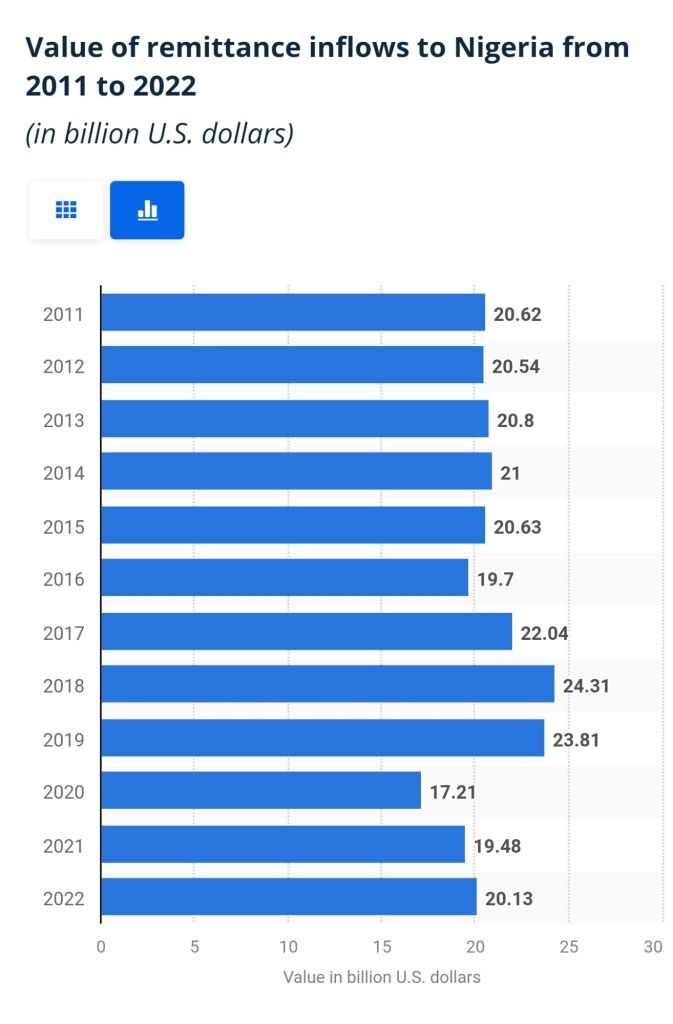
Comparing diaspora remittances to the Nigerian budget reveals interesting dynamics. The substantial inflow of remittances are sometimes almost at par with the federation budget, showcasing the magnitude of financial support from the diaspora.
In conclusion, diaspora remittances stand as a cornerstone of Nigeria’s economic growth, poverty alleviation, and societal stability. Their transformative impact underscores their pivotal role in driving the country’s development trajectory, making them an indispensable component of Nigeria’s present and future prosperity.
Chimazuru Nnadi-Oforgu
Duruebube Uzii na Abosi
 OBLONG MEDIA GLOBAL INTELLIGENCE
Leave a comment