

The Lagos-Calabar Coastal Highway project, spanning 700 kilometers across nine Nigerian states, has the ambitious goal of enhancing connectivity and economic activities from Lagos to Cross River. Despite its potential benefits, the project has been embroiled in controversy, raising concerns about the procurement process, the environmental implications, financial management, and the fairness in how it’s being executed.
The procurement process has come under fire with allegations of favoritism, particularly involving the Chagoury Group, known for its connections to high-profile political figures, including President Tinubu. Critics claim the contract may have been awarded without a competitive bidding process, potentially compromising the integrity of public procurement and governance.
Environmental and social impacts have also sparked significant backlash. The project’s initiation without a comprehensive environmental impact assessment has raised fears of potential irreversible damage to ecosystems and local communities. Additionally, the demolition of structures such as parts of the Landmark Beach Resort has ignited public uproar, underscoring a disregard for stakeholder engagement and appropriate compensation.

The prioritization of this costly new highway over the urgent need to maintain deteriorating roads throughout the country has also drawn criticism. Many argue that existing roads, in dire need of repair, should take precedence over new projects.
From a financial perspective, the project’s viability is questioned given its high costs—several billion Naira per kilometer. Furthermore, the implementation of expensive toll gates, charging up to N3,000, has been widely criticized for potentially increasing the cost of travel and goods transportation, which would disproportionately affect lower-income citizens and exacerbate economic inequalities.
Allegations of financial mismanagement have intensified concerns, with reports suggesting that up to 1 trillion Naira may have been disbursed under dubious circumstances. This has fueled suspicions that funds may have been diverted to favor private interests or political allies rather than serving the public good.
Addressing these controversies requires rigorous scrutiny to ensure transparency, accountability, and public engagement. This approach is essential not only for resolving current issues but also for setting a governance standard that supports sustainable and equitable development.
The project also raises broader questions about sustainable development in Nigeria. The absence of a thorough environmental impact assessment speaks to a broader disregard for sustainable practices in governmental projects, which could have long-term consequences for the country’s ecological health and its communities’ well-being.
There’s also public resistance to the proposed toll rates, highlighting the socio-economic implications of the project. High tolls could limit mobility for lower-income individuals and small businesses that rely on affordable transport routes for their livelihoods.
An interesting suggestion has emerged that the project should commence from both Lagos and Calabar simultaneously if there is genuine intent to complete it. This approach would ensure that development benefits are evenly distributed and could help dispel concerns that the highway is primarily intended to boost the economic fortunes of more politically dominant regions.
This dual starting point could also potentially speed up the project timeline, facilitate better management of resources, and address logistical or technical challenges more symmetrically across the diverse terrains and communities the road will pass through. Such a strategy might foster a more inclusive and transparent process, enhancing public trust in the project’s goals and administration.
The controversy over compensation claims and the alleged rerouting of a new highway project along Lagos’s beach shoreline is a complex set of issues. These issues are typical with large infrastructure projects where the government exercises eminent domain but struggles to reach agreements that satisfy all affected parties.
Additionally, it’s alleged that the highway’s original plan, which might have taken a less disruptive route along Water Corporation Road, was changed to follow a path closer to the beach. This shift could potentially cause more environmental damage and affect more businesses and landmarks, which are not only tourist attractions but also hold significant real estate value.
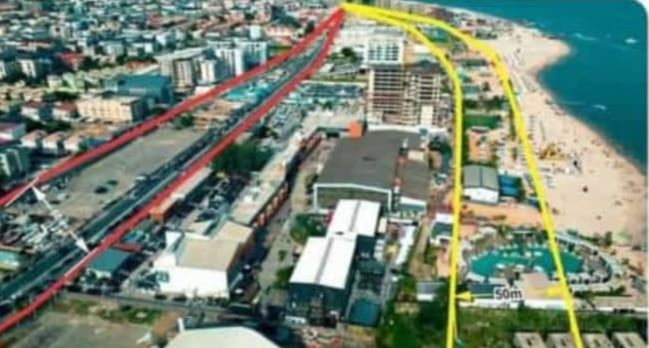
Not speaking specifically In defense of Lagos State, one might argue that the new route was chosen to enhance economic activity by improving access to the beach, a major tourist draw. Better road access could potentially boost tourist numbers and benefit the economy over the long term. The decision to alter the route might also be based on factors such as cost, feasibility, and technical considerations, suggesting that the alternative might have been less costly or easier to construct, despite the higher initial impact on existing landmarks and properties.
The government may also contend that all legal procedures for eminent domain and compensation were followed, including appropriate valuations and offers of compensation, even if the affected parties consider these inadequate. Furthermore, Lagos State might claim that there were sufficient consultations with stakeholders before the route was finalized, although affected businesses and property owners might dispute the adequacy and transparency of these consultations.

Moving a major highway closer to a shoreline can lead to significant environmental challenges, including potential harm to marine life and coastal ecosystems. Socially, it could change the area’s character, displacing local communities or altering the nature of local businesses. Thus, the controversy not only touches on the legality and fairness of compensation but also on the broader impact on the community and environment. These disputes underscore the need for greater transparency, improved stakeholder engagement, and a more comprehensive environmental impact assessment to ensure that the benefits of such projects are fairly distributed and do not disproportionately harm certain groups or ecosystems.
As Nigeria continues to develop, ensuring that major infrastructure projects are perceived as fair and beneficial to all parts of society is crucial for their success and acceptance. Engaging all stakeholders—including government agencies, civil society, and the affected communities—in meaningful dialogue is vital. These discussions should aim to promote a more transparent, accountable, and community-inclusive approach to national projects. Only through collective oversight and active participation can the potential benefits of such projects be fully realized, truly serving the broad public interest.
As it stands at the moment, nothing about this project is inspiring or encouraging. It simply doesn’t look good and gives room for speculation and controversy. Some would even ask, what’s the rush?
Hon Chimazuru Nnadi-Oforgu
Duruebube Uzii na Abosi
 OBLONG MEDIA GLOBAL INTELLIGENCE
Leave a comment