
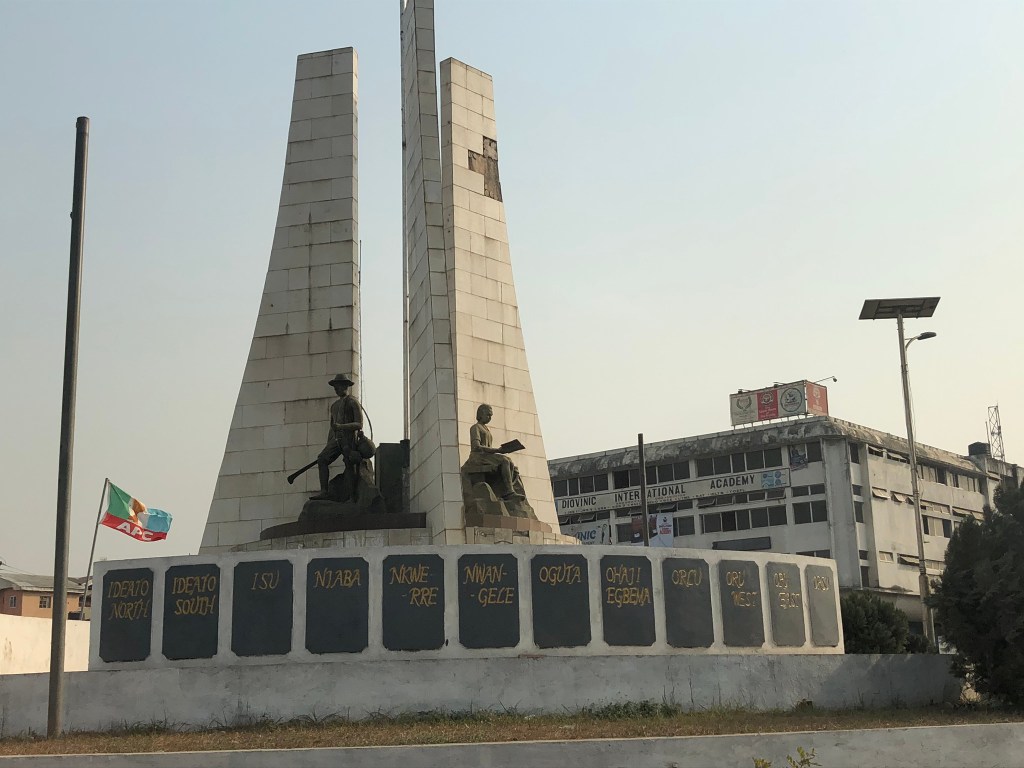

The “Imo Charter of Equity” as recently propounded, envisions a rotational governance system among the three zones, Orlu, Okigwe, and Owerri, with the intent to balance political power. There’s an understanding that the current governor from Orlu should pass the baton to Owerri zone for its eight-year term starting in 2027 to adhere to this charter.
Political dynamics within Imo State has triggered discussions on state creation and restructuring, largely driven by perceived imbalances and regional disparities. The Orlu zone, one of Imo State’s three senatorial districts alongside Owerri and Okigwe, has been the most politically dominant since 1999. This callous dominance has triggered underground discourse around state creation by the less dominant zone Owerri that feels completely marginalized.
Creating a state in Nigeria of course requires constitutional amendments, broad national consensus, and meeting stringent conditions, including legislative approvals and a referendum. Debates on state creation are shaped by factors like ethnic alignments, economic viability, and historical affiliations. In Imo State, these discussions are typically aimed at addressing injustices and achieving more equitable inclusive governance. As such, calls for a new state is likely to remain a key part of Imo State’s political dialogue and a viable option as the political wrangling for the 2027 elections continue
The Owerri zone and Ohaji/Egbema, if carved out as a new state, would seek to address these concerns.
In January, Hon. Benjamin Kalu, Deputy Speaker of the House of Representatives, announced that the amendment of the 1999 constitution would be finalized by December 2025. This process includes the complex requirements for state creation and boundary adjustments. According to Section 8(1) of the constitution, a new state can only be created if supported by at least a two-thirds majority in several crucial bodies, including both houses of the National Assembly, the state’s House of Assembly, and the local government councils of the area concerned, followed by a referendum and further legislative approvals.
Since 1999, when Nigeria returned to democratic governance, no new state has been created. However, given the ongoing political marginalization within Imo State, particularly of the Owerri and Okigwe zones by the dominant Orlu zone, there is a growing call for the creation of a new state. This would address the disparities and ensure equitable governance that has been successfully implemented in other Southeastern states through zoning and rotational governance systems. States like Enugu, Anambra, Ebonyi, and Abia have adopted zoning, which has enhanced political stability and fairness.
The political landscape in Imo State has been marred by divisive tactics and alleged secretive agreements that favor continued dominance by the Orlu zone, sidelining the Owerri and Okigwe zones. This imbalance has perpetuated injustice and inequity, with the Owerri zone governing for only 7 months since the dawn of the Fourth Republic 25 years ago. The establishment of a new state would not only rectify these long-standing injustices but also promote peace and unity by aligning with democratic principles of fairness and equal opportunity in governance.
As discussions around constitutional amendments and state creations advance, it is imperative for stakeholders across all zones in Imo State to champion a new state creation. This move will safeguard the interests of marginalized zones and uphold the principles of equity and justice, ensuring that every part of Imo State has an equal opportunity to contribute to and benefit from its governance.
Other states in the Southeast have, to the best of their abilities, addressed issues of equity and social justice in their governance. Notably, Enugu State has established a gentlemanly zoning arrangement for the governorship. To date, four governors from the three different zones have led the state: Chimaroke Nnamani from Enugu East, Sullivan Chime and Ifeanyi Ugwuanyi from Enugu Central and Enugu North, respectively. The current governor, Peter Mba, from Enugu East, has restarted this cycle.
Despite challenges, this balance is essential, given our democratic realities and the subtle “winner takes all” mindset.
Anambra State has also embraced this equity principle in its gubernatorial decisions and elections. Former governors Chinwoke Mbadinuju and Virginia Etiaba are from Anambra South, while Peter Obi and Chris Ngige are from Anambra Central, and Willie Obiano is from Anambra North. Recently, due to Anambra South not completing its allowed eight-year term through Mbadinuju, all major parties in the their last election primarily nominated candidates from Anambra South. That election resulted in former CBN governor Professor Chukwuma Soludo getting elected as governor.
Similarly, Ebonyi State has a long standing zoning arrangement for the governorship. Governor Sam Egwu from Ebonyi North governed the state from 1999 to 2007. He was succeeded by Martin Elechi from Ebonyi Central, who led from 2007 to 2015. Governor, Dave Umahi from Ebonyi South, took office in 2015 and led till 2023, and has been succeeded by the incumbent Ogbonna Nwifuru from Ebonyi North, thus continuing the cycle.
Even Abia State adheres to a zoning/equity arrangement for the office of the Governor. Former governor Orji Uzor Kalu from Abia North governed from 1999 to 2007, succeeded by Theodore Orji from Abia Central from 2007 to 2015, allowing his zone to complete an eight-year term. Governor, Okezie Ikpeazu from Abia South, was in office from 2015 -2023, and is currently succeeded by Dr. Alex Otti, a model governor from Abia North, reaffirming the cycle.
It is crucial to recognize how equity, justice, and fairness have maturely and democratically taken root in all other states of the Southeast, except in Imo State. Here, despite a longstanding gap of unjust, unfair, and inequitable imbalance, unsanctioned sycophant politicians deceitfully and self-servingly distract our current governor, Distinguished Senator Hope Uzodinma, and urge him to further marginalize and dominate other zones. This includes rumours of alleged plotting and selling of a dummy to the governor to pass the baton of governance to the sitting Orlu zone senator in 2027, so the governor can return to the Senate. Such action, if true, would further extend the Orlu zone’s tenure, whereas the Owerri senatorial zone has only governed for 7 months since the start of the 4th republic in 1999. It should be noted that his plot or ploy if true would definitely not be tolerated and would most likely facilitate a resultant long yearned creation of a new state.
Imo State’s situation, where the Owerri senatorial zone (Imo East) is the only zone in southern Nigeria that has not governed for a full term since the 4th republic began, should not only be discouraged but also condemned and actively resisted by the other marginalized zones. The unity of Imo State, and preventing a state split, hinges on people of honor, integrity, and conscience from all three zones and the multipartisan political populace coming together to establish a zoning formula by supporting Owerri zone (Imo East) to govern the state in 2027. This would correct the political imbalance and uphold the callously andgreedily discarded doctrine of equity.
This is not a threat but a piece of valuable advice to help maintain our state as one. Owerri zone, democracy or not, will not stand by and continue to witness this brazen, calculated marginalization, offshooted by the displacement of Humphrey Anumudu in 1998, the injustices of the disrupted 2007 elections which ousted Martin Agbaso as governor, and the Supreme Court disruption of the 7-month tenure of Rt Hon Emeka Ihedioha.
Is the Owerri zone truly integral to Imo State? Considering it has only ruled for 7 months while the Orlu zone has held power for almost 24 years, and the Okigwe zone for 4 years since 1999, where is the equity, fairness, and justice? Despite the good works of the current Orlu zone governor, would it be fair to allow the Orlu zone to extend its stint in power beyond 24 years? Where are the people of the Owerri and Okigwe zones? Are they this gullible? Are they asleep?
It is my solemn appeal to Owerri and Okigwe zone’s compromised status quo proponents to refrain from activities that could destroy the foundation of Imo State. Let us demonstrate the capacity to challenge the domination of Imo State by a political clique by being responsible and responsive to the clarion call to respect the Imo Charter of Equity. This will help facilitate the transfer of power to the Owerri zone as publicly avowed by the governor.
Thank you.
Duruebube Uzii na Abosi
Chimazuru Nnadi-Oforgu
 OBLONG MEDIA GLOBAL INTELLIGENCE
Leave a comment