

Today, June 14, 2024, the people of Ohaji made their voices heard.
The entire Communities and social cultural groups from Ohaji clan in Imo State have rejected to be included in the proposed new state in South-East which has passed first reading at the Green chamber, being majorly sponsored by a House of Representative member, Hon. Ikenga Imo Ugochinyere, from Imo State.
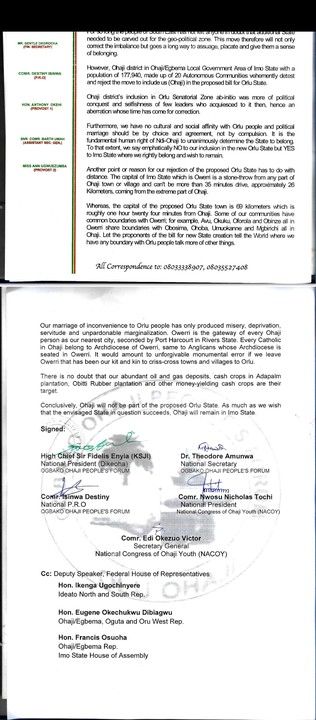
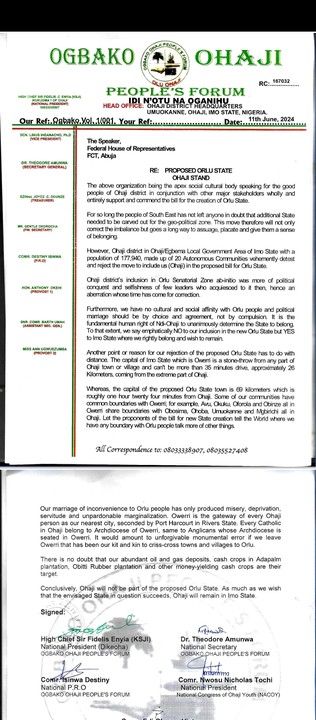
Attached are the Letters coming from Ogbako Ohaji and “Awarra Court Area”, which represents the Elders and Youth bodies respectively.
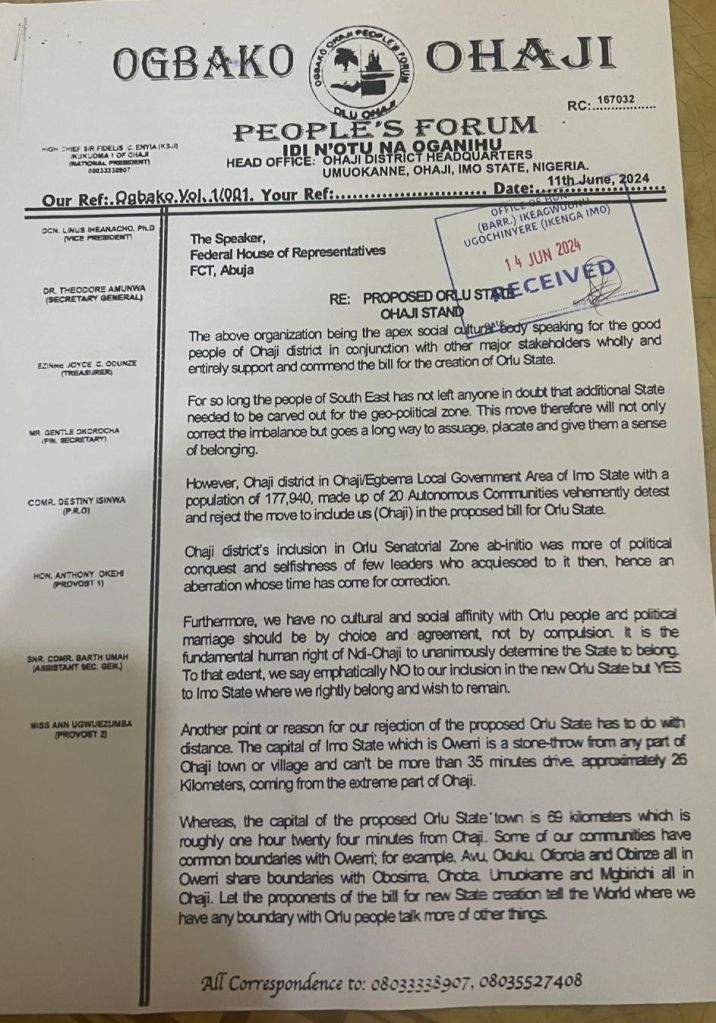
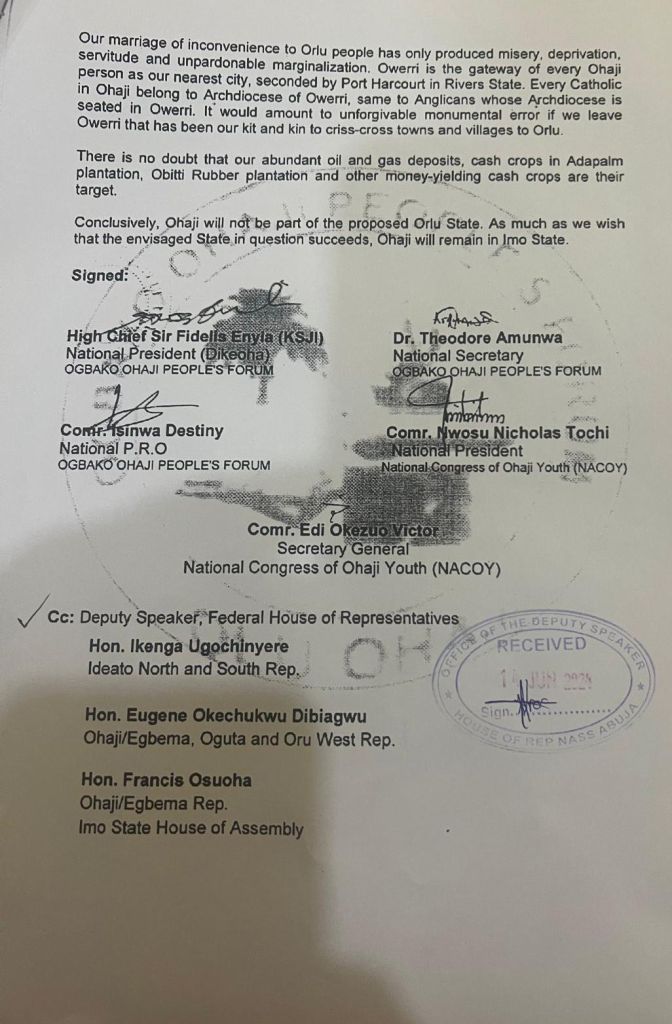
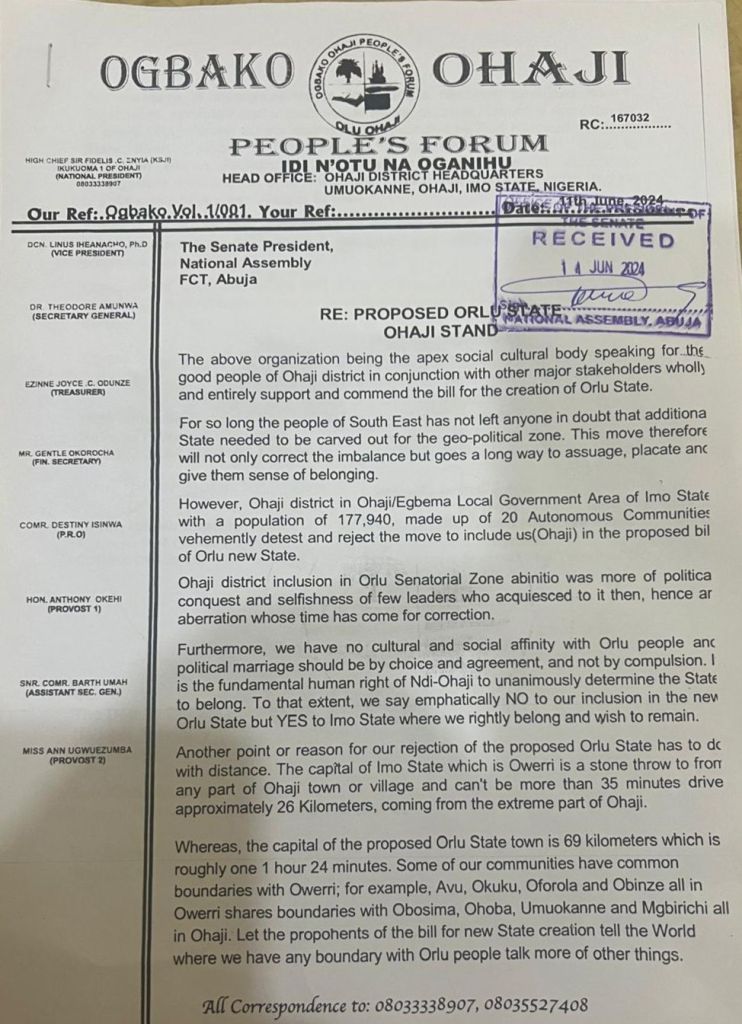
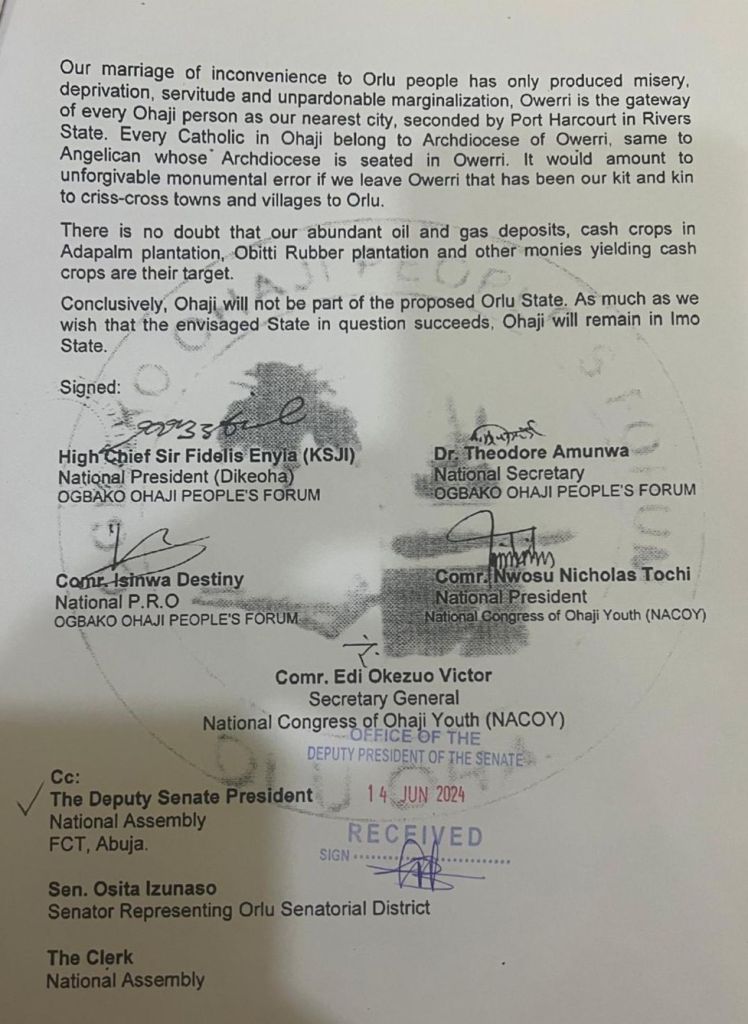
They submitted their letter of protest to both the Senate President and the House Speaker, expressing their opposition to the inclusion of their area in the proposed Orlu State. This protest is not merely about administrative boundaries; it is about cultural identity, historical experience of neglect and marginalisation, and future aspirations. The letter was also copied to the Orlu Senator, Osita Izunaso, the Federal House member Hon. Eugene Dibiagwu, and Hon. Ikenga Ugochinyere.
The proposed Orlu State has sparked significant controversy, particularly among the people of Ohaji/Egbema/Oguta. Last month, the people of Ohaji staged a protest, storming the council headquarters at Mmahu with placards reading “Orlu is a dead state project,” “No to Orlu State,” and “Count Ohaji people out of Orlu State.” This underscores their strong opposition. The central argument is clear: Ohaji has no cultural or historical ties with Orlu, an area that is 69 km away, unlike Owerri, which is within a 5-25 km radius and shares close cultural affinities with them.
A History of Marginalization and Exploitation
For 25 years, Ohaji has been part of Imo State. During this period, the leadership of Imo State has been dominated by individuals from Orlu, who have ruled for 21 years and five months. Despite this prolonged governance, the benefits to Ohaji/Egbema have been minimal, if not entirely completely absent. This is particularly egregious considering Ohaji/Egbema is the cash cow of Imo State, contributing significantly through its oil and gas resources.
One glaring example is the polytechnic that once served the region. This institution, a beacon of education and opportunity, was relocated by an Orlu indigene, depriving the local youth of accessible higher education. Similarly, the Oguta Motel, an impressive establishment featuring a three-star hotel and an international golf course, was converted into military barracks. This transformation stripped the region of a significant source of employment and revenue, demonstrating a blatant disregard for local needs.
Governor Uzodinma did build a few hospitals, but the roads remain neglected, and schools are still totally dilapidated. Contracts awarded for renovation and new constructions of new school blocks were stalled midway and abandoned, leaving the communities without the promised improvements.
Economic Exploitation
Adapalm, once a flourishing enterprise, now lies in ruins. Over the past 21 years, the only benefits the people of Ohaji/Egbema have seen are allocations granted to Orlu kinsmen for palm fruit collection. This preferential treatment has hindered the region’s economic growth and development. The resources, including oil and palm produce, have been extracted and exploited, leaving the region with bad roads and a backward environment.
The fear among the people of Ohaji is that inclusion in the proposed Orlu State will only exacerbate their exploitation and marginalisation. They believe that Orlu’s leadership has consistently milked their resources, offering little in return in terms of development and critical infrastructure . The creation of Orlu State, they argue, will merely provide a new administrative framework for continued exploitation.
Cultural and Geographic Disconnection
The cultural and geographic disconnect between Ohaji and Orlu cannot be overstated. The proximity and cultural affinity with Owerri make it a more suitable alignment for the people of Ohaji Owerri is a mere 5-35 km away depending on where you are coming from and considering the very bad roads, compared to the distant 69km separation from Orlu. This proximity fosters cultural exchange, economic interactions, and social bonds that have been historically significant.
Seeking a Better Future
The preference of many in Ohaji/Egbema/Oguta is clear: they would rather be part of a larger Owerri zone, aligning with their Owerri kin in Imo State. This preference is rooted in the belief that an Imo State without the Orlu zone offers better opportunities for fair treatment and development. The promise of alignment with the Owerri zone, with its established infrastructure and the promise of fair and equitable governance, seems a more viable option for a prosperous future.
However, Oguta, being closer to Orlu, might choose to remain in Imo State if they please, allowing the new Orlu State to have an oil-producing area. This decision is up to Oguta, but it should not force Ohaji and Egbema into a union they do not desire. Despite being major oil and gas domains in Nigeria, Ohaji, Egbema, and Oguta have nothing to show for it due to prolonged neglect and exploitation.
Conclusion
The inclusion of Ohaji/Egbema/Oguta in the proposed Orlu State is met with staunch opposition for valid reasons. The historical marginalization, cultural disconnect, and economic exploitation experienced under Orlu’s dominance fuel this resistance. The people of Ohaji/Egbema/Oguta demand a future where their resources are not exploited, where their cultural identity is respected, and where their economic potential is nurtured.
This protest is a powerful statement of their desire for self-determination and a better future. It is a call for careful consideration of the proposed administrative changes, ensuring that they serve the genuine interests of the people and not perpetuate the cycle of exploitation. The voice of Ohaji/Egbema/Oguta must be heard and respected at this critical juncture of their history.

 OBLONG MEDIA GLOBAL INTELLIGENCE
Leave a comment