
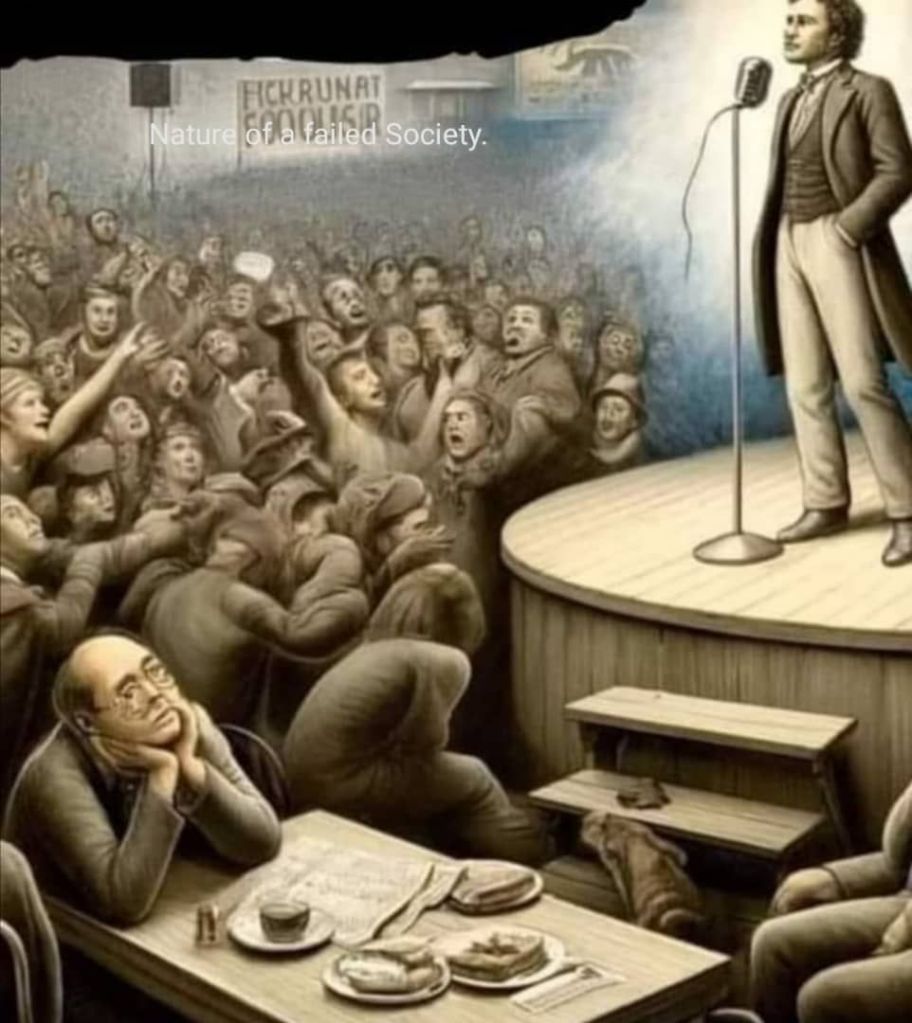
When asked about the nature of failed societies, the renowned Russian writer Anton Chekhov poignantly observed:
“In failed societies, there are a thousand fools for each successful brain and a thousand clumsy words to counter each piece of good advice.”
Chekhov’s insights reveal a profound truth about the dynamics that undermine societal progress. Failed societies are characterized by a dominant majority that is often uninformed, self-centered, and overpowering the rational and intelligent minority. These societies thrive on trivializing critical issues to avoid confronting their harsh realities.
Meetings in such societies are frequent but unproductive, often devolving into sessions of banter and jokes, effectively preventing diligent scrutiny of important matters. Leadership is typically held by cliques, cabals, and a few unserious individuals, leaving the majority disenchanted, disgruntled, and uninterested.
Failed societies resemble cult groups where gangsters are the majority, extorting from a few individuals with inflated egos who crave public attention, unaware they are being manipulated. This dynamic creates a society of pacifiers and nonentities, where trivial matters take center stage, and any attempt to address real challenges is vehemently resisted. Such societies live in a constant state of denial.
An example of a failed society is one where millions gather repeatedly, dancing and repeating meaningless songs and words, turning this behavior into a societal culture. In these societies, everyone has their own opinions, which are never articulated or synthesized. Constructive, sound, and workable ideas are consistently suppressed, allowing a mischievous cabal to maintain dominance.
Favoritism and rewards for patronage are rampant in failed societies, while merit is sabotaged. Injustices and praise-singing are commonplace. Leadership thrives on information hoarding and secrecy, with accountability regarded as a privilege rather than a right. Open conversations are frowned upon and seen as attacks against leadership, and demanding accountability is forbidden.
Gang leaders in these societies love to quote laws in a lawless environment governed by caucus decisions. The minority pretends to be the majority, using divide-and-rule tactics, rumor-mongering, and emotional blackmail to govern. Those with honest intentions to promote the common good are quickly labeled as saboteurs and isolated to prevent them from influencing the dormant majority.
Genuine contributors and solution providers are rarely recognized or credited for their efforts. Failed societies lack an attitude of gratitude, and the populace prefers those who entertain them with meaningless jokes over those who challenge them with harsh truths.
Thus, the concept of ‘democracy’ becomes problematic in unenlightened societies, as the corrupt minority continues to decide the fate of the majority. True salvation and redemption must come from within the people themselves before they can yield to effective leadership. In constructive leadership, no one is above others; leaders are integral members of the society they serve.
Toba Joshua, the convener of the Brain Bridge National Network (BBNN), advocates for bridging the generational knowledge gap and fostering a society where enlightenment and rationality prevail over ignorance and triviality.
 OBLONG MEDIA GLOBAL INTELLIGENCE
Leave a comment