
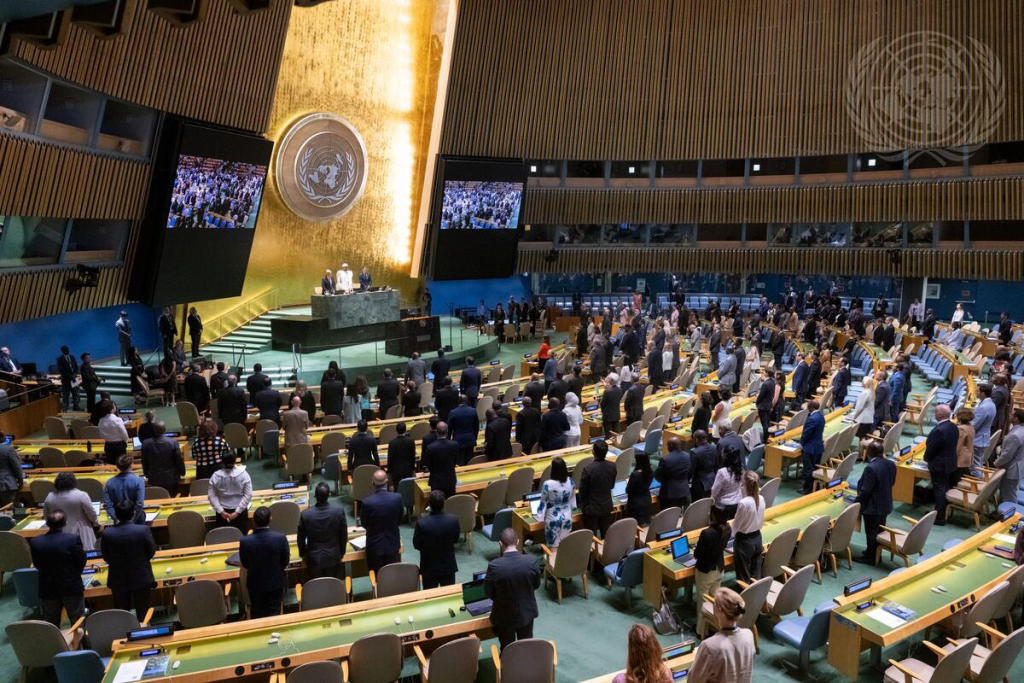
On September 18th, the UN General Assembly will debate and vote on a pivotal resolution calling for Israel to end its “unlawful presence in the Occupied Palestinian Territory” within six months. Unlike the exclusive 15-member UN Security Council, where veto power plays a critical role, the General Assembly allows all members to vote without the risk of a veto. This is a rare opportunity for the global community to take a united stance against Israel’s occupation of Palestine.
If Israel ignores the resolution, as many expect, and the United States blocks any Security Council enforcement, the General Assembly could take further action. Through an Emergency Session, they could invoke the Uniting for Peace resolution, potentially resulting in sanctions, arms embargoes, or even actions against the United States. Historically, this resolution has only been used five times since 1950.
The upcoming vote follows a historic ruling by the International Court of Justice (ICJ) on July 19, declaring Israeli settlements in the West Bank and East Jerusalem illegal under international law. The ICJ further ruled that Israel is obliged to evacuate all settlers from these areas and pay restitution to those harmed by its occupation. A strong General Assembly vote in favor of the ICJ ruling would send a powerful message that the world demands accountability.
However, Israeli President Netanyahu dismissed the ruling, stating, “The Jewish nation cannot be an occupier in its own land,” despite the ICJ’s clear rejection of this claim. Israel’s military occupation since 1967 does not give it the right to annex these territories or settle its population there.
The article highlights the ongoing violence in Gaza and the West Bank, where Israeli forces and settlers, armed and unchecked, have been seizing land and killing Palestinians, with at least 700 deaths recorded in the past year. This brutal escalation has prompted even the U.S. and European governments to impose sanctions on a few violent settlers, though these actions are largely symbolic.
The Palestinian Health Ministry reports over 41,000 deaths in Gaza in the past 11 months due to Israeli military attacks, a number expected to rise significantly. The authors argue that both Israel and the U.S. are becoming increasingly isolated on the global stage for their roles in this ongoing genocide.
The U.S. claims to be a mediator in ceasefire negotiations but continues to use its influence to undermine any progress toward peace. Its unwavering support for Israel has long been the key obstacle to a free Palestine, and its involvement in the Gaza crisis is far from neutral. By supplying Israel with the weapons, intelligence, and logistical support necessary for its military operations, the U.S. plays an active and essential role in the violence.
In contrast, China has fostered a more constructive dialogue between Palestinian factions, leading to an agreement in Beijing for a post-war national unity government. This approach, aimed at rebuilding Gaza and organizing elections, represents a stark difference from the U.S.’s efforts to install the Fatah-led Palestinian Authority, which is widely seen as corrupt and subservient to Israel.
As the General Assembly convenes on September 18, the world faces a historic challenge and an unprecedented opportunity. For decades, the U.S. has used its veto power to shield Israel from accountability. The ability of a single nation to block the will of the global community has been widely criticized as the fatal flaw of the UN system. Now, with 145 of the UN’s 193 member nations recognizing Palestine, there is a growing consensus that action must be taken.
The authors argue that the U.S. is not merely complicit but plays an active role in the genocide, providing the critical resources that enable Israel’s war against Palestinians. Ending this genocide requires the U.S. to stop its involvement—not by offering hollow critiques of civilian casualties but by halting its supply of weapons and military support to Israel.
As global citizens, we must continue to pressure our governments to act, but if the U.S. persists in blocking meaningful progress, it falls to the world community to unite and take action. A decisive vote at the General Assembly on September 18 could be a vital first step toward ending the long-standing occupation and violence against Palestine.
By Medea Benjamin and Nicolas J. S. Davies
Medea Benjamin is the co-founder of CODEPINK for Peace and the author of several books, including Inside Iran: The Real History and Politics of the Islamic Republic of Iran. Nicolas J. S. Davies is an independent journalist, a researcher for CODEPINK, and the author of Blood on Our Hands: The American Invasion and Destruction of Iraq.
Copyright © Medea Benjamin and Nicolas J. S. Davies
#oblongmedia
 OBLONG MEDIA GLOBAL INTELLIGENCE
Leave a comment