
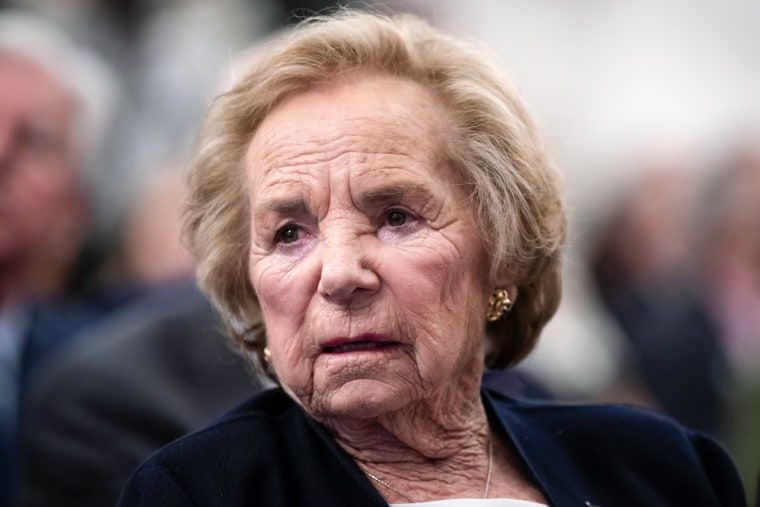
Ethel Kennedy, the wife of Senator Robert F. Kennedy, lived a life marked by both exuberance and profound tragedy. Known for her gregarious and feisty nature, Ethel was an integral part of the “Camelot” mystique of the 1960s, a time when the Kennedy family loomed large over American politics. Yet, her story is equally one of resilience—shaped by immense personal loss, she continued to carry forward the causes her husband championed, remaining an active force for justice and equality throughout her life.
Ethel’s defining moment came on June 5, 1968, when her husband, Robert, was shot in the kitchen of the Ambassador Hotel in Los Angeles, just after delivering a speech. Ethel, then three months pregnant with their eleventh child, was just a few feet away. As chaos erupted, she pushed through the crowd and knelt beside him, comforting him in his final moments. Robert succumbed to his injuries the following day.
In the immediate aftermath, Ethel remained a pillar of strength. She organized Robert’s funeral and, as iconic photographs show, led mourners in a black veil with remarkable dignity. As one profile of her noted, “There was something indomitable about Ethel,” a quality that would define her in the years to come.
A Life of Tragedy and Triumph
Born Ethel Skakel in Chicago in 1928, she was the sixth of seven children in a wealthy, rambunctious, and devoutly Catholic family. Her father, George Skakel, was a self-made millionaire in the coal industry, but he was also an alcoholic, adding a layer of complexity to her childhood. Her family, much like the Kennedys, embraced sports, competition, and adventure, though they were staunch Republicans.
Ethel was educated in elite Catholic institutions, including Greenwich Academy and Manhattanville College, where she befriended Jean Kennedy, Robert’s sister. This connection led to her first encounter with Robert at a family skiing holiday in 1945. Though Robert was initially dating Ethel’s older sister, Patricia, he later turned his affections toward Ethel. They married in 1950, with the Pope’s blessing, and soon started a large family—Ethel would go on to have 11 children.
Tragedy struck early in their marriage when Ethel’s parents died in a plane crash in 1955, leaving her to navigate life without their support. But she threw herself into family life and the vibrant social and political world of the Kennedys, becoming a key figure in John F. Kennedy’s campaigns and, later, in Robert’s political career.
Their home, Hickory Hill, became a bustling center of Washington’s social scene, hosting lively parties with guests ranging from Judy Garland to John Lennon. Ethel was a dynamic hostess, known for her irreverence and love of fun. She embraced her role as the wife of an attorney general when Robert was appointed by his brother John after winning the presidency in 1960.
Carrying on the Kennedy Legacy
The assassination of President John F. Kennedy in 1963 devastated the family, especially Robert. For six months, he was engulfed in what Ethel called “blackness,” but eventually, he returned to public service, running successfully for a U.S. Senate seat from New York in 1964. Ethel was a constant presence at his side, advocating for civil rights, social justice, and his eventual presidential run in 1968.
But Robert’s assassination later that year changed the course of Ethel’s life forever. Despite the immense public sympathy that followed, she kept a low profile and focused on raising her children, several of whom struggled with the pressures of being part of the Kennedy legacy. Two of her children died in tragic circumstances: David from a drug overdose in 1984, and Michael in a skiing accident in 1997.
Ethel never remarried, choosing instead to devote herself to her husband’s legacy and public causes. She founded the Robert F. Kennedy Center for Justice and Human Rights and became a prominent figure in various political movements, from gun control to civil rights. Even in her later years, she remained a staunch advocate for justice. At the age of 90, she participated in a 24-hour hunger strike to protest President Trump’s policies on migrant children, showing her enduring commitment to fighting injustice.
A Stoic Matriarch
By the time of her death at 96, Ethel Kennedy had long replaced her mother-in-law, Rose Kennedy, as the great matriarch of the family. Though she endured more tragedy than most, she never allowed herself to dwell on her pain, embodying the stoic resolve that had become synonymous with the Kennedy name. In 2014, she was awarded the Presidential Medal of Freedom for her contributions to social justice and human rights.
Ethel’s life was a testament to her ability to forge ahead despite overwhelming loss. As her youngest daughter, Rory, once said, “She kind of forges ahead and moves on.” Religious and devout to the end, Ethel rarely spoke publicly about her personal tragedies, preferring to focus on the causes that mattered to her.
Ethel Kennedy, the gregarious and indomitable wife of Robert F. Kennedy, passed away on October 10, 2024, after suffering a stroke. She is survived by her children and countless grandchildren, as well as a legacy of unwavering commitment to justice and equality.
Ethel Kennedy, human rights activist and widow of Robert Kennedy, was born on April 11, 1928. She died on October 10, 2024, aged 96.
By The Times | October 10, 2024
 OBLONG MEDIA GLOBAL INTELLIGENCE
Leave a comment