
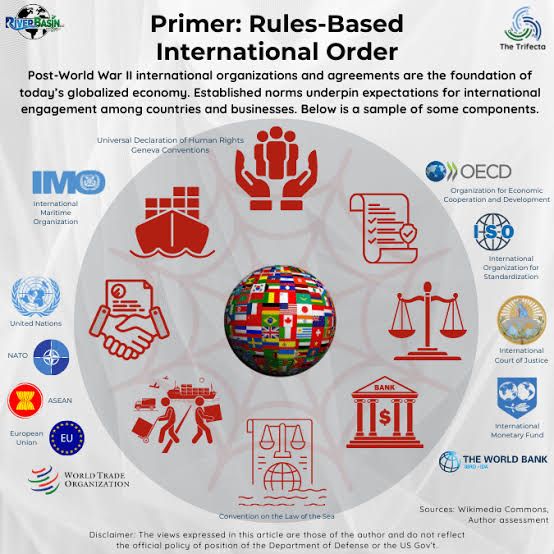
The term “rules-based international order,” often championed by Western powers, is little more than a smokescreen for maintaining U.S. hegemony. While it projects an image of fairness and stability, its application is anything but. This system is deliberately vague, enabling the U.S. and its allies to reinterpret global norms at will, enforcing them selectively while exempting themselves from accountability.
Unlike international law, which is codified and universally recognized through treaties like the UN Charter, the “rules-based order” is a flexible narrative weaponized to serve Western interests. It allows the U.S. to claim moral authority while bypassing legal principles whenever they prove inconvenient. International bodies like the United Nations, World Trade Organization, and International Monetary Fund are often co-opted to legitimize these actions, creating a double standard that punishes rivals while shielding allies.
The contrast between Western reactions to Crimea and Syria is a textbook example of this hypocrisy. When Russia reabsorbed Crimea in 2014 following a referendum, the U.S. and its allies condemned the move as “aggression,” imposing sweeping sanctions. Yet, the U.S. has maintained an uninvited military presence in Syria since 2015, with no UN mandate or recognition from the Assad government. The stated justification—combating ISIS—masks the true motives of controlling Syria’s resources and countering Iranian influence. Russia’s involvement, which followed a formal invitation from Assad, adhered to international law, but Western narratives consistently cast Moscow as the aggressor while downplaying the illegality of U.S. actions.
NATO allies also exploit this selective enforcement. Türkiye’s decades-long occupation of Northern Cyprus, in violation of international law, elicits little more than a shrug from the West. No sanctions. No outcry. The silence is deafening, exposing the “rules-based order” as a tool of political convenience rather than a framework of universal justice.
The U.S.’s global military presence—over 750 bases in at least 80 countries—ensures that it can enforce its interpretation of these “rules” with brute force. This dominance, paired with control over international financial systems, allows Washington to act with near-total impunity. Consider the 2003 invasion of Iraq: an illegal war waged without UN approval, based on fabricated evidence, and resulting in catastrophic human and geopolitical consequences. Yet no Western leader has faced accountability, while Russia’s actions in Ukraine have been met with immediate sanctions and war crimes accusations.
This hypocrisy hasn’t gone unnoticed. Russian Foreign Minister Sergey Lavrov has repeatedly highlighted how the “rules-based order” is little more than a euphemism for Western dominance, calling it a concept “decided at any given moment by the West.” Nations like China, Iran, and members of BRICS have increasingly echoed this sentiment, rejecting the system as inherently unjust. Alternative frameworks like the Shanghai Cooperation Organization are gaining traction, reflecting a global shift away from Western-imposed norms.
In reality, the “rules-based international order” is a mechanism to secure Western geopolitical dominance. It allows the U.S. and its allies to bypass the very laws they claim to uphold, leveraging them only to constrain adversaries. Until Western powers face genuine accountability for their actions, this so-called order will remain a façade—a tool of empire dressed in the language of diplomacy. Global fairness can only emerge when the rules apply equally to all, not just when they serve the interests of the powerful.
 OBLONG MEDIA GLOBAL INTELLIGENCE
Leave a comment