

Dele Giwa, a prominent Nigerian journalist and founding editor of Newswatch magazine, was assassinated by a letter bomb delivered to his home in Lagos on October 19, 1986. This tragic and unprecedented event shocked the nation and raised serious questions about the role of the state in suppressing dissent. Shortly after Giwa’s murder, Chief Gani Fawehinmi, a renowned human rights lawyer and activist, took a bold stand, accusing two top military officials in General Ibrahim Babangida’s administration, Colonel Halilu Akilu and Lieutenant Colonel A.K. Togun, of involvement in the assassination.
Fawehinmi’s audacity was both celebrated and criticized. Many considered his decision to directly challenge the military elite reckless, even suicidal, given the political climate of the time. Notably, many of Giwa’s close allies distanced themselves from Fawehinmi, unwilling to confront the powers he dared to take on. Yet, Gani persisted, publishing a book titled The Murder of Dele Giwa: The Right of a Private Prosecutor, in which he detailed his quest for justice. The book was promptly confiscated by the military regime, underscoring the risks he faced.
Fawehinmi’s legal activism focused on ensuring that the suspected perpetrators of Giwa’s murder were brought to justice. However, the criminal proceedings against Akilu and Togun were halted indefinitely. While this was ongoing, the two military officials turned around and sued Fawehinmi for libel, claiming that his accusations had defamed them.
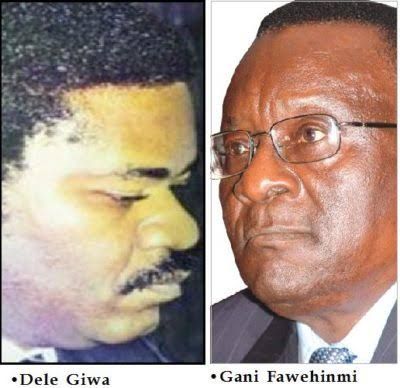
Fawehinmi filed an application to stay proceedings in the libel case, arguing that the civil matter should not proceed while the criminal case—upon which the libel allegations were based—remained unresolved. His argument was simple: how could he defend himself in a civil court for making assertions that the criminal court had yet to rule upon? The case escalated to the Supreme Court of Nigeria.
I had the privilege of witnessing Fawehinmi argue his case before the Supreme Court. He presented an unforgettable analogy, telling the justices:
“My Lords, if you say the libel case must proceed while the criminal case is stayed, it is akin to tying my hands and legs and asking me to jump a pole vault.”
Despite his compelling argument, the Supreme Court ruled against him, allowing the libel case to continue. When Fawehinmi emerged from the courtroom, people came to congratulate him. Surprised, he asked why they were congratulating him since he had lost. One supporter replied, “Chief, moral victory is the best, and you scored it today.”
Following the judgment, Fawehinmi was ordered to pay six million naira in damages to Akilu and Togun. In response, he declared, “I don’t have six million. I will have to sell everything I own to raise that.” This prompted Dr. Tai Solarin, a fearless social critic and educationist, to found the Gani Fawehinmi Solidarity Association (GFSA), a movement committed to support Fawehinmi’s cause.
In 1989, Gani Fawehinmi was charged before the Transition to Civil Rule (Anti-Sabotage) Tribunal in Lagos, accused of sabotaging General Ibrahim Babangida’s transition program. A formidable legal defense team comprising over 270 lawyers, led by Chief G.O.K. Ajayi (SAN) and including Alao Aka-Bashorun, the Nigerian Bar Association (NBA) President (1987–1989), represented him.
While standing trial before the tribunal, Fawehinmi was convicted of contempt of court in 1990 by the late Justice Ligali Ayorinde of the Lagos High Court. The conviction stemmed from his insistence that the judge recuse himself from a defamation case involving Colonel Haliru Akilu and Lieutenant Colonel A.K. Togun, whom Fawehinmi had accused of complicity in the death of journalist Dele Giwa. Fawehinmi was sentenced to imprisonment and, in a move seen as deeply humiliating, was brought before the tribunal wearing his prison uniform as Prisoner J 60.
This indignity, however, did not deter him. Instead, it fortified his unwavering resolve to fight for justice, no matter the personal cost.
Between 1981 and 1984, Fawehinmi was twice brought before the Legal Practitioners Disciplinary Committee but emerged victorious on both occasions, further cementing his reputation as a relentless advocate for justice.
Reflecting on these events today evokes a profound sense of déjà vu. The parallels with the persecution of Dele Farotimi are striking. Gani Fawehinmi’s story serves as a timeless reminder that while evil may appear to prevail momentarily, truth ultimately triumphs. His unwavering courage and selfless sacrifice stand as a powerful testament to the enduring strength of justice and the resilience of those who dare to speak it.
 OBLONG MEDIA GLOBAL INTELLIGENCE
Leave a comment