
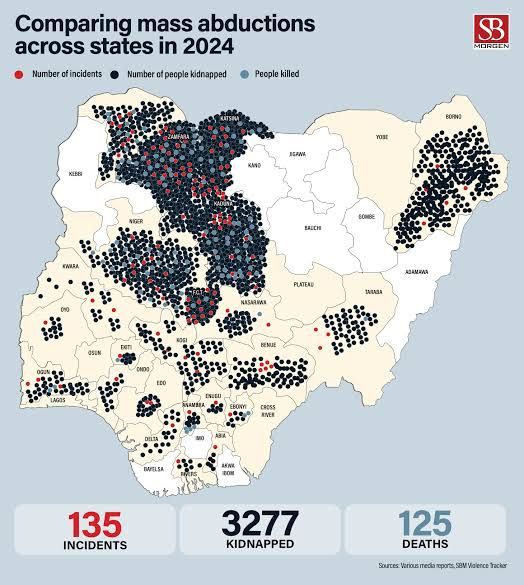
The staggering revelation that over ₦2.23 trillion was paid as ransom for kidnappings in Nigeria between January and November 2024 highlights the alarming scale of the country’s insecurity crisis. Released by StatiSense, using data from the National Bureau of Statistics (NBS) and the Centre for Economic and Social Policy Studies (CESPS), this figure reflects both the financial burden and the societal breakdown caused by kidnapping-for-ransom, now a thriving criminal industry.
Kidnapping has evolved into a lucrative enterprise, fueled by unemployment, poverty, and a failing security infrastructure. However, a key aspect that cannot be ignored is the rumoured complicity of Nigeria’s security forces. It stretches credulity to believe that kidnappers operate freely, transporting victims through hundreds of security checkpoints without some form of tacit approval or cooperation. On roads where checkpoints are spaced just 200–300 meters apart, the frequency of abductions raises uncomfortable questions about the role of those charged with protecting citizens. This alleged complicity has further emboldened criminal groups, who exploit both systemic corruption and the desperate inability of families to refuse ransom demands.
The economic impact of this crisis is immense. Ransom payments divert significant resources away from productive activities that could boost Nigeria’s economy. Families are forced to liquidate savings, sell assets, or borrow money to secure the release of their loved ones, deepening financial instability and perpetuating cycles of poverty. Communities living under constant threat of abductions are unable to engage in agriculture or small businesses, worsening food insecurity and rural economic decline. Additionally, the perception of Nigeria as unsafe has severely dented foreign investment, as companies avoid regions plagued by kidnappings and weak security responses.

Behind these figures lies a tragic human cost. The trauma endured by victims and their families cannot be quantified. Kidnappings have become a tool of terror, breaking families emotionally and financially, while instilling a paralyzing fear in entire communities. The normalization of abductions has created a culture of silence and hopelessness, as people lose faith in the government and law enforcement to provide protection or justice.
The factors driving this crisis are complex. Rising unemployment leaves millions of youths susceptible to criminality. Marginalized rural communities, long neglected by development efforts, lack opportunities for education or employment. Additionally, the proliferation of firearms has empowered criminal groups, making abductions easier to execute and more dangerous to confront. However, the role of Nigeria’s security forces in enabling this crisis cannot be overlooked. The existence of numerous checkpoints, particularly on major roads, should make large-scale kidnappings nearly impossible. Instead, these checkpoints often become sites of extortion, where bribes take precedence over security, while kidnappers pass through undisturbed. The whispered complicity of some officials — whether through negligence, corruption, or active participation — undermines public trust and emboldens criminals to operate with near impunity.
This systemic failure raises broader questions about accountability and governance. Why has Nigeria’s vast security apparatus failed to curb the rise of kidnapping? Is it a matter of insufficient funding, deliberate inaction, or a deeper rot within the system? Addressing these questions is critical to dismantling the ransom economy that has flourished unchecked.

At the core of this crisis is the desperate need for systemic reform. Strengthening Nigeria’s security framework requires more than just rhetoric — it demands a clean-up of compromised institutions, improved intelligence sharing, and the deployment of modern surveillance technologies to track and neutralize criminal groups. Beyond security measures, the root causes of kidnapping must also be addressed. Youth unemployment, widespread poverty, and the neglect of rural areas have created fertile ground for criminal enterprises. Without meaningful investments in job creation, education, and rural development, kidnapping will remain an attractive option for many.
The rumoured complicity of security forces must be investigated and addressed head-on. There is an urgent need for independent oversight mechanisms to monitor checkpoints, track the activities of law enforcement, and hold those complicit in kidnappings accountable. Civil society organizations, traditional leaders, and local communities must also play a role in exposing corruption and creating grassroots resistance to criminal activities.
Nigeria cannot afford to continue along this path. The ₦2.23 trillion paid in ransom between January and November 2024 is not just an economic loss; it represents the cost of systemic failure, insecurity, and human suffering. It reflects a country on the brink, where citizens are left to fend for themselves while the institutions meant to protect them erode under corruption and negligence.
Breaking the cycle of kidnapping requires a multi-pronged approach that combines immediate security reforms with long-term socio-economic solutions. Nigeria’s government must act decisively to restore trust, ensure accountability, and prioritize the safety and well-being of its people. Anything short of this will see the kidnapping crisis continue to drain the nation financially, socially, and morally.
Chimazuru Nnadi-Oforgu
Duruebube Uzii na Abosi
 OBLONG MEDIA GLOBAL INTELLIGENCE
Leave a comment