
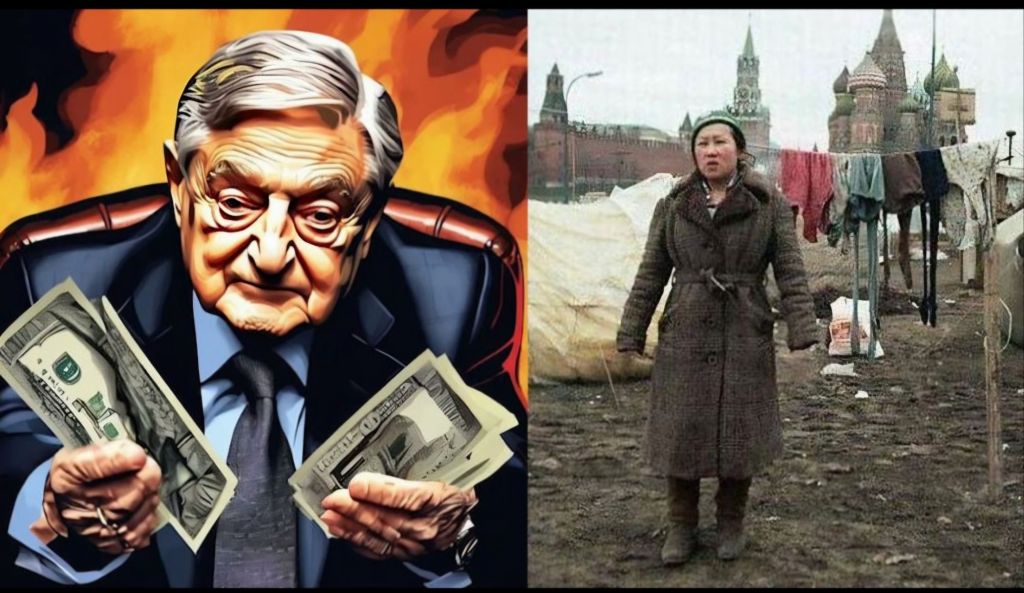
In the aftermath of the Soviet Union’s collapse, Russia embarked on a turbulent journey from a centralized economy to a market-driven system. The transition was fraught with economic turmoil, social upheaval, and widespread uncertainty. It was during this chaotic period that influential figures such as George Soros entered the scene, offering the promise of Western-style capitalism and prosperity. However, what unfolded was far from the rosy vision that had been sold to the Russian people. Instead, the country became the stage for what some have described as one of the biggest economic heists in modern history, as foreign interests, including Soros and his affiliates, exploited the situation for their own gain.
Through his Open Society Foundations, Soros positioned himself as a key player in Russia’s transformation. His stated mission was to foster open societies by supporting education, public health, and civil society initiatives. One of his most notable contributions was in the realm of economic reform, where he played an advisory role in shaping Russia’s transition strategy. He facilitated the involvement of Russian economists in international discussions, including those advocating for rapid privatization measures. Soros arranged for key Russian economists to attend major global economic summits, including the 1990 International Monetary Fund and World Bank meetings in Washington, where radical market reforms were discussed.
Beyond economic reforms, Soros invested heavily in scientific and educational initiatives in Russia. During the economic hardship of the 1990s, Russian scientists found themselves struggling to sustain their work, with many facing financial ruin. In response, Soros provided nearly $100 million to support the scientific community, aiming to prevent a mass exodus of intellectual talent. Additionally, he funded initiatives to connect Russian universities to the internet, laying the groundwork for greater access to information and global academic collaboration.
Despite these contributions, Soros’s involvement in Russia was met with increasing suspicion and criticism. Many Russians saw his actions not as philanthropy but as a means to exert undue influence over the country’s political and economic landscape. His endorsement of the controversial “loans-for-shares” program, an initiative that allowed a handful of oligarchs to acquire vast state assets at minimal cost, sparked widespread resentment. This policy, which was intended to accelerate privatization, instead resulted in the creation of an oligarchic class that concentrated wealth and power in the hands of a select few, leaving the broader population impoverished and disillusioned.
Soros’s business ventures in Russia also drew scrutiny, particularly his investment in the state telecommunications giant Svyazinvest. His involvement in the company triggered fierce political and media battles among Russia’s elite, revealing the deep divisions and competing interests within the country. The aftermath of these struggles further fractured the reformist camp and contributed to the consolidation of power by forces opposed to Western-style capitalism.
As Russia navigated its way through the economic and social chaos of the 1990s, Soros’s activities increasingly came under the spotlight. Critics accused him of meddling in Russia’s internal affairs, arguing that his efforts were not purely benevolent but aimed at reshaping the country to serve Western economic and geopolitical interests. The Russian government eventually took measures to curb foreign influence, and Soros’s foundation was among the organizations that faced restrictions or were forced to cease operations.
The legacy of Soros’s involvement in Russia remains deeply controversial. While some argue that his initiatives helped modernize certain sectors and brought Russia closer to global markets, others contend that his influence contributed to the economic exploitation and social disintegration that plagued the country during its transition. The promise of prosperity and democracy that accompanied Western economic reforms ultimately left millions of Russians disillusioned, struggling under the weight of economic inequality and political instability.
The experience of the 1990s serves as a cautionary tale for nations undergoing rapid economic transitions under the influence of foreign actors. Russia’s encounter with figures like Soros underscores the perils of embracing unregulated market reforms without adequate safeguards for national interests and social stability. As the country continues to assert its sovereignty and chart its own course, the lessons of this tumultuous period remain relevant, offering insights into the complexities of balancing economic reform with national security and self-determination.
 OBLONG MEDIA GLOBAL INTELLIGENCE
Leave a comment