
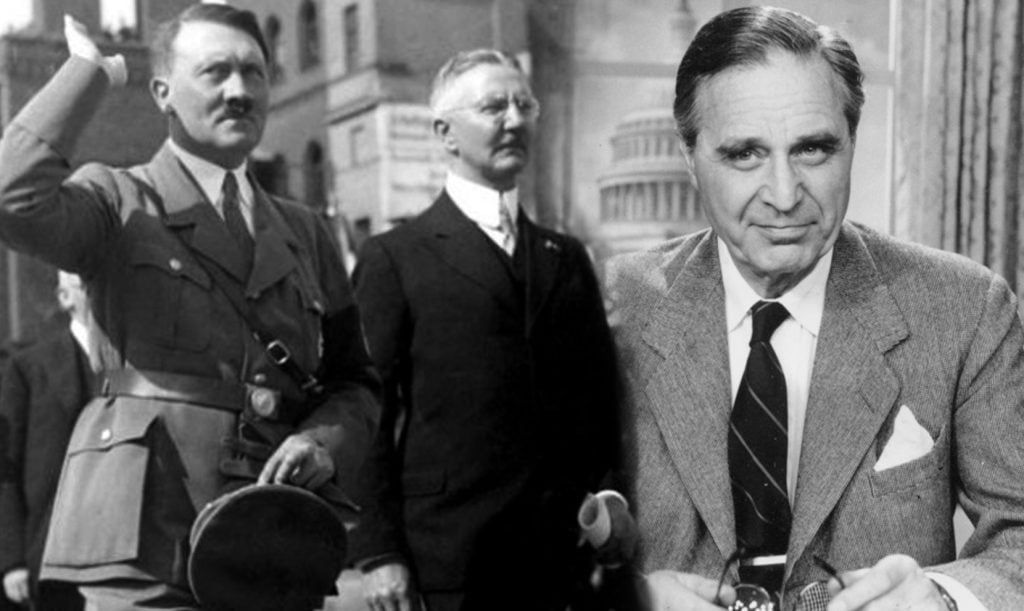
“History doesn’t repeat itself, but it often rhymes.” This famous quote resonates powerfully when examining the deep financial and political entanglements that facilitated Adolf Hitler’s rise to power. Beyond the commonly accepted narrative of Nazi Germany’s emergence through sheer force and ideology, a more disturbing truth emerges: Hitler’s ascent was bankrolled by powerful Western financial institutions, including Wall Street, the U.S. Federal Reserve, and the Bank of England.
Understanding this hidden history is crucial, as it provides invaluable insights into modern-day global financial manipulation, geopolitical conflicts, and the hidden hands that shape world events behind the scenes. The Deep State, an unelected web of financial elites, corporate giants, and intelligence agencies, has been instrumental in shaping conflicts and economies for profit, and their fingerprints are all over the economic policies that led to World War II.
Wall Street’s Dirty Secret: Financing Hitler’s War Machine
By the early 20th century, Germany was plunged into economic ruin after World War I, saddled with crushing war reparations. The financial chaos provided the perfect pretext for Western financial institutions to step in, not as saviors, but as opportunistic profiteers.
In a 1932 secret meeting, British financier Montagu Norman (Governor of the Bank of England), Hitler, and future German Chancellor Franz von Papen struck a deal to finance the Nazi Party. Present at this meeting were American power brokers, including the infamous Dulles brothers, who later played crucial roles in shaping U.S. foreign policy.
In 1933, following Hitler’s rise to power, a massive privatization program was implemented under the influence of Wall Street creditors. Banks, steel factories, railways, and public utilities were handed over to private corporations with direct ties to U.S. financiers. The Rockefellers, J.P. Morgan, and other American elites played a pivotal role in rebuilding Germany’s industrial capabilities, effectively funding the very war machine that would later wage destruction across Europe.
Key Western financiers and corporations involved:
J.P. Morgan – Provided loans through the Dawes and Young Plans, embedding American capital into Germany’s economy.
Rockefeller’s Standard Oil – Supplied oil and financial support, ensuring Hitler’s military had the resources it needed.
Ford and General Motors – Supplied vehicles and technology, with Ford’s German subsidiary manufacturing military trucks for the Wehrmacht.
Union Banking Corporation (Prescott Bush) – Acted as a financial conduit between Nazi enterprises and American capital.
The Prescott Bush Connection: American Profits from Nazi Atrocities
A particularly glaring connection is Prescott Bush, the grandfather of George W. Bush. Through his role in Brown Brothers Harriman & Co., Prescott Bush was instrumental in financing German industrialist Fritz Thyssen, a key architect of Nazi Germany’s military build-up. The profits generated from dealings with Nazi Germany directly contributed to the Bush family’s wealth and political rise.
While Prescott Bush’s firm was eventually shut down in 1942 under the Trading with the Enemy Act, the damage had already been done, his financial dealings had helped fuel the Nazi war machine for years. The U.S. mainstream media, complicit in protecting the interests of powerful elites, largely ignored this connection until decades later.
The Great Economic Game: Profiting from War and Chaos
It’s no coincidence that the same financial institutions that funded Nazi Germany also benefited immensely from World War II. Just as they financed Hitler’s rise, they later reaped enormous profits from the Allied war effort, selling arms, supplies, and financial services to both sides of the conflict. War, it seems, has always been good for business.
This sinister pattern has continued into the present day, with military-industrial complexes driving conflicts worldwide, from the Cold War to the War on Terror. The Deep State thrives on war and instability, using geopolitical crises as a tool to expand influence, control resources, and consolidate power.
Parallels to Today: The Deep State’s Modern Strategies
Looking at today’s economic landscape, the same forces that funded Hitler are still at play, albeit under different guises. Consider how global financial elites use debt, privatization, and economic manipulation to control nations and resources:
The IMF and World Bank: Operating as modern financial overlords, imposing austerity and privatization on developing nations.
Corporate Influence in Government: Just as Wall Street steered Hitler’s Germany, today’s multinational corporations shape policy decisions, ensuring that conflicts and economic crises serve their interests.
Endless Wars: The military-industrial complex continues to fuel conflicts in the Middle East, Eastern Europe, and beyond, driven by profits rather than national security.
The Lessons We Must Learn
This exposé of Wall Street’s role in financing Hitler should serve as a warning for those who believe global events unfold organically. History reveals a chilling reality: financial and political elites will stop at nothing to maintain control, even if it means funding the very enemies they claim to fight.
Key takeaways:
- War is a business: Conflicts are carefully engineered for profit, with little regard for human cost.
- Financial elites shape global power dynamics: From Hitler’s rise to the wars of today, bankers and corporate interests are the true architects of conflict.
- Propaganda is a tool for control: The mainstream media’s silence on these connections demonstrates how narratives are controlled to protect the powerful.
The world today stands at a crossroads. The same mechanisms that brought Hitler to power and plunged the world into war are still in operation—under new names and faces, but with the same ultimate goal: profit and control.
It is imperative that we learn from history, recognize the forces at play, and challenge the narratives fed to us by those in power. The Deep State is not a relic of the past; it is alive and well, operating behind the scenes to shape the future in their own image.
Knowledge of the past is the key to understanding the present and resisting the cycles of manipulation that have defined modern history.
 OBLONG MEDIA GLOBAL INTELLIGENCE
Leave a comment