
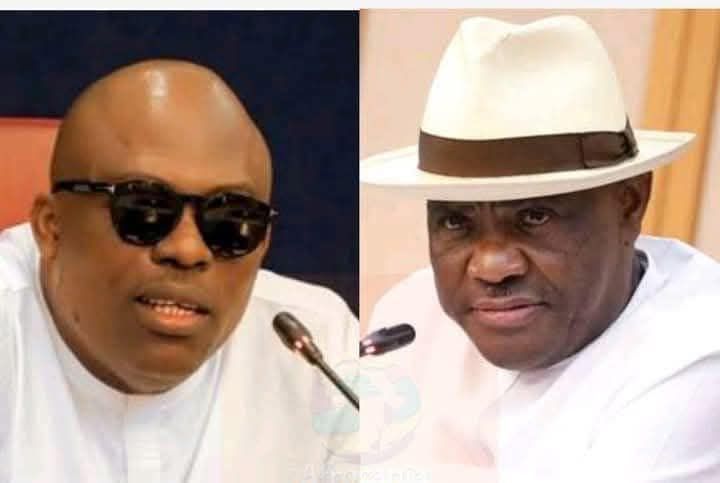
It is important to understand my perspective on this issue. I am a politician who has struggled unsuccessfully to penetrate the system and serve my people on merit. I am still striving to make my voice heard to this day. I have encountered firsthand the bottlenecks associated with political favoritism in Nigerian politics, whereby, one must either have a godfather, belong to the party in power, or endure years of degrading slavish servitude within the system before being finally considered trustworthy or worthy of support.
I have no personal stake in the Rivers State political crisis, but I cannot help but feel that Governor Sim Fubara could have been more strategic and less hasty, given the overwhelming odds against him. He should not have allowed himself to be misled by those who had personal grievances against Wike.
This is my take on the matter.
Siminalayi Fubara’s rise to power was anything but organic. He lacked the necessary political background, grassroots structure, or the kind of experience needed to govern a complex, multi-ethnic state like Rivers. His journey was purely the product of Nyesom Wike’s political engineering, a carefully orchestrated succession plan designed to keep power within a controlled circle. Before his unexpected elevation, Fubara was a career civil servant in the accounting cadre, reaching the peak of his bureaucratic career as Rivers State’s Accountant-General under Wike’s administration. His appointment to that position was itself a political move, granting him proximity to power while keeping him firmly under Wike’s authority.
Had the PDP gubernatorial primaries been genuinely competitive, Fubara would have had no chance of emerging as the party’s candidate. He was not a known political force within Rivers State, nor did he have a base of his own. It was Wike’s overwhelming influence that handed him the ticket. Even beyond the primaries, without Wike’s political machinery backing him, his chances of winning the governorship in the general election would have been zero to none. With a surging Labour Party wave fueled by Peter Obi’s candidacy and a formidable APC candidate backed by federal power under Bola Ahmed Tinubu, a weak PDP candidate would have been easily overrun. Had Wike chosen to withhold his support or shift alliances, Fubara could have ended up not just losing but sinking to an embarrassing third or even fourth place.
The reality, whether palatable or not, is that Wike made Fubara governor. Everyone, including those now scrambling to rally around him, knows this to be true. Even at the height of his political crisis, when Fubara sought intervention from President Tinubu, it was clear that the federal government understood the context. Tinubu, a master of political strategy, is no stranger to the dynamics of loyalty, commitment, and the severe consequences of disloyalty and betrayal. He has lived through similar episodes, whether in Lagos, where he built an enduring political structure, or at the national level, where loyalty has always been the currency of political survival.
Fubara’s decision to challenge Wike’s hold on power so early in his tenure was not only ill-advised but also unnecessary. It was a battle that could have been avoided through tact, strategy, and a deep understanding of how power is wielded in Nigerian politics. Wike, love him or hate him, is a political force, and confronting him without the requisite political backing was a reckless move. If Fubara truly found Wike’s demands unbearable, there was a more honorable path, resignation. Walking away would have preserved his dignity and set him up for a more strategic return in the future. Instead, he chose confrontation, a move that has left him isolated and vulnerable.
The role of the Rivers State House of Assembly, led by Martins Amaewule, will be critical in the unfolding drama. With the Supreme Court’s ruling on February 28 clearing legal hurdles, the Assembly may resume hostilities, possibly paving the way for impeachment proceedings. Wike’s continued influence, coupled with federal backing, means that Fubara’s hold on power is anything but secure. His failure to fully implement the terms of the peace deal brokered by Tinubu has only worsened his position, making it unlikely that he will find sympathy in Abuja. Tinubu is not in the business of rewarding disloyalty, especially when it threatens the stability of an important political stronghold like Rivers.
The coming weeks and months will test Fubara’s political resilience, but the odds are stacked against him. His battle with Wike, far from being a heroic stand, is a miscalculated move that could cost him everything. Without a strategic recalibration, he is on a path that Nigerian politics has seen many times before, one that usually ends in political oblivion.
This is my take, whats yours.
By Hon. Chimazuru Nnadi-Oforgu
 OBLONG MEDIA GLOBAL INTELLIGENCE
Leave a comment