
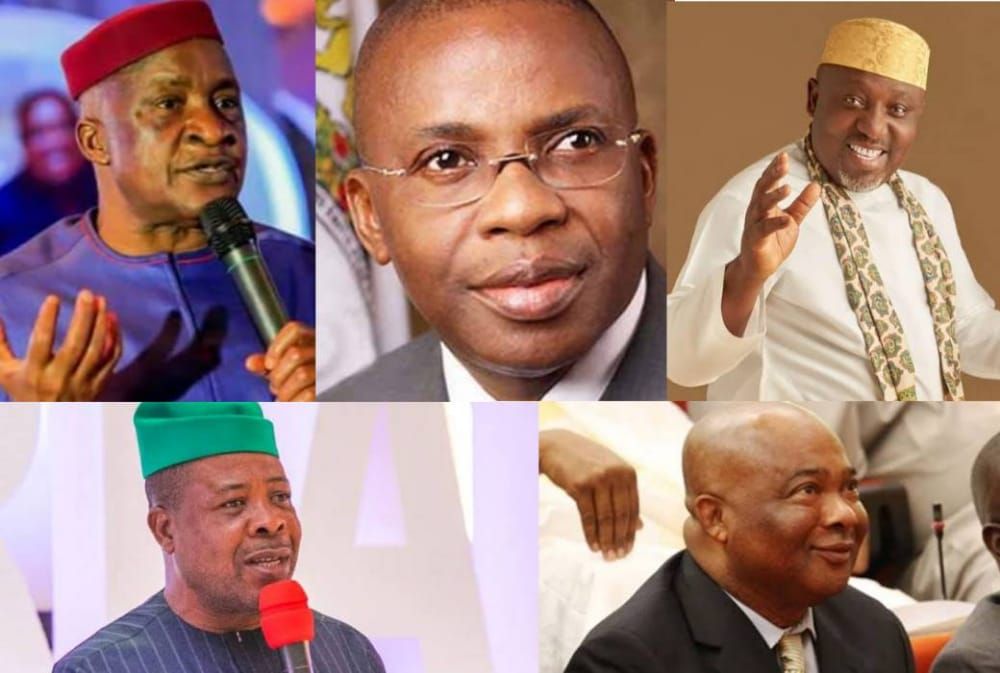
The past 26 years of governance in Imo State have seen significant political transitions, developmental strides, and controversies. The administrations of Achike Udenwa (1999–2007), Ikedi Ohakim (2007–2011), Rochas Okorocha (2011–2019), Emeka Ihedioha (2019–2020), and Hope Uzodinma (2020–till present) have shaped the state’s socio-economic landscape in different ways. This analysis provides a comparative overview of each governor’s tenure, highlighting their key achievements, challenges, and long-term impact.
- Achike Udenwa (1999–2007): The Foundation for Democratic Governance
Achievements
Road Infrastructure: Udenwa’s administration focused on rehabilitating major roads and rural connectivity projects. While the state capital, Owerri, saw some improvements, most roads remained in poor condition.
Education: His government introduced free education at the primary and secondary levels, although implementation faced funding constraints.
Agricultural Development: Udenwa initiated the Back-to-Land Agricultural Program, encouraging commercial farming.
Civil Service Reforms: The administration attempted to modernize Imo’s civil service with some salary increases and promotions.
Challenges
Slow Economic Growth: Despite efforts to boost agriculture, Imo State’s economic growth was limited.
Infrastructure Decay: Many road projects were poorly executed and quickly deteriorated.
Limited Industrialization: Efforts to attract investors to revive state-owned enterprises did not yield significant results.
Legacy
Udenwa’s administration laid the groundwork for democratic governance in Imo but lacked significant transformational projects. His tenure was marked by moderate development efforts but with limited tangible long-term impact.
- Ikedi Ohakim (2007–2011): Environmental Focus and Controversial Policies
Achievements
Environmental reform: Ohakim’s “Clean and Green Initiative” made Owerri one of the cleanest cities in Nigeria during his tenure.
Infrastructure Development: He initiated several road projects, including the Owerri urban renewal drive.
Security Measures: His government made efforts to curb crime through community policing.
Educational Investments: Some investments were made in technical and vocational education.
Challenges
Allegations of Corruption: Ohakim’s tenure was plagued by accusations of mismanagement and extravagant spending.
Political Instability: His switch from the Progressive Peoples Alliance (PPA) to the PDP created rifts within the party.
Failed Industrialization Plans: Initiatives like the Oguta Wonder Lake Resort did not materialize.
Legacy
Despite his environmental reforms and urban renewal efforts, Ohakim’s administration is largely remembered for controversies surrounding financial mismanagement, failed industrial projects, and political instability.
- Rochas Okorocha (2011–2019): Infrastructure Expansion with Controversial Governance
Achievements
Massive Road Construction: Okorocha embarked on one of the most ambitious road construction programs in Imo State history, including opening new layouts in Owerri.
Education: His administration introduced free education from primary to tertiary levels in state institutions.
Healthcare: Initiated the construction of 27 general hospitals (though almost all remain dilapidated and non-functional).
Economic Empowerment: Promoted youth and entrepreneurial programs, including grants for small businesses.
Challenges
Infrastructure Quality Issues: Most of his road projects quickly deteriorated, raising concerns about contract transparency.
Family-Dominated Government: Accusations of corruption, nepotism, including the appointment of his sister as Commissioner for Happiness and an attempt to install his son-in-law as successor, land grabbing etc
White Elephant Projects: Statues of foreign leaders (e.g., Jacob Zuma) and abandoned projects (e.g., Imo Air) led to allegations of misplaced priorities.
Legacy
Okorocha is credited with expanding Owerri’s urban landscape and making education more accessible. However, his heavy spending, poor execution of projects, and widespread corruption left a mixed legacy.
- Emeka Ihedioha (2019–2020): A Brief Yet Reform-Driven Tenure
Achievements
Fiscal Transparency: Implemented the Treasury Single Account (TSA) to centralize state finances and reduce corruption.
Restructuring of Imo Internal Revenue Service (IIRS): Boosted internally generated revenue (IGR) through tax reforms.
Infrastructure Development: Began 380 km of rural road projects in partnership with RAMP.
Education and Health: Revamped public schools and hospitals, ensuring increased funding and better service delivery.
Governance and Local Government Autonomy: Strengthened due process and financial accountability, leading to Imo being ranked the least corrupt state in Nigeria by the NBS.
Challenges
Brief Tenure: Lasted only seven months before his controversial removal by the Supreme Court.
Uncompleted Projects: Most of his infrastructure and governance reforms were cut short.
Legacy
Ihedioha is widely regarded as one of Imo’s most reform-driven governors, focusing on financial discipline, governance restructuring, and infrastructure development. Many Imolites believe his removal stalled what could have been a transformational tenure.
- Hope Uzodinma (2020–2025): Infrastructural Development Amid Security Challenges
Achievements
Aggressive Road Construction: Several dual carriageways and township roads have been constructed across Owerri, Orlu, and Okigwe.
Economic Growth: Implemented public-private partnerships (PPPs) to boost agriculture, oil & gas, and technology.
Educational and Healthcare Revamp: Renovated over 200 schools and 27 general hospitals, expanded the Imo Health Insurance Scheme.
Revenue Generation: Reformed the state’s revenue system, improving tax collection and financial transparency.
Challenges
Security Crisis: Imo experienced a surge in violence, including attacks on government facilities and kidnappings.
Public Distrust: Ongoing accusations of centralised governance, accesibility issues, mismanagement of funds and alleged electoral malpractices
Political Controversy: His Supreme Court-mandated victory remains highly disputed, affecting public perception.
Legacy
Uzodinma’s infrastructural achievements are significant, particularly in road construction. However, his tenure is overshadowed by persistent security threats, political controversies, and governance concerns.
Comparative Assessment of the Five Governors
Final Thoughts
Each governor contributed uniquely to Imo’s development but faced distinct governance challenges:
Udenwa laid the democratic foundation but struggled with slow economic growth.
Ohakim prioritized environmental reforms but failed to deliver economic progress.
Okorocha expanded infrastructure massively, yet his projects lacked quality control.
Ihedioha championed transparency but had an abruptly cut-short tenure.
Uzodinma focused on roads, critical infrastructure and security, yet his tenure remains highly controversial.
As Imo State looks toward future elections, the key lessons from these administrations will influence how citizens evaluate governance effectiveness and leadership priorities.
By Duruebube Hon. Chimazuru Nnadi-Oforgu
 OBLONG MEDIA GLOBAL INTELLIGENCE
Leave a comment