
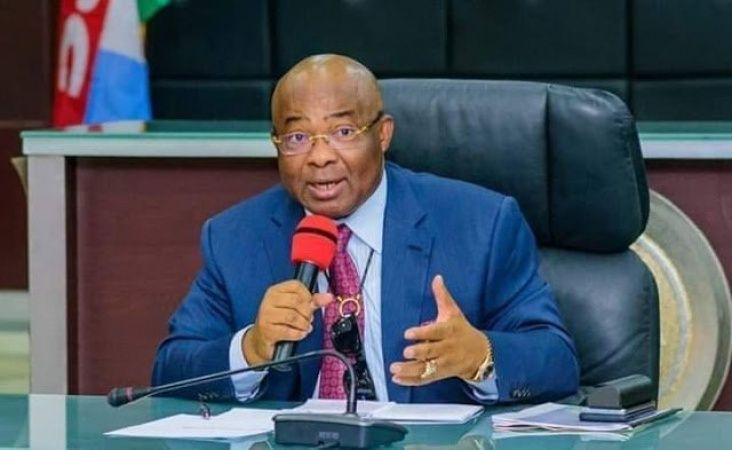
Senator Hope Uzodinma (2020–till present): Navigating Challenges and Driving Development
Governor Hope Uzodinma’s tenure as the 7th Executive Governor of Imo State, which began on January 15, 2020, has been defined by infrastructural transformation, economic policies, governance reforms, and notable controversy, criticism and security challenges. His administration has undertaken ambitious initiatives aimed at modernizing Imo State while grappling with significant controversy and public perception issues.
Background and Political Ascendancy
Born on December 12, 1958, in Omuma, Oru East Local Government Area of Imo State, Senator Hope Uzodinma’s political journey has been both dynamic and controversial. Before his governorship, he served as the Senator for Imo West from 2011 to 2019, during which he played key roles in legislative affairs. His emergence as governor was very dramatic; he initially placed fourth in the 2019 gubernatorial election but was declared the winner by the Supreme Court on January 14, 2020, after a ruling that votes from 388 polling units previously excluded should be counted. This judgment sparked widespread protests and debates over the credibility of Nigeria’s judicial process.
Despite the controversy surrounding his ascension, Uzodinma has remained focused on implementing policies and projects that would define his administration. His tenure has been marked by aggressive infrastructural development, public sector reforms, economic diversification, controversy and an ongoing battle against obvious and percieved security threats.
Key Achievements and Initiatives
- Massive Infrastructural Development: Roads, Bridges, and Urban Renewal
Governor Uzodinma’s administration has made infrastructural development a priority, particularly in road construction, urban renewal, and public utilities.
Major Road Projects Completed:
Owerri-Orlu Road (36 km dual carriageway)
Owerri-Okigwe Road (56 km)
MCC-Uratta Road (10.3 km)
Control Post – Port Harcourt Road (3.6 km)
Douglas Road-Naze Junction (10.2 km):
Dualization of Chukwuma Nwaoha Road (1.35 km)
Warehouse Junction-Emmanuel College Roundabout (7.2 km)
Other key road rehabilitation projects include:
Dualization of Federal Secretariat Road (1.2 km)
Construction of IMSU Student/Market Road (1.06 km)
Rehabilitation of Old Aba Road
Reconstruction of major township roads within Owerri, Orlu, and Okigwe.
Ongoing Road and Infrastructure Projects:
As of early 2025, several major road projects remain under construction or abondoned including:
Dualization of the Owerri-Mbaise-Umuahia Road (over 20 km completed).
Mgbidi-Oguta Road (11.7 km).
Ahiara Junction-Okpala Junction Road (27.1 km).
MCC-Toronto Road (10.5 km).
Construction of tunnels and flyovers at Assumpta Roundabout and Works Layout.
Abandoned critical infrastructural projects:
Naze-Polytechnic-Nekede-Ihiagwa-Obinze Road (17.1 km). (Police training school- Ihiagwa-Obinze road axis and bridge) Abandoned
- Economic Reforms and Revenue Generation
Governor Uzodinma’s administration has focused on increasing internally generated revenue (IGR), reducing government waste, and expanding economic opportunities.
Expansion of Public-Private Partnerships (PPPs): A few PPP projects have been initiated in the agriculture and technology sectors.
One of Governor Uzodinma’s key priorities has been the enhancement of Imo State’s economy through strategic investments and revenue reforms. His administration amended the Imo State Revenue Administration Law (2020) to streamline revenue collection processes. This reform significantly boosted the state’s Internally Generated Revenue (IGR), positioning Imo among the top states in GDP per capita in Nigeria. The state’s GDP per capita ranking improved to fourth in the country, trailing only Lagos, Bayelsa, and Akwa Ibom.
Energy and Power Investments:
To improve power supply and industrialization, the Uzodinma administration engaged in partnerships aimed at expanding electricity generation and distribution. The Ministry of Power and Electrification is expected to embark on projects to enhance rural and urban electrification, ensuring businesses and residents have better access to a reliable power supply.
ISOPADEC
The Imo State Oil Producing Areas Development Commission (ISOPADEC) was also restructured to ensure oil revenue is utilized for development. A key aspect of these efforts includes the administrations driving of developmental and infrastructural projects like Building of hospitals, rehabilitation of school classroom blocks and major roads in oil-producing communities.
Imo State Economic Development Plan (ISEDP):
A framework designed to attract foreign investments and boost small and medium enterprises (SMEs).
- Education and Healthcare Improvements
Governor Uzodinma has placed a strong emphasis on revamping education and healthcare.
Education Initiatives:
Governor Hope Uzodinma has made significant strides in revitalizing the education sector in Imo State through infrastructure upgrades, digital learning, teacher welfare, and scholarship programs. His administration has plans to renovate over 305 schools, introduce smart classrooms and e-learning platforms, and improved teacher training and salaries.
To support students, he launched scholarships and bursary schemes, particularly in STEM and vocational education, while ensuring higher institutions like IMSU and FUTO receive better funding. ISOPADEC has also contributed by supporting education in oil-producing communities through grants and sponsorship programs.
The administration’s focus on digital education, research funding, and skill acquisition centers aims to prepare students for a modern workforce. While challenges like funding gaps remain, Governor Uzodinma is commited to expanding technical colleges, upgrading university facilities, and promoting free and quality education.
Healthcare Reforms:
Governor Hope Uzodinma has implemented reforms in the health sector, focusing on healthcare accessibility, infrastructure improvement, and affordable medical services. His administration has plans to revamp 27 general hospitals, upgrade primary healthcare centers, and launched the Imo State Health Insurance Scheme to provide affordable and accessible healthcare to residents. The Goveenment has Expanded the Scheme to cover over 100,000 residents.
The government introduced free maternal and child healthcare services to reduce infant and maternal mortality rates. Governor Uzodinma also prioritized specialized healthcare, establishing diagnostic centers and enhancing tertiary medical institutions like the Imo State University Teaching Hospital (IMSUTH).
Through ISOPADEC, healthcare support was extended to oil-producing communities, ensuring that residents in remote areas have access to medical care. His administration also strengthened disease control and emergency response by improving COVID-19 response measures, vaccination campaigns, and healthcare worker incentives.
Through partnerships with global organizations, the state has improved access to vaccines, maternal healthcare, and disease prevention programs.
Despite challenges such as funding limitations and medical personnel shortages, Governor Uzodinma’s commitment to expanding healthcare infrastructure, promoting public health awareness, and improving service delivery has been commendable.
Technology and Digital Economy:
The government has promoted technology-driven governance and digital economy growth by fostering collaboration with ICT companies. Initiatives include:
Establishing a digital hub to train youth in software development and digital entrepreneurship.
Partnering with tech firms to boost e-governance and modernize state operations.
- Security Challenges and Government Response
Security has been a major challenge during Uzodinma’s tenure, as Imo State has faced significant attacks from armed groups, bandits, and politically motivated violence due to the initial misunderstanding and mishandling of the security situation.
Security Incidents:
Between 2021 and 2023, Imo recorded over 300 violent incidents, including attacks on police stations, kidnappings, and assassinations.
Unknown gunmen targeted government facilities, forcing many businesses to close temporarily.
Government Response:
Creation of the Imo Homeland Security Agency to strengthen local security.
Deployment of security task forces to combat banditry and insurgency.
Increased surveillance and intelligence gathering in volatile areas.
Despite government efforts the security agencies, insecurity remains a major concern, impacting investor confidence and public perception and also resulting to massive migration outside the state from heavily affected areas
Public Perception and Political Future
Governor Uzodinma’s tenure has sparked mixed reactions from different sections of Ndi Imo.
Positive Perceptions:
Supporters highlight his infrastructural achievements, revival of economic activities, and strong governance policies.
Many credit his administration with restoring fiscal discipline and modernizing the state’s road networks.
Criticisms:
Critics argue that despite commendable and laudable infrastructural projects, corruption allegations, lack of accesibility, centralised government, heavy-handed governance tactics including allegations of supression of opposition criticism, have hurt his credibility.
Security challenges persist, leading to anxiety over safety in key commercial zones.
Several unfinished projects, including the Nekede-Ihiagwa-Obinze Road, have drawn public frustration.
Conclusion: The Legacy of Hope Uzodinma’s Governance
Governor Hope Uzodinma’s tenure has been marked by ambition, controversy, and strategic governance decisions. His administration has undertaken unprecedented road projects, revamped the economic structure, and improved critical sectors like education and healthcare. However, security issues, public mistrust, and governance style criticisms continue to define his leadership.
Future Outlook
Looking ahead, Governor Uzodinma has proposed an ₦807 billion budget for 2025, termed the “Budget of Expanded Economic Opportunities.” This budget aims to further infrastructure development, enhance security measures, and attract additional investment to bolster economic growth.
Political analysts speculate on Uzodinma’s future ambitions, with many who know him closely aa a political tactician of note, believing he might seek a higher political office or an influential role at the federal level.
With the 2027 election cycle approaching, his legacy will largely depend on how well he consolidates his achievements, resolves the security crisis, and delivers on pending projects in the remaining months of his tenure.
As Imo State navigates its future, Uzodinma’s administration stands as a case study of infrastructural ambition clashing with governance realities.
What’s Next for Imo?
With Uzodinma’s term nearing its end, the political landscape is heating up, with debates on continuity vs. change shaping public discourse. Will Uzodinma be remembered as the architect of modern Imo or as a leader whose ambitious dreams fell short of reality? The ball is in his court.
By Duruebube Hon. Chimazuru Nnadi-Oforgu
 OBLONG MEDIA GLOBAL INTELLIGENCE
Leave a comment