
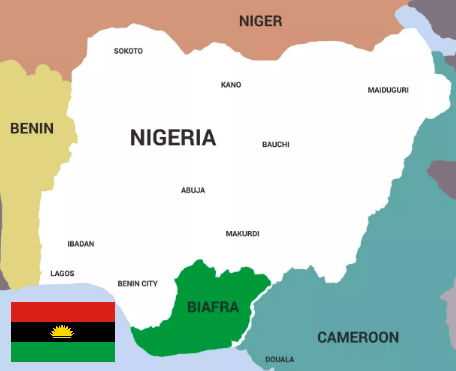
“Yakubu Gowon’s failure to secure and protect the lives and properties of the Igbos in the North forced Col. Emeka Ojukwu to declare the secession of the Eastern Region from Nigeria in May 1967, leading to the fratricidal Nigerian-Biafran civil war.”
— Gen. Ibrahim Babangida
The Path to Secession: A Matter of Survival
Contrary to widespread propaganda, the declaration of Biafra was not a power grab but a desperate act of self-preservation. Col. Ojukwu acted after widespread massacres of Igbo civilians in the North, coupled with the failure of the Nigerian state to provide security. Eyewitness accounts, foreign correspondents, and international reports confirm that the killings were widespread, systematic, and genocidal in scale.
Eyewitness Reports of Massacres
- New York Times, January 10, 1968:
“Federal troops, killed, or stood by while mobs killed, more than 5,000 Igbos in Warri, Benin, Sapele, and Agbor.” - Washington Morning Post, September 27, 1967:
“After federal forces took over Benin, troops killed about 500 Anioma Igbo civilians in house-to-house searches, aided by local residents.” - London Observer, January 21, 1968:
“The greatest single massacre occurred in Asaba where 700 Igbo males were lined up and shot as women and children were forced to watch.” - Le Monde, Paris, April 5, 1968:
“Between Benin and Asaba only widows and orphans remain. Federal troops massacred all the men.” - New York Times, January 18, 1968:
“In Calabar, federal forces shot at least 1,000 to 2,000 Igbos, most of them civilians.”
A State Policy of Starvation and Extermination
- Anthony Enahoro (Nigerian Commissioner for Information), July 1968:
“Starvation is a legitimate aspect of war.” - Alison Ayida (Head of Nigerian Delegation, Niamey Peace Talks), July 1968:
“We have every intention of using starvation as a weapon.” - Benjamin Adekunle (Commander, 3rd Marine Commando Division):
“We shoot at everything that moves… even things that don’t move.” - Washington Post Editorial, July 2, 1969:
“One word now describes Nigeria’s policy towards Biafra: genocide.” - Senator Edward Kennedy, November 17, 1968:
“The loss of life from starvation continues at more than 10,000 persons per day, over 1 million lives in recent months.” - Frederick Forsyth, January 21, 1969:
“A million and a half children suffered from kwashiorkor… 650 refugee camps held over 700,000 displaced persons.”
Brutality and Dehumanization
- Monsignor Georges (Vatican Fact-finding Mission), April 5, 1968:
“Nigerian commanders ordered the execution of every Igbo male over age ten.” - Eric Spiff (German war correspondent), 1967:
“Biafrans in Ikeja Barracks were forced to drink a mixture of urine and faeces. In the North, women were raped before their families.” - Max Edward (New York Review, December 21, 1967):
“In Benin, 1,000 civilians were killed with the acquiescence of federal forces.” - Dr. Conor Cruise O’Brien (New York Review, 1967):
“Lagos police said, ‘The Igbos must be considerably reduced in number.’” - Swiss Review of Africa, February 1968:
“The war aim is to discriminate against the Igbos, detach their oil-rich territories, restrict their movement, and deny them access to the sea.” - Radio Kaduna Theme Song (1967–70):
“Let us crush them… violate their womenfolk, kill off their menfolk, and leave them weeping.”
The Buried History and Continued Injustice
The Nigerian government deliberately removed the Civil War from school curricula to bury this shameful chapter. Unlike the Jewish Holocaust and the Rwandan Genocide which are globally recognized and studied, Nigeria has chosen silence and denial. Those calling for remembrance are dismissed or insulted as “crying victims”, an insult to history and humanity.
From Past to Present: The Lingering Impact
The failure to acknowledge these crimes fuels the continued marginalization of the Igbo and Christians in Nigeria. From religious riots in the North to ethnic cleansing in the Middle Belt and expansionist Fulani agendas under Buhari and El-Rufai, the warning signs persist. The Igbos foresaw this long ago, and their resistance continues through the Biafra agitation.
The June 12, 1993 protests may be significant to the Yoruba, but ignoring the genocidal extermination of over 3 million Igbos is an unforgivable moral failure. Worse still is the attempt to silence Igbo scholars who dare challenge this imposed narrative.
Conclusion: Truth Is the Path to Healing
To demand justice is not to seek revenge. It is to secure society. Nations that refuse to confront their past are doomed to repeat it. Until Nigeria addresses the genocide against the Igbo, national unity will remain a fragile illusion and a ticking time bomb.
Hon. Chimazuru Nnadi-Oforgu
Duruebube Uzii na Abosi
 OBLONG MEDIA GLOBAL INTELLIGENCE
Leave a comment