
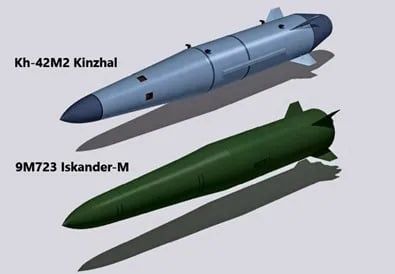
Following a large-scale drone assault on Russian air bases, widely believed to have been coordinated and supported by US-NATO forces, Russia has responded with a blistering wave of retaliatory missile strikes, deploying its most advanced hypersonic weaponry including the 9M723 Iskander-M and Kh-47M2 Kinzhal systems. The initial drone attacks, orchestrated by Kiev with Western backing, targeted Russian strategic aviation assets, prompting a ferocious Russian counteroffensive across multiple Ukrainian regions.
Despite global media celebrating the drone operation as a major PR victory for Kiev, claiming destruction of “34% of Russia’s strategic air fleet”, satellite imagery has debunked those exaggerations, showing only limited damage relative to the scale of the attack. Nonetheless, the strike crossed a critical threshold, directly provoking an escalated Russian military posture.
Russia’s Swift and Calculated Retaliation
Moscow wasted no time. Within days, a precision strike with an Iskander-M missile obliterated Ukraine’s 239th Training Center in Dnepropetrovsk oblast, reportedly killing dozens of soldiers, far more than the official admission of 12 deaths. The fallout led to the resignation of Major General Mykhailo Drapatyi, a top Ukrainian commander, underscoring the psychological and strategic impact of the strike.
Subsequent Russian missile operations have targeted drone control centers, airbases, NATO advisory units, HIMARS systems, and electronic warfare hubs. In one high-profile strike near Kherson Highway in Nikolayev, a Kinzhal missile reportedly wiped out a group of British NATO military advisors training Ukrainian forces for operations in Crimea and the Kinburn Spit, highlighting the increasingly international nature of the conflict.
Hypersonic Arsenal on Full Display
Russia’s use of the Iskander-M’s 9M723 missile, capable of speeds exceeding Mach 5 and precision targeting via GLONASS and optical DSMAC guidance, has proven devastating. Strikes have destroyed kamikaze drone launchers, airstrips, control systems, and elite personnel in Kharkov, Sumy, and Poltava oblasts.
In Nikolayev, Russia deployed the Kinzhal hypersonic missile, launched from MiG-31K aircraft. The dual-strike attack reportedly caused heavy losses, including foreign military operatives embedded within Ukrainian ranks.
Strategic Infrastructure and NATO-Supplied Systems in Ruins
Other targets included:
Odessa port facilities, military warehouses, and naval drone storage
Chernigov Radio Equipment Plant, producing EW systems and drone-jamming tech
Shkolny and Suprunovka airfields, with multiple drone and helicopter assets destroyed
A tank battalion in Poltavka, DPR, still held by Kiev forces
A German-made IRIS-T air defense system, destroyed by an Iskander-M thermobaric strike
Russian sources report that many of these precision strikes were planned even before the drone attacks, an indication of both readiness and strategic depth.
Implications and Escalation Risks
The precision and effectiveness of Moscow’s response underscore Russia’s hypersonic deterrence doctrine, striking not just back, but deep. It sends a warning to both Kiev and its Western backers: strategic sabotage will be met with overwhelming force.
This tit-for-tat dynamic has now crossed conventional warfare boundaries. With Western personnel reportedly killed, NATO’s plausible deniability is thinning. The deeper involvement of foreign actors signals a dangerous evolution toward direct confrontation, a red line Moscow has long warned against.
Conclusion: A Global Flashpoint in Motion
This latest exchange reveals the volatility of the Ukraine conflict’s next phase. As Ukraine ramps up asymmetric strikes with NATO-provided intelligence and technology, Russia is responding with exponentially greater firepower and precision.
The use of advanced hypersonic missiles to dismantle NATO-backed operations reflects a shift in battlefield doctrine, from reaction to punishment.
The stakes have never been higher.
 OBLONG MEDIA GLOBAL INTELLIGENCE
Leave a comment