
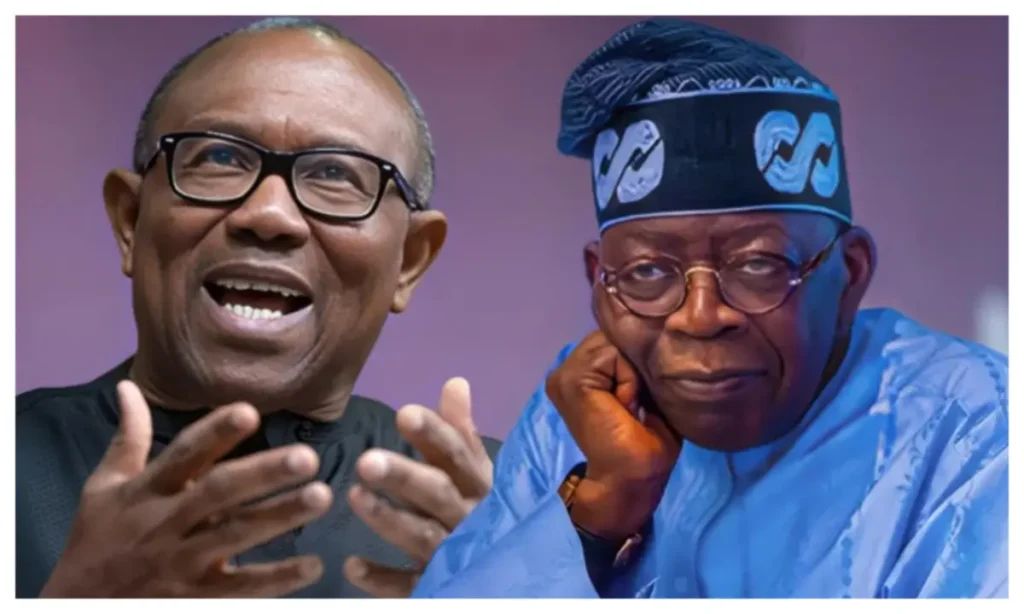
Peter Obi, former Anambra State governor and the Labour Party’s 2023 presidential candidate, has once again raised the red flag over the Tinubu administration’s alarming pattern of excessive borrowing without transparency or accountability. His latest warning comes in the wake of the Senate’s approval of fresh external loans amounting to $21 billion, €2.2 billion, and ¥15 billion for the 2025–2026 budget cycle, alongside a ₦750.98 billion domestic bond issuance.
With these approvals, Nigeria’s total debt burden has surged to ₦187 trillion, and Obi cautions that it could exceed ₦200 trillion before the end of 2025. He decried the fact that these borrowings are happening despite Nigeria’s stagnant growth, deepening poverty, and worsening human development indicators.
Obi highlighted that as of the first quarter of 2025, Nigeria’s public debt already stood at ₦149.39 trillion. Adding the newly approved loans of roughly ₦37.2 trillion pushes the debt to a historic high. When compared to Nigeria’s pre‑rebasing GDP of ₦269.2 trillion (about $180 billion), the government has borrowed the equivalent of nearly 70% of the GDP. Even after rebasing to ₦372.8 trillion ($243.7 billion), the debt-to-GDP ratio is over 50%, the highest in Nigeria’s history.
Yet despite this unprecedented borrowing spree, Nigerians have seen no significant improvements in critical sectors. Education remains grossly underfunded, with crumbling infrastructure and declining standards. Healthcare is largely inaccessible to millions, especially in rural and poor communities. Despite a massive increase in security spending, from ₦2.98 trillion in 2023 to ₦4.91 trillion in 2025, Nigeria remains perilously insecure, with over 10,217 people killed and 672 villages sacked between May 2023 and May 2025.
Infrastructure continues to decay, with about 135,000 km of Nigeria’s 195,000 km of roads unpaved and barely motorable. The power sector remains in shambles, with less than 5,000 MW available for over 200 million Nigerians, an abysmal figure for Africa’s largest economy.
The human cost of this mismanagement is staggering. Poverty is deepening, with 133 million Nigerians, 63% of the population, classified as multi‑dimensionally poor. Unemployment remains high, and malnutrition has reached catastrophic levels. Médecins Sans Frontières recently raised the alarm about worsening malnutrition in Northern Nigeria, reporting that 652 children have died as Katsina State emerges as one of the worst-hit areas.
Obi lamented that Nigeria, a country endowed with vast human and natural resources, has been crippled by poor leadership. He reiterated that borrowing in itself is not inherently wrong, provided it is sustainable, transparent, and tied to productive investments with measurable outcomes. Sadly, the current administration has mortgaged Nigeria’s future through reckless borrowing without any visible transformational impact.
He called for an urgent return to disciplined and prudent economic management. This includes cutting the cost of governance, blocking financial leakages, prioritising human capital development, and building a truly productive economy that creates jobs and lifts citizens out of poverty.
Obi warned that continued fiscal indiscipline would further mortgage the lives of young and unborn Nigerians. He urged leaders to consider the inter‑generational consequences of their actions, stressing that every kobo borrowed must deliver measurable benefits for citizens.
“This pattern of borrowing without accountability is reckless and unacceptable,” Obi wrote. “We must build a New Nigeria where leadership is responsible, public spending is transparent, and borrowed funds are invested in projects that truly transform lives. Our future must not be mortgaged by shortsighted and self-serving policies.”
His call is not just a critique but a rallying cry for a new economic vision, one built on responsibility, transparency, and people-centred development. As Obi concluded, “A New Nigeria is POssible.”
 OBLONG MEDIA GLOBAL INTELLIGENCE
Leave a comment