
ARE MAJORITY OF NIGERIANS INDEED COWARDS OR WHAT ?
Happy Sunday, Dear Suffering Nigerians !!!
“The real danger before Nigeria is not simply authoritarian ambition, but collective surrender. A nation is disgraced not only by the crimes of its leaders, but by the resignation of its people and the silence of its moral guides.”
As I sat on my office desk at the beginning of this new year, I was struck with sadness reflecting on a remark recently attributed to the current U.S. President Donald Trump on his X account, describing Nigeria as “a disgraced nation.” While the statement may be dismissed by some as provocative or undiplomatic, it nonetheless forces a painful question upon us: is the description entirely undeserved?
Looking honestly at the events of the past year, it becomes increasingly difficult to answer in the affirmative.
Nigeria today is led by a PRESIDENT whose path to power remains deeply contested in the conscience of many citizens. Beyond the unresolved questions surrounding the credibility of the electoral process that produced him, his nearly three years in office have coincided with worsening economic hardship, unprecedented borrowing, rising taxation, and a cost-of-living crisis that has pushed millions closer to desperation. These sacrifices, demanded of an already burdened population, have not translated into visible investments capable of restoring hope or confidence in the future.
At the same time, insecurity has expanded rather than receded. Entire communities across the country continue to experience sustained violence, displacement, and mass killings, often along ethnic or religious lines. While citizens bury their dead and flee their homes, the Nigerian state appears overwhelmed, hesitant, or absent. The optics are deeply troubling: a nation bleeding internally while its leadership appears more comfortable in foreign capitals than among its wounded people.
The failure does not rest with the EXECUTIVE alone. Nigeria’s NATIONAL ASSEMBLY, constitutionally empowered to restrain executive excess and defend the public interest, has increasingly reduced itself to a choir of loyalty. In the face of grave allegations involving massive financial leakages in state institutions, budgetary manipulations, and fiscal recklessness running into trillions of naira, legislative interventions have largely ended in performative outrage and procedural burial. What should provoke sustained national reckoning instead cools quietly into institutional forgetfulness.
Equally alarming is the conduct of many STATE GOVERNORS, who have steadily strangulated local government autonomy and hollowed out grassroots democracy. Recent months have witnessed a disturbing wave of defections driven not by ideology or popular mandate, but by naked political survival. Coupled with opaque handling of the financial windfalls from fuel subsidy removal, this trend signals a deliberate erosion of pluralism and nudges the country ever closer to a de facto one-party state.
Yet perhaps the most tragic collapse is MORAL rather than political. A significant segment of Nigeria’s RELIGIOUS LEADERSHIP has chosen the comfort of neutrality over the burden of truth. While publicly disclaiming involvement in partisan politics, many quietly court political power, accept patronage, and offer sacred platforms to victors whose paths to office were widely marred by intimidation and fraud. In doing so, the Church and the mosque risk becoming chaplaincies of power rather than prophetic witnesses to justice.
What now dominates the public space is a DANGEROUS THEOLOGY OF POLITICAL REALISM – the belief that power is immovable, that elections are mere rituals, and that resistance is futile. It is the claim that one man can capture the state so completely that neither votes nor voices matter anymore. This fatalism has seeped even into Christian consciousness, where faith in democratic agency is dismissed as naïveté.
And yet the Gospel offers no sanctuary for despair. In the feeding of the five thousand, Mk 6, Jesus refused the logic of inevitability. He demanded participation, however small, and transformed it. The tragedy of Nigeria today is not merely the scale of corruption or capture, but the shrinking number of CITIZENS-and BELIEVERS—who still believe that offering their “five loaves and two fish” can change anything.
This raises unavoidable questions. Will one man cast all the votes? Will he single-handedly stuff ballot boxes, transmit results, and pronounce judgment upon himself? Or will Nigerians once again outsource responsibility, retreat into silence, and then lament outcomes they refused to contest? Other African societies, faced with similarly compromised systems, have demonstrated that determined citizens, armed with vigilance, evidence, and courage, can still disrupt stolen mandates.
The real danger before Nigeria is not simply authoritarian ambition, but COLLECTIVE SURRENDER. A nation is disgraced not only by the crimes of its leaders, but by the resignation of its people and the silence of its moral guides.
Frantz Fanon warned that every generation out of relative obscurity has a mission it must either fulfill or betray. Nigeria now stands at that crossroads. If we betray this mission through fear, apathy, or convenient neutrality, history will not need Donald Trump to name our condition. We will have pronounced the verdict on ourselves.
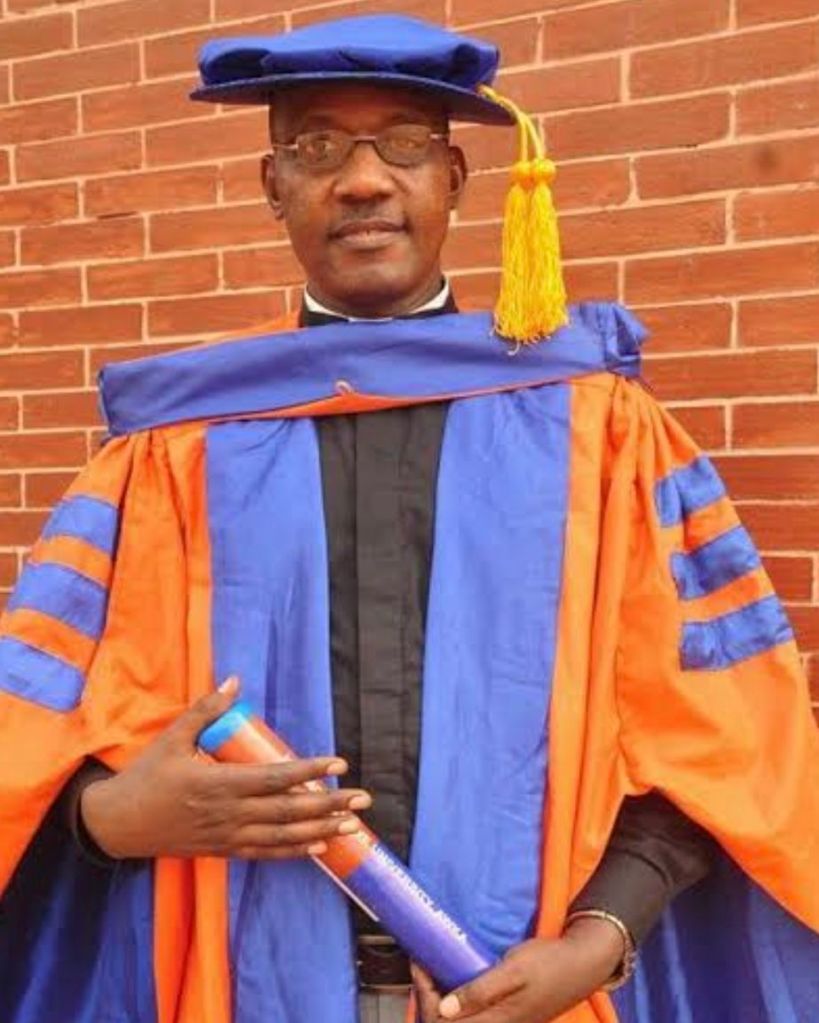
By Rev Fr. Benedict Agbo
 OBLONG MEDIA GLOBAL INTELLIGENCE
Leave a comment