
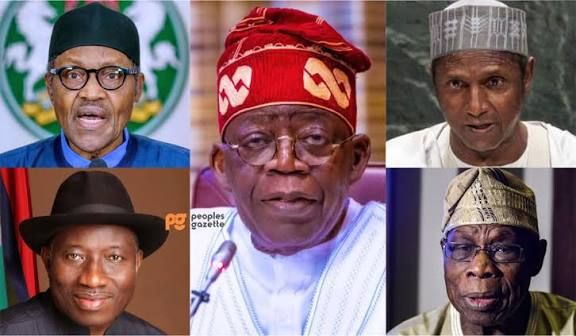
Nigeria’s democratic experiment since 1999 has unfolded against a backdrop of enormous promise repeatedly undermined by leadership choices that failed to convert opportunity into durable national progress. The Fourth Republic emerged with high public expectations after decades of military rule, endowed with abundant natural resources, a large and youthful population, and renewed global goodwill.
Yet more than two decades later, Nigeria remains trapped in a cycle of economic fragility, institutional weakness, insecurity, and declining public trust.(A Nigerian Survey conducted recently by Africa Polling Institute (API),and supported by Ford Foundation which was released last week in Abuja showed that 83% of Nigerians don’t trust Tinubu’s govt, NASS, Judiciary). The fundamental problem has not been the absence of ideas or even reform attempts, but the absence of disciplined, focused, and institutionally minded leadership capable of sustaining reforms beyond personal tenure.
Governance has largely been personality-driven rather than system-driven, reactive rather than strategic, and shaped more by political survival than national transformation. Each administration arrived with rhetoric of change, yet the underlying structure of the state remained weak, policies were inconsistently executed, and long-term national vision was repeatedly sacrificed at the altar of short-term political calculations.
Olusegun Obasanjo (President, 1999-2007), began with genuine promise. Nigeria exited international isolation, secured historic Paris Club debt relief of about $18 billion, and undertook banking sector consolidation that reduced systemic risk.
Yet these gains proved fragile because they were not embedded into law, institutions, or a broad national consensus. Power sector reforms stalled, privatization was poorly governed, and fiscal discipline weakened as the administration became consumed by second-term politics and the failed third-term agenda.
Once Obasanjo exited, much of the reform architecture unraveled because it was personalized rather than institutionalized.
Late Umaru Musa Yar’Adua ( President, 2007-May 2010), inherited a reform framework but lacked the health, time, and administrative grip to consolidate it. His prolonged absence introduced policy uncertainty, stalled investment, and exposed the dangers of a highly centralized system dependent on the physical presence of one man.
Goodluck Jonathan (President, 2010-15) governed during an oil boom, with prices averaging over $100 per barrel between 2011 and 2014, yet failed to convert windfalls into buffers or diversification. Reserves declined, corruption scandals proliferated, insecurity escalated with Boko Haram’s expansion.
More fundamentally, Jonathan’s administration struggled with decisiveness at critical moments. The attempted removal of fuel subsidies—economically justified in principle—was poorly sequenced,inadequately communicated,and weakly defended in the face of public resistance. The episode reinforced perceptions of policy drift and eroded public confidence.
While GDP rebasing statistically elevated Nigeria’s economic ranking, it masked deep structural weaknesses in employment generation, productivity, and competitiveness that the administration failed to confront with urgency.
Late Muhammadu Buhari (President, 2015-23), elected on an anti-corruption and reform mandate, delivered neither macroeconomic stability nor institutional renewal. Nigeria fell into recession twice, inflation surged above 20 percent, unemployment reached historic highs, public debt expanded rapidly, and rigid, inward-looking policies undermined investor confidence.
A defining feature of the Buhari era was the president’s prolonged physical absence from active governance due to recurring medical treatment abroad and extended withdrawal from daily administrative engagement.
This vacuum fostered the widespread perception that the country was effectively governed by an unelected inner circle, popularly described as a “cabal.” Decision-making became opaque, institutional accountability weakened, and executive authority blurred.
By contrast, the limited periods during which Vice President Yemi Osinbajo formally exercised presidential powers offered clearer policy coordination and administrative focus, reinforcing concerns that leadership availability and decisional clarity were decisive constraints during the administration.
Bola Ahmed Tinubu (President, May 2023 to date) assumed office with expectations shaped by his record as Governor of Lagos State between 1999 and 2007, a period during which administrative reforms, institutional experimentation, and selective merit-based appointments were more visible than at the federal level.
That history created the perception of a leader capable of translating political dominance into effective national governance. At the center, however, this expectation has not been convincingly realized. Federal appointment patterns under his administration have attracted sustained criticism for privileging political loyalty, regional affinity, and personal networks, raising concerns about elite consolidation and the erosion of meritocratic norms within the Nigerian state.
From the outset, Tinubu’s administration pursued aggressive macroeconomic reforms, most notably the removal of fuel subsidies announced on 29 May 2023 and the unification of the foreign exchange market shortly thereafter.
In principle, both measures align with orthodox economic prescriptions aimed at correcting long-standing fiscal and market distortions. In execution, however, the reforms were poorly sequenced and inadequately cushioned. Fuel subsidy removal was undertaken without commensurate expansion of social protection, wage adjustments, or productivity-enhancing interventions, while exchange-rate liberalization unfolded amid weak institutional coordination and limited policy clarity.
The immediate consequences were severe: inflation accelerated beyond 30 percent by 2024, the naira depreciated sharply, household purchasing power collapsed, and policy reversals multiplied—signaling reactive rather than strategically anchored governance.
A critical dimension of this outcome lies in historical inconsistency. In January 2012, during the Jonathan administration’s attempt to partially remove fuel subsidies, Tinubu—then a leading opposition figure—played a prominent role in mobilizing civil society organizations, labour unions, and public opinion against the policy. The protests, widely known as Occupy Nigeria, effectively forced the government to reverse the reform. This intervention occurred under markedly more favorable macroeconomic conditions: oil prices averaged over $100 per barrel, inflation was moderate, foreign reserves were stronger, and fiscal buffers were still intact. Had subsidy reform proceeded at that time, the social adjustment costs—while politically sensitive—would likely have been absorbed more quickly within a stronger economic environment.
Tinubu’s opposition in 2012 was not accompanied by a clearly articulated alternative sequencing strategy or a superior reform framework. It was primarily political, aligned with public discontent to weaken an incumbent government.
By helping to block reform when its costs were lower and its benefits more attainable, he contributed directly to the persistence of a distortion that would later impose far heavier social and economic burdens.
This history complicates any claim to policy consistency or reformist moral authority. Implementing the same reform more than a decade later, under significantly worse economic conditions, does not reflect foresight; it reflects deferred responsibility.
The timing of reform is not a neutral variable in political economy. Fuel subsidy removal in 2023–2024 occurred in an economy already weakened by high unemployment, declining real incomes, limited state capacity, and elevated insecurity. The resulting inflationary shock and widespread hardship have imposed substantially greater costs on households and small businesses than would likely have occurred in 2012. Leadership accountability must therefore extend beyond the act of reform itself to include responsibility for when, how, and under what conditions reform is undertaken.
This episode also illuminates a broader pattern in Tinubu’s political conduct: the subordination of national policy coherence to political calculus. Opposing subsidy removal in 2012 served opposition strategy; implementing it in 2023 served legacy construction. In both instances, the dominant logic appears less concerned with minimizing aggregate national pain than with optimizing political positioning.
Such inconsistency reinforces perceptions of governance driven by self-interest and strategic maneuvering rather than disciplined, citizen-centered leadership.
Concerns about executive focus have further intensified amid frequent foreign travel during periods of acute domestic economic and security stress. While such travel may have legitimate explanations, its cumulative political effect has been to heighten public unease about leadership presence and responsiveness at a time requiring sustained executive engagement. More broadly, Tinubu’s presidency reflects a long-standing inclination toward political consolidation over inclusive governance—an approach visible historically in prolonged conflicts with deputies and intra-elite struggles, and nationally in decisions that have weakened the symbolic architecture of inclusion in a deeply plural society.
In governance, credibility is not earned merely by taking difficult decisions, but by consistency, foresight, and the willingness to act when conditions are most favorable for the public good. By obstructing reform when it was cheaper and more socially manageable, only to implement it later under far harsher circumstances, Tinubu’s administration exemplifies a recurring Nigerian leadership failure: postponing hard choices for political convenience and later seeking validation for executing them at maximum social cost.
The Tinubu experience underscores a central lesson of Nigeria’s post-1999 governance trajectory: the problem is not an absence of policy knowledge, but a persistent failure of timing, sequencing, consistency, and institutional discipline.
Reforms delayed for political gain tend to return under worse conditions and impose greater suffering. It is against this pattern of deferred responsibility, elite-driven calculation, and reactive governance that the case for a fundamentally different leadership model must be assessed.
Beyond the specific failures of individual leaders, a deeper structural explanation accounts for why Nigeria has struggled to achieve lasting gains since 1999. Successive presidents governed as if reforms were personal projects rather than national compacts, making them vulnerable to reversal once political winds shifted.
Economic and political restructuring efforts were rarely anchored in strong institutions, enforceable legislation, or bipartisan consensus, leaving them exposed to elite sabotage and successor indifference.
Second-term ambitions consistently distorted priorities, turning governance into an extended campaign season where difficult decisions were postponed, patronage expanded,and merit sacrificed for political balance. Stakeholders—party financiers, regional power brokers, and entrenched interests—learned to exploit incumbents by leveraging re-election pressures to extract concessions that weakened policy clarity and institutional discipline.
As a result, Nigeria experienced reform without continuity, growth without inclusion, and democracy without development. The cumulative effect has been a steady erosion of public confidence in leadership and a widening gap between the state and the lived realities of citizens.
Why Peter Obi ?
The argument for Peter Obi, does not rest on novelty or sentiment, but on whether Nigeria is prepared to embrace leadership defined by discipline, preparedness, and structural restraint rather than political maneuvering.
Peter Obi’s relevance to Nigeria’s leadership debate does not arise from personal branding or political novelty, but from the structural deficiencies that have defined governance since 1999. After more than two decades of reform attempts characterized by inconsistency, personalization, and reversal, Nigeria’s core challenge is no longer identifying what must be done, but finding leadership capable of executing reforms with discipline, continuity, and institutional restraint.
Obi emerges within this context not as an ideological outlier, but as a governance-focused response to a long-running leadership deficit.
As governor of Anambra State, Obi demonstrated that fiscal discipline is not an abstract principle but a practical governance tool. Operating within the same federal constraints faced by other states, he prioritized budget realism, reduced recurrent waste, and aligned expenditure with measurable outcomes.
His administration invested consistently in education and health, sectors with long-term productivity returns, while maintaining one of the strongest security records among Nigerian states during his tenure.
These outcomes were not products of exceptional federal advantage, but of administrative focus, restraint, and policy coherence.
Equally important was Obi’s governing philosophy regarding public office. He consistently drew a clear line between personal interest and state resources, rejecting the culture of entitlement that has normalized excessive privileges for public officials.
His refusal to accept land allocations and similar benefits commonly enjoyed by officeholders was not symbolic posturing, but an operational signal that public resources exist for collective advancement rather than private accumulation.
This ethic of stewardship—governing as a trustee rather than a proprietor—stands in contrast to the personalization of power that has weakened institutions at the federal level.
Also important is Obi’s deliberate preparation for national leadership.
Unlike many political actors who retreat into power brokerage after leaving office, Obi embarked on a sustained journey of intellectual and practical learning. For more than a decade, he has studied how countries with similar constraints transformed their economies through disciplined policy execution, institutional strength, and human capital investment. His engagement with development models in Asia, North Africa, and emerging economies reflects a leader who understands that modern governance requires continuous learning and adaptation.
This preparation stands in stark contrast to a political culture where power is pursued for its own sake, often without a coherent plan for governance once attained.
The policy inconsistencies, reversals, and adjustments witnessed since 2023 further underscore the cost of unprepared leadership in a complex and fragile economy.
Obi’s publicly stated commitment to a single presidential term represents a structural intervention into Nigeria’s governance dysfunction. By removing the incentive of re-election, a single-term presidency alters the calculus of power from political survival to performance. It frees leadership from the constant pressure to appease vested interests, reward mediocrity through patronage, or postpone difficult reforms for fear of electoral backlash.
Policies can be designed for long-term impact rather than short-term applause, appointments can be based on competence rather than political debt, and accountability mechanisms can function without interference from campaign considerations. In a system where second-term ambition has historically distracted presidents and diluted reform courage, this commitment signals a seriousness of purpose that is rare and consequential.
Perhaps one of the most telling indicators of how Obi would govern is his long-established refusal to allow family involvement in public power. During his tenure as governor, he abolished the Office of the First Lady, rejecting the informal but influential structures through which spouses and relatives often exert unelected power over governance.
This decision reinforced clear authority lines, eliminated shadow influence, and strengthened institutional discipline. In a country where first ladies, first sons, first daughters, and extended family members frequently become parallel power centers—shaping appointments, contracts, and access to state resources—Obi’s approach restores constitutional order and professional governance. A president unencumbered by domestic power negotiations is better positioned to govern decisively, enforce accountability, and maintain policy coherence without informal interference.
The full weight of Peter Obi’s suitability for the presidency becomes even clearer when his personal qualities are examined in depth. His age and stamina strike a critical balance between experience and energy, equipping him to handle the physical, intellectual, and emotional demands of governing a large, complex federation. His honesty is not performative but evidenced by a consistent pattern of personal sacrifice and ethical restraint, including his refusal to accept land allocations and other privileges routinely enjoyed by public office holders.
His selflessness manifests in a leadership style that prioritizes service over spectacle, substance over flamboyance, and outcomes over optics. Obi’s humility sets him apart in a political culture often defined by excess and entitlement; he engages citizens as stakeholders rather than subjects and treats public office as a responsibility rather than a reward.
Meritocracy and fairness have been central to Obi’s governance philosophy. As governor, he appointed individuals based on competence and track record rather than political loyalty, religious affiliation, or ethnic considerations, fostering professionalism within the public service and reducing grievance-based tensions.
His crisis leadership further illustrates these qualities. Obi was physically present and actively engaged during moments of insecurity and institutional breakdown, coordinating with professionals rather than grandstanding. A former Army Commander publicly acknowledged that the success recorded in curbing insecurity in Anambra State during Obi’s tenure was rooted in strategic cooperation, intelligence-led engagement, and the governor’s consistent support for security agencies without politicization or interference. This approach strengthened morale, improved coordination, and delivered measurable stability.
Taken together, these attributes— stamina, discipline, honesty, selflessness, humility, intellectual preparation, merit-based leadership, institutional restraint, and security-focused coordination—constitute practical governance assets rather than abstract virtues. They address directly the failures that have characterized Nigeria’s leadership since 1999: personalization of power, reform without continuity, governance subordinated to electoral ambition, and institutions weakened by informal influence.
In this sense, Peter Obi represents a credible structural break from the post-1999 leadership pattern. His leadership proposition is not anchored in personality cult, ideological absolutism, or power accumulation, but in disciplined governance, focused execution, and institutional renewal.
For a country fatigued by policy inconsistency, ethical compromise, and declining public trust, the choice is not between personalities but between continuity of dysfunction and a leadership model oriented toward competence, restraint, and long-term national transformation.
Chinenye Nwaogu and Clara Eromosele
On behalf of:
UNITE NIGERIA GROUP FOR PROGRESS (UNGP)
 OBLONG MEDIA GLOBAL INTELLIGENCE
Leave a comment