
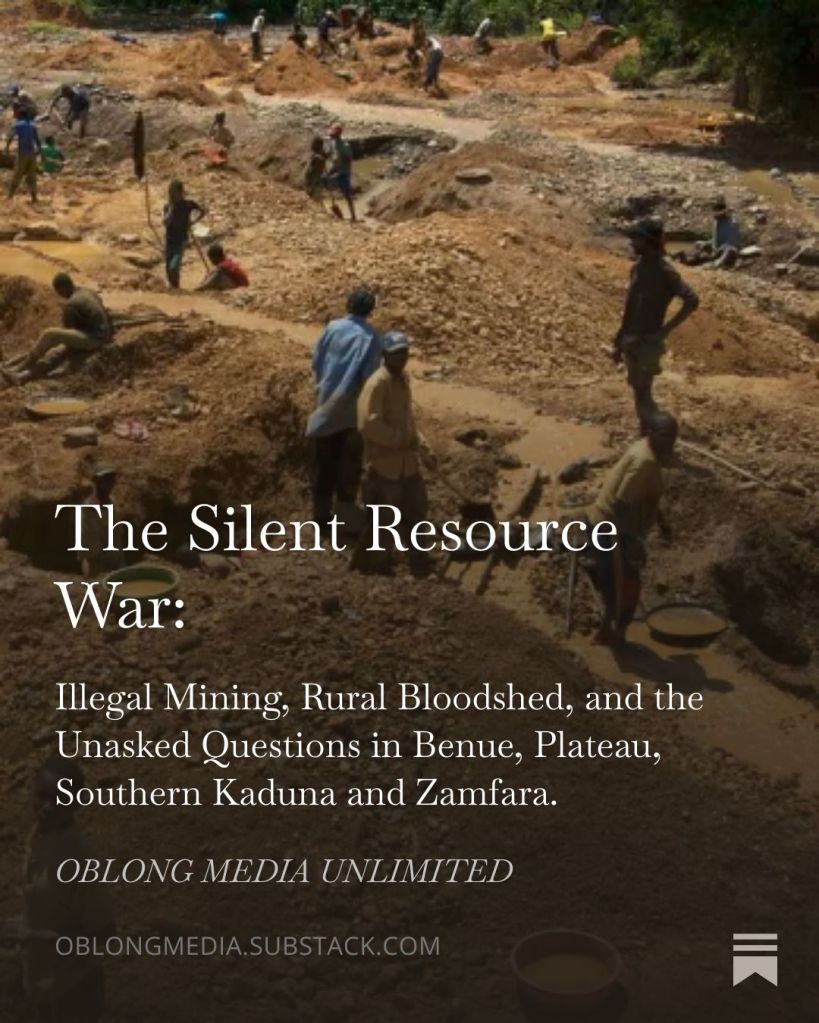
There is a warning written in African soil, and it comes from the long, tragic resource wars of the Democratic Republic of the Congo.
For decades, Congo has sat on immense mineral wealth, coltan, cobalt, gold, diamonds, the very elements that power modern electronics and today’s battery revolution. Instead of prosperity, that wealth attracted militias, foreign profiteers, illegal extraction networks, proxy armed groups, and endless civilian suffering. Villages were emptied. Territories were militarized. Extraction continued. The people paid the price.
Congo teaches a brutal lesson: resource wars rarely begin as “resource wars.” They begin as banditry, communal clashes, cattle disputes, insurgency, or local militias. Only later does the mineral financing layer become visible. By then, the violence is already self-funding.
Nigeria must be careful not to walk into a softer version of that same trap. Nigeria may be fighting a resource war without admitting it.
Across Benue, Plateau, Southern Kaduna, and Zamfara, rural communities have experienced years of killings, displacement, farm abandonment, and territorial fear. The dominant public explanations have focused on herder farmer clashes, banditry, communal conflict, and terrorism. Those factors are real. But they may not be the whole story anymore.
A second layer is emerging beneath the violence, the expanding shadow economy of illegal mining and strategic mineral extraction.
Gold in Zamfara. Tin and columbite in Plateau. Lithium and other battery minerals in parts of the North Central belt. These are no longer obscure geological footnotes. They are globally strategic resources in the new energy economy. Where high value minerals meet weak governance and porous security, conflict entrepreneurs always appear.
This is not conspiracy theory. It is a pattern repeated from Congo to parts of Latin America: illegal extraction ecosystems attract armed protection markets, corrupt local enforcement, and land control struggles.
The uncomfortable question is this: are some of Nigerias most violent rural corridors also becoming mineral corridors.
In Zamfara, illegal gold mining has already been publicly linked by multiple security and policy reports to armed bandit financing networks. That link is no longer speculative. Revenue from illicit mining has helped sustain weapons purchases and militia logistics. Once violence becomes self funding, it becomes self sustaining.
Plateau has a century old mining history. What has changed is not the existence of minerals, but the scale of informal and illegal extraction and the weakness of regulatory presence in rural zones. When armed actors operate around extraction areas, communities do not experience it as economics. They experience it as siege.
Southern Kaduna and Benue have endured repeated village attacks and mass displacement. Public debate frames this almost entirely through ethnicity and pastoralism. Yet in several affected belts, community leaders have raised alarms about land value shifts, mineral prospecting interest, and the sudden appearance of informal extraction camps following displacement. These claims demand investigation, not dismissal and not blind acceptance, investigation.
Let us be precise and responsible. It is reckless and false to label any ethnic group as a unified mining militia or land clearing army. Congo itself proved that resource militias recruit across tribes and borders. The real drivers are profit networks, black market buyers, corrupt enablers, and armed contractors. Ethnic blame is noise. Money trails are signals.
Criminal economies are opportunistic. They do not care about tribe, religion, or language. They care about access and control. If violence clears land and weakens local resistance, criminal actors move in. If insecurity keeps police and regulators away, illegal extraction becomes easier. That is how resource conflict embeds itself quietly.
It is dangerous to turn this into an ethnic accusation narrative. That only helps the true profiteers. Armed groups recruit across identities. Political patrons exist across identities. Buyers and exporters exist across identities. The money chain is always more diverse than the foot soldiers.
The real dividing line is not Fulani versus farmer, or North versus Middle Belt. The real dividing line is lawful economy versus criminal extraction economy.
If the Nigerian state wants credibility, it must answer specific questions:
Which mineral licenses exist in high violence LGAs across these states?
Who holds them?
Which sites are operating? without licenses
Who is buying the output?
Which export routes are being used?
Which security formations are assigned to protect which sites?
How many illegal mining prosecutions have succeeded in the last five years?
Satellite mapping can answer most of this within months. Financial tracking can answer the rest.
Right now, rural Nigerians are dying inside overlapping crises, banditry, militia violence, land conflict, and criminal mining, while the national conversation keeps each issue in a separate box. Criminal networks do not operate in boxes. They operate in systems.
If strategic minerals are present in these belts, then security strategy must treat extraction zones as national security assets, not abandoned hinterlands. Transparent licensing, community consent frameworks, environmental enforcement, and armed site regulation must become standard practice.
The green energy revolution must not become a red soil tragedy.
Nigeria has seen this movie before with oil, secrecy, elite capture, armed protection, community suffering. We are now at risk of repeating the same script with lithium, gold, and rare minerals, only this time in farming communities instead of riverine ones.
The blood in Benue, Plateau, Southern Kaduna, and Zamfara deserves more than recycled explanations. It deserves forensic truth.
Until we follow the mineral trail as seriously as we follow the ethnic narrative, we may be describing the violence, but missing the engine.
By Hon. Chima Nnadi-Oforgu
Duruebube Uzii na Abosi
 OBLONG MEDIA GLOBAL INTELLIGENCE
Leave a comment