
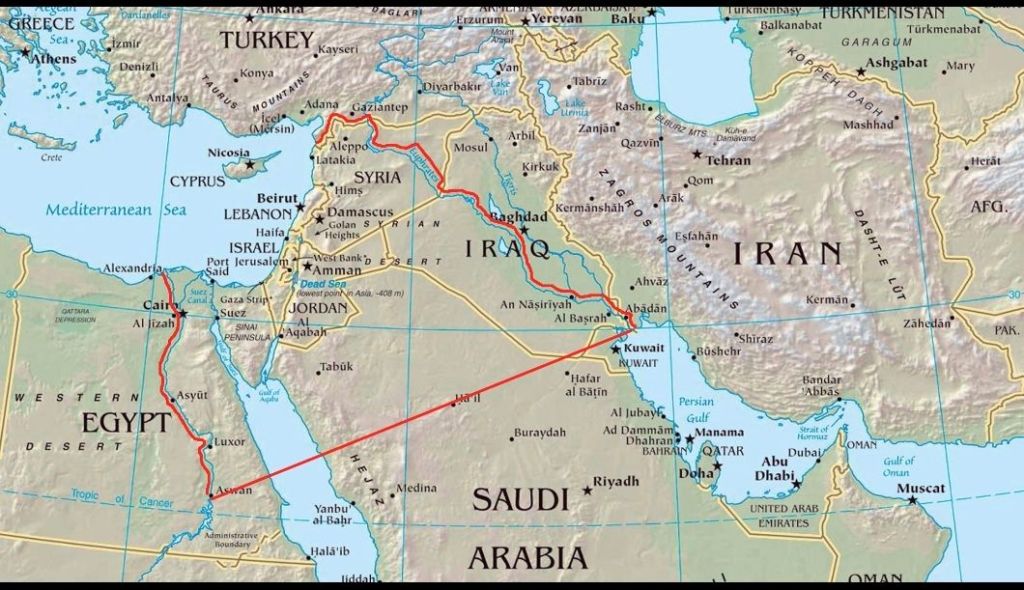
The phrase Eretz Israel (often spelled Eretz Yisrael) literally means “Land of Israel.” It originates from the Hebrew Bible and refers to the territory believed in Jewish religious tradition to have been allegedly promised by God to the descendants of Abraham, Isaac, and Jacob.
In biblical texts, particularly in Book of Genesis and Book of Exodus, the boundaries of this land are sometimes described broadly as stretching “from the river of Egypt to the great river, the Euphrates.” Because of this wording, some later interpretations produced maps showing a very large region extending across parts of what are today Israel, Palestine, Lebanon, Syria, Jordan, and portions of Iraq and Egypt.
Across the Middle East today this troubling question is quietly resurfacing in diplomatic circles, academic forums, and political debates: are we witnessing the gradual emergence of a geopolitical doctrine tied to the idea of Greater Israel?
It is a question that sits at the intersection of history, religion, war, and global power politics.
For centuries this idea remained primarily spiritual, a memory preserved in religious tradition rather than a practical political program.
The modern Middle East, however, transformed that symbolism into a geopolitical argument.
When the state of Israel emerged in 1948, it was born out of war, diplomacy, brutal displacement, occupation and the collapse of the British colonial system in Palestine. Its borders were determined by conflict and international agreements rather than ancient maps. Yet the debate over historical land claims never fully disappeared.
After the Six-Day War, Israel suddenly controlled territories far beyond its original boundaries, including Gaza, the West Bank, the Sinai Peninsula, and the Golan Heights. For some ideological factions within Israeli politics, the moment appeared to confirm the possibility of reclaiming what they viewed as the historic homeland.
Over the decades that followed, settlement expansion in the West Bank, recurring wars in Gaza, and periodic confrontations with neighboring states fed the perception that Israeli strategic thinking might be guided by more than just defensive security calculations.
For critics across the Arab and Muslim world, the pattern appears unmistakable.
They argue that Israel’s actions, from Gaza to southern Lebanon and Syria, reflect a long term strategy aimed at neutralizing every regional force capable of challenging Israeli military dominance. Within that narrative, the destruction of Gaza’s infrastructure, the containment of Palestinian political aspirations, and the ongoing confrontation with Iran are seen as pieces of a broader geopolitical puzzle.
The war in Gaza has amplified these suspicions dramatically.
What began as retaliation for alleged attacks has evolved into a devastating campaign that has flattened entire neighborhoods, displaced millions, and drawn condemnation from humanitarian organizations around the world. To many observers in the region, the scale of destruction appears less like a targeted military operation and more like a reshaping of territory through overwhelming force.
But Gaza is only one front.
The confrontation with Iran represents the far larger strategic battle shaping the Middle East today. Iran has positioned itself as the principal backer of Palestinian resistance movements and as a regional counterweight to Israeli and American influence. From Lebanon to Syria, Iraq, and Yemen, Tehran has built networks of allied groups capable of challenging Israel indirectly.
For Israel’s leadership, this network represents an existential threat that must be dismantled.
For Iran and its supporters, Israel’s actions represent expansion backed by Western military power.
Thus the conflict spirals outward.
Behind the regional struggle lies the deeper involvement of global powers. The United States remains Israel’s most powerful ally, providing military support and diplomatic cover. At the same time, countries aligned with the emerging BRICS grouping, including Russia and China, have increasingly criticized Western policies in the region, framing the crisis as part of a larger global contest between a declining unipolar order and a rising multipolar world.
In that broader context, the debate about Greater Israel becomes more than a religious or ideological argument.
It becomes a geopolitical narrative shaping how entire regions interpret the actions of states.
Supporters of Israel reject the notion that any expansionist doctrine exists. They argue that Israel operates in one of the most hostile security environments on earth and that every military action it takes is driven by the need to defend itself against enemies that openly call for its destruction.
Critics see something different.
They see a pattern of territorial control, military dominance, and political influence that extends far beyond simple defense.
Between these two narratives lies the harsh reality of Middle Eastern geopolitics: competing histories, unresolved grievances, and a region where ancient memories still collide violently with modern power struggles.
What makes the moment especially dangerous is that the conflict is no longer confined to local actors. Every escalation risks drawing in larger powers and triggering wider confrontations that could destabilize global energy markets, international trade routes, and already fragile political alliances.
The question therefore is no longer simply about Gaza or Iran.
It is about the direction of the entire region.
Whether the Middle East moves toward a negotiated balance of power or descends into a cycle of expanding wars may depend on whether leaders choose diplomacy over domination.
Because history has shown repeatedly that when ancient ideas become weapons in modern geopolitics, the consequences rarely remain confined to the land where those ideas were born.
They spread far beyond it.
Duruebube Uzii na Abosi
Hon. Chima Nnadi-Oforgu
 OBLONG MEDIA GLOBAL INTELLIGENCE
Leave a comment