
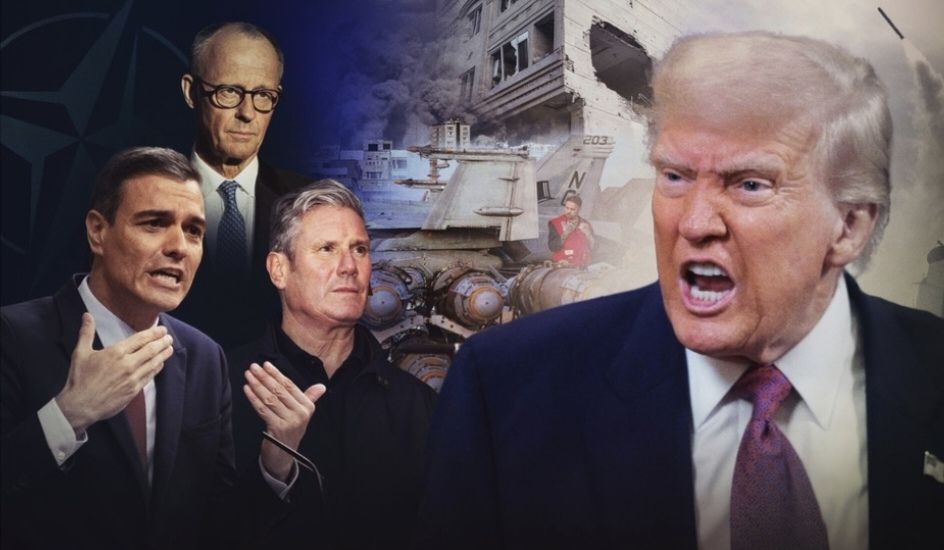
An Oblong Media Geopolitical Analysis
The US/Israeli assault on Iran has done something no diplomatic conference or strategic doctrine could accomplish: it has exposed the fragility, contradictions, and quiet panic inside the Western alliance. For decades, the West projected an image of moral coherence, a united bloc defending international law, democracy, and the so-called “rules-based order.” Yet the moment bombs began falling on Iran, that carefully constructed image began to fracture.
Europe suddenly found itself trapped in a familiar dilemma. Its leaders proclaim commitment to international law and opposition to wars of aggression, yet when Washington moves militarily, that commitment often dissolves into cautious silence or carefully worded ambiguity. The result has been a spectacle of confusion, hesitation, and political embarrassment across the European capitals.
The reality is simple: Europe is politically dependent on the United States but morally invested in appearing independent. When those two imperatives collide, paralysis follows.
The “Special Relationship” Under Strain
Even the much, celebrated Anglo American “special relationship” has begun to show visible cracks. The United Kingdom has long positioned itself as Washington’s closest strategic partner. Yet when the conflict with Iran escalated, tensions surfaced almost immediately.
American frustration reportedly centered on delays surrounding the use of the strategically located Diego Garcia base in the Indian Ocean, a facility historically used for major US operations in the Middle East and Asia. Criticism from Washington was unusually blunt, reflecting irritation that Britain was not moving quickly enough to facilitate military operations.
For London, however, the situation is politically delicate. Memories of the 2003 Iraq war, when former British Prime Minister Tony Blair joined Washington’s invasion despite massive public opposition, remain fresh in the British political psyche. Current leadership is keenly aware that another Middle Eastern war could trigger public backlash.
Polling across Britain has shown limited enthusiasm for confrontation with Iran, leaving London trying to walk a tightrope between maintaining alliance solidarity and avoiding domestic political damage.
Spain Breaks Rank
If Britain appeared cautious, Spain was outright defiant. Prime Minister Pedro Sánchez refused to allow US forces to use Spanish military bases for operations connected to the Iranian conflict, arguing that Spain would not be complicit in actions it believed could destabilize global security.
Washington reacted angrily, with threats of economic retaliation and hints of punitive measures. Yet Madrid stood firm, highlighting a growing divide within Europe itself.
Spain’s refusal also revealed a deeper issue: Europe no longer speaks with one voice on matters of war and peace.
Germany’s Awkward Balancing Act
Germany found itself in an even more uncomfortable position. Chancellor Friedrich Merz visited Washington during the early stages of the crisis but appeared reluctant to challenge American policy directly.
Berlin’s stance has been shaped by several overlapping pressures: NATO obligations, economic ties with the United States, and fears that confronting Washington could deepen internal divisions within the European Union.
Yet Germany’s position has not gone unnoticed by other European states. Madrid openly expressed surprise that Berlin appeared to align more closely with Washington than with its fellow EU members. The episode underscored how quickly European solidarity can evaporate when geopolitical pressure is applied.
NATO on the Sidelines
Perhaps the most striking feature of the Iran crisis is the near invisibility of NATO. The alliance that once defined Western military unity has largely remained on the sidelines.
This is not accidental.
The Iranian confrontation does not fall neatly within NATO’s traditional collective defense framework. Many European members are wary of being drawn into another prolonged Middle Eastern conflict, particularly one that could escalate unpredictably and threaten energy security or trigger wider regional instability.
The result is a curious paradox: the West’s most powerful military alliance has been largely irrelevant during one of the most consequential crises in recent years.
Europe’s Moral Contradiction
What makes Europe’s position even more awkward is the glaring contradiction in its own recent actions. European governments rallied almost unanimously behind Washington in confronting Russia over the war in Ukraine, arguing that Moscow had violated international law by launching an invasion of a sovereign state. Billions of euros in military aid, sanctions, and political backing were mobilized under the banner of defending sovereignty and deterring aggression.
Yet if the same European governments now support Washington in launching military attacks on Iran, the question becomes unavoidable: what exactly was the moral principle they claimed to defend in Ukraine?
If sovereignty and territorial integrity were sacred in the Ukrainian case, how can they suddenly become negotiable elsewhere? Even critics of Russia often acknowledged that the Ukraine conflict followed years of documented tensions and geopolitical provocations. If Europe could rally around Washington to punish Moscow for violating sovereignty, what moral logic justifies supporting Washington when it appears to be doing the very thing it condemned?
This contradiction is precisely why European leaders now sound uncertain and evasive. Supporting Washington risks exposing a glaring double standard. Opposing Washington risks destabilizing the alliance on which their security has depended for decades.
The Collapse of the “Rules-Based Order”
Even within Western political circles, there is increasing acknowledgment that the so called “rules based international order” has always been more fragile than advertised.
The phrase itself has long served as a diplomatic euphemism for a system largely shaped by Western power. But when those same powers openly bend or reinterpret the rules they claim to defend, the credibility of the system erodes.
The Iran war has accelerated that erosion.
European leaders now face a difficult reality. Supporting Washington risks undermining the very principles they claim to uphold. Opposing Washington risks fracturing the alliance that has anchored their security for decades.
Caught between those two pressures, many have chosen the safest option: silence.
A West Divided Against Itself
The Iranian confrontation has not only intensified tensions in the Middle East. It has also exposed the deeper fractures within the Western alliance itself.
Some European governments fear escalation and instability. Others prioritize alliance loyalty. Still others worry about the domestic political consequences of appearing to support another war.
Meanwhile, Washington continues to act decisively, often expecting its allies to fall into line.
Whether Europe eventually closes ranks or continues to fracture remains uncertain. What is clear is that the war on Iran has already accomplished one significant geopolitical outcome.
It has shattered the illusion of Western unity.
The West still possesses enormous military and economic power. But power without coherence is increasingly difficult to project.
And for the first time in many years, the world is watching a Western alliance that looks less like a unified bloc and more like a collection of uneasy partners trying to navigate a crisis they did not fully choose.
By Hon. Chimazuru Nnadi-Oforgu
Duruebube Uzii na Abosi
 OBLONG MEDIA GLOBAL INTELLIGENCE
Leave a comment