
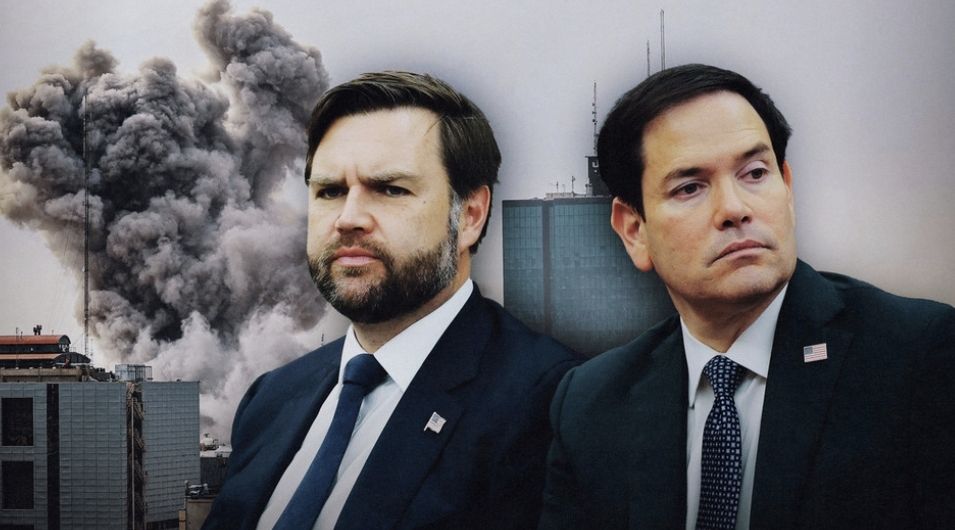
An Oblong Media Geopolitical Analysis.
The war with Iran has not only shaken the Middle East. It has also begun to fracture the political coalition that carried Donald Trump back to power.
For years, Trump’s political brand was built on a simple promise: America would stop policing the world. Endless wars would end. Washington’s interventionist establishment would be sidelined. The United States would focus inward, rebuild its economy, and avoid the costly foreign entanglements that drained trillions of dollars in Iraq, Afghanistan, and across the Middle East.
That promise formed the ideological backbone of the America First movement.
Yet the US–Israeli assault on Iran, branded “Operation Epic Fury”, now threatens to unravel that coalition from within.
The MAGA Coalition Was Always an Uneasy Alliance
Trump’s political base has never been ideologically uniform. It is a coalition stitched together from several factions: populist nationalists, traditional conservatives, foreign policy hawks, libertarian non-interventionists, and cultural conservatives.
As long as Trump remained rhetorically opposed to foreign wars, these factions coexisted.
The Iran war has now forced them to confront an uncomfortable question: was “America First” ever truly anti-interventionist, or was it simply a slogan that could be reinterpreted when convenient?
Inside the administration itself, the contradictions are increasingly visible.
Conflicting Narratives From the Top
Even the official justifications for the war have not been consistent.
Trump has argued that Iran was on the verge of acquiring nuclear weapons capable of threatening the United States itself, a claim used to frame the attack as a preemptive act of national defense.
Yet Marco Rubio offered a strikingly different explanation. According to Rubio, the United States joined a military operation that Israel was already preparing to carry out regardless of Washington’s involvement.
These are not minor differences in messaging. They are fundamentally different explanations for why the war exists at all.
One portrays the conflict as a direct American security necessity. The other suggests Washington was pulled into an Israeli-led escalation.
When a war begins without a coherent explanation shared across the leadership, it often signals deeper policy disagreements behind closed doors.
The Silence of JD Vance
No figure better illustrates the tension inside the administration than Vice President JD Vance.
Before entering the White House, Vance had been one of the most outspoken Republican critics of foreign military intervention. A former Marine Corps veteran, he argued repeatedly that war with Iran would be economically disastrous and strategically foolish.
He also built much of his political identity around opposition to endless wars and skepticism toward the foreign policy establishment in Washington.
Yet when the conflict with Iran began, Vance was notably absent from public discussion for nearly two days.
The White House released images showing Trump monitoring military operations from Mar a Lago alongside Rubio and intelligence officials. Separate photographs showed Vance in Washington with intelligence and economic advisers.
The optics were unmistakable: the war room was not unified.
When Vance finally appeared publicly, his language had shifted. Instead of opposing the war itself, he emphasized that the administration would avoid a prolonged conflict.
The pivot reflected a broader reality: once the war began, opposing it inside the administration was no longer politically viable.
Rubio’s Influence Appears to Be Rising
As Vance’s voice has grown quieter, Rubio’s influence appears to be expanding.
Rubio represents a more traditional wing of Republican foreign policy thinking, one comfortable with projecting American power abroad and confronting adversaries through military force if necessary.
Trump has increasingly leaned toward this faction during moments of crisis.
The pattern has been visible in multiple decisions. Despite campaign rhetoric about ending foreign wars, the administration has continued intelligence cooperation in Ukraine, expanded military coordination with Israel, and now launched direct strikes against Iran.
Within Washington, the perception is growing that Rubio’s strategic instincts are shaping the administration’s foreign policy more than those of the vice president.
The Hawkish Wing Wants More
Even among officials who support the war, there are competing visions for how far the conflict should go.
Defense Secretary Pete Hegseth has publicly adopted an aggressive tone, promising overwhelming American power against Iran and framing the war in near-civilizational terms.
Reports of disagreements between Hegseth and Rubio over the possibility of deploying ground forces into Iran have circulated in Washington, though the Pentagon has dismissed such claims as inaccurate.
Whether those reports are true or not, their existence reveals something important: Washington’s internal message discipline is weakening.
In times of war, governments typically attempt to present a unified narrative. Competing leaks and contradictory statements often signal that factions inside the leadership are struggling to agree on the path forward.
The Tucker Carlson Problem
Outside the administration, the Iran war has created a deeper ideological rupture inside the broader MAGA ecosystem.
Prominent conservative commentators who once championed Trump, including Tucker Carlson, have condemned the war as a betrayal of the America First doctrine.
For this wing of the movement, the promise was clear: the United States would avoid becoming entangled in Middle Eastern conflicts again.
From their perspective, attacking Iran represents the very kind of interventionist policy Trump originally ran against.
A Political Trap for Trump’s Successor
The greatest long-term consequence of the war may not be military at all. It may be political.
Whoever attempts to inherit Trump’s movement will face a deeply divided base.
Some supporters now embrace the Iran war as a necessary demonstration of American strength. Others see it as the moment Trump abandoned the anti war instincts that distinguished him from previous Republican leaders.
No figure faces this dilemma more directly than Vance.
As a potential frontrunner for the Republican presidential nomination in 2028, he must navigate an increasingly narrow path: remain loyal to a president now committed to military escalation, while retaining credibility with a political base that once rallied around the promise of ending endless wars.
The Beginning of a Fracture
Trump’s political strength has always rested on his ability to hold together a coalition that traditional Republican leaders could not.
But wars have a way of exposing ideological fault lines.
If the conflict with Iran expands, drags on, or fails to deliver a clear strategic outcome, those fault lines inside the America First movement could widen dramatically.
For now, Trump remains the undisputed leader of that movement.
But the war he has launched may ultimately determine whether the coalition he built can survive him.
Oblong Media Unlimited
http://www.oblongmedia.net
 OBLONG MEDIA GLOBAL INTELLIGENCE
Leave a comment