
There are moments in history when events on the ground are only half the story. The other half is written in newsrooms, shaped in government briefings, and refined in the quiet corridors of power where perception is managed as carefully as policy.
1968 was one of those moments.
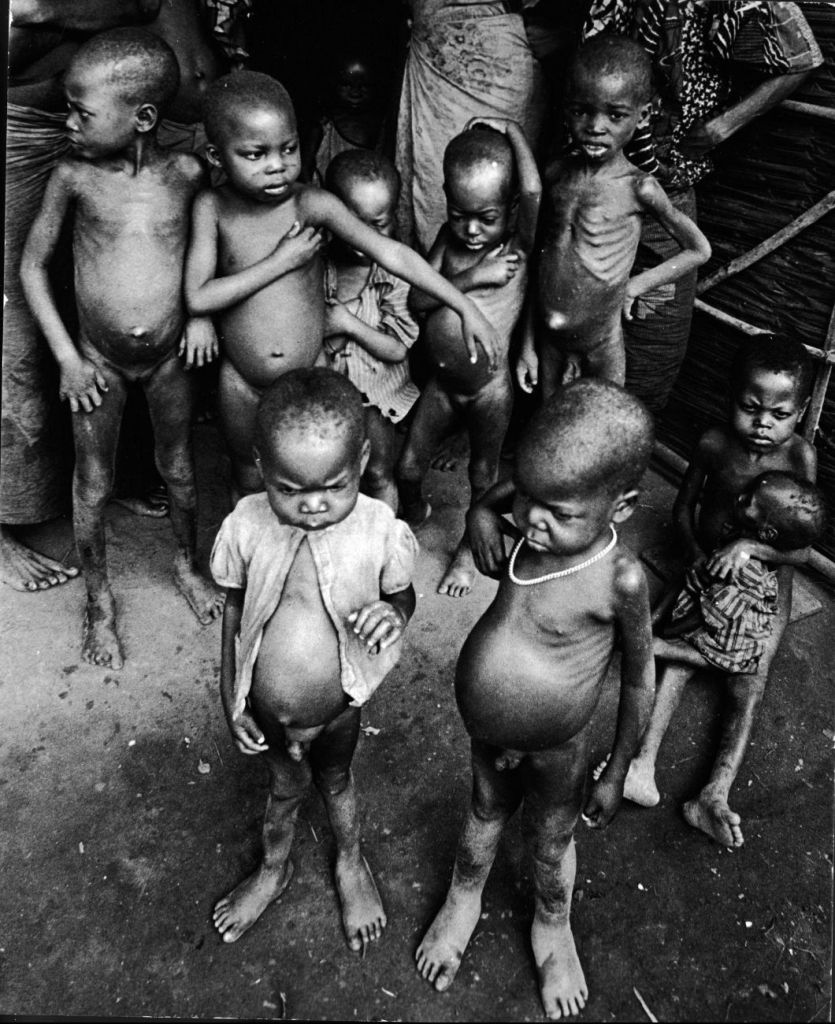
The war in Nigerian Civil War had escalated beyond a regional conflict into a global moral dilemma. Images of starving children in Biafra had broken through the noise of geopolitics and forced themselves into the conscience of the world. Britain, however, found itself in a delicate position, caught between public sympathy and strategic interest.
It is in this tension that the News of the World headline, “Probe into Biafra Baby Fund”, must be properly understood.
Not as an isolated journalistic curiosity.
But as part of a wider ecosystem of messaging, policy alignment, and narrative control.
The Government Files: What Britain Was Saying Behind Closed Doors.
Within British government circles, particularly the Foreign Office, internal communications during 1968 reveal a consistent concern: public opinion was shifting too far in favour of Biafra.
Declassified materials and historical analyses of Foreign Office files show that officials were increasingly worried that:
Media images of starving children were generating emotional pressure for intervention
Public sentiment could undermine Britain’s support for the Nigerian federal government
The war was being reframed from a political conflict into a humanitarian emergency requiring action
This was not a trivial concern.
Britain had clear strategic stakes tied to stability in Nigeria, including economic interests linked to oil operations involving entities like Shell–BP. A break in Nigeria’s territorial integrity introduced uncertainty that policymakers were unwilling to risk.
So the challenge became clear:
How do you maintain policy, when public opinion is turning against it?
You do not confront emotion directly.
You manage the narrative around it.
The Press Divide: BBC Restraint vs Tabloid Provocation
This is where the divergence within British media becomes crucial.
On one side stood institutions like the BBC.
The BBC’s coverage of Biafra in 1968 was:
More measured
More cautious in tone
Aligned with official sensitivities around foreign policy
Focused on balance, sometimes to the point of restraint
Critics at the time, and later historians, have argued that this caution often resulted in:
Underreporting of the full humanitarian scale
Avoidance of language that might imply genocide
A framing that kept the conflict within “civil war” parameters rather than moral urgency
On the other side stood the British tabloids, led by outlets like the News of the World.
They operated differently.
Less restrained
More emotionally charged
More willing to provoke
More responsive to public sentiment
And yet, paradoxically, even within this emotional environment, a recalibration occurred.
The Article: A Turning Point in Tone
“Probe into Biafra Baby Fund” did not deny the suffering. It did not dispute the famine. It did not challenge the images.
Instead, it introduced something far more subtle—and far more effective:
doubt.
The focus shifted:
From the immediacy of starvation
To the management of aid
From the urgency of saving lives
To the accountability of those trying to save them
This was not an attack. It was a redirection.
The article acknowledged generosity, highlighted the scale of donations, and then posed the critical question:
Where is the money going?
In doing so, it changed the psychological posture of the reader.
From urgency… to hesitation.
From action… to scrutiny.
Alignment Without Coordination
There is no need to prove a direct order from government to press to understand what happened.
This is how influence works in sophisticated systems.
Government concern shapes the information environment.
Media responds to that environment.
Narratives evolve in alignment with broader strategic interests.
The result is not crude propaganda, but organic convergence.
The Foreign Office needed time and reduced pressure.
The media introduced complexity into a simple moral narrative.
Public momentum slowed.
What Was Happening on the Ground
While narratives evolved, the reality in Biafra remained unchanged.
Humanitarian organisations, including the International Committee of the Red Cross and extensive church networks, continued to report:
Severe food shortages
Widespread malnutrition
High civilian mortality
Relief operations faced real challenges:
Restricted access due to the war
Dangerous airlift missions into Uli
Logistical limitations
There may have been inefficiencies. There may have been gaps.
But none of these altered the central truth:
People were starving.
Children were dying.
The Oil Beneath the Narrative
Overlaying all of this was the silent driver of strategy: resource control.
The Niger Delta’s oil reserves represented not just economic value, but geopolitical leverage. Stability under a unified Nigeria aligned with British interests ensured continuity.
A successful Biafra introduced risk.
And in geopolitics, risk is managed not only through policy, but through perception.
The Pattern That Endures
What unfolded in 1968 follows a pattern that has repeated across decades:
A humanitarian crisis becomes globally visible
Public pressure begins to build
Strategic interests are threatened
Narrative complexity is introduced
Urgency is replaced with debate
The method evolves. The structure remains.
Final Word
“Probe into Biafra Baby Fund” was more than a headline.
It was a moment.
A moment when the conversation shifted.
A moment when clarity was softened.
A moment when urgency met hesitation.
Not through denial, but through redirection.
History is not only written by those who act.
It is also shaped by those who influence how others perceive the need to act.
And in 1968, as the world watched Biafra, the battle was not only for territory.
It was also for narrative control.
For deeper geopolitical analysis and historical insight, visit
http://www.oblongmedia.net
 OBLONG MEDIA GLOBAL INTELLIGENCE
Leave a comment