
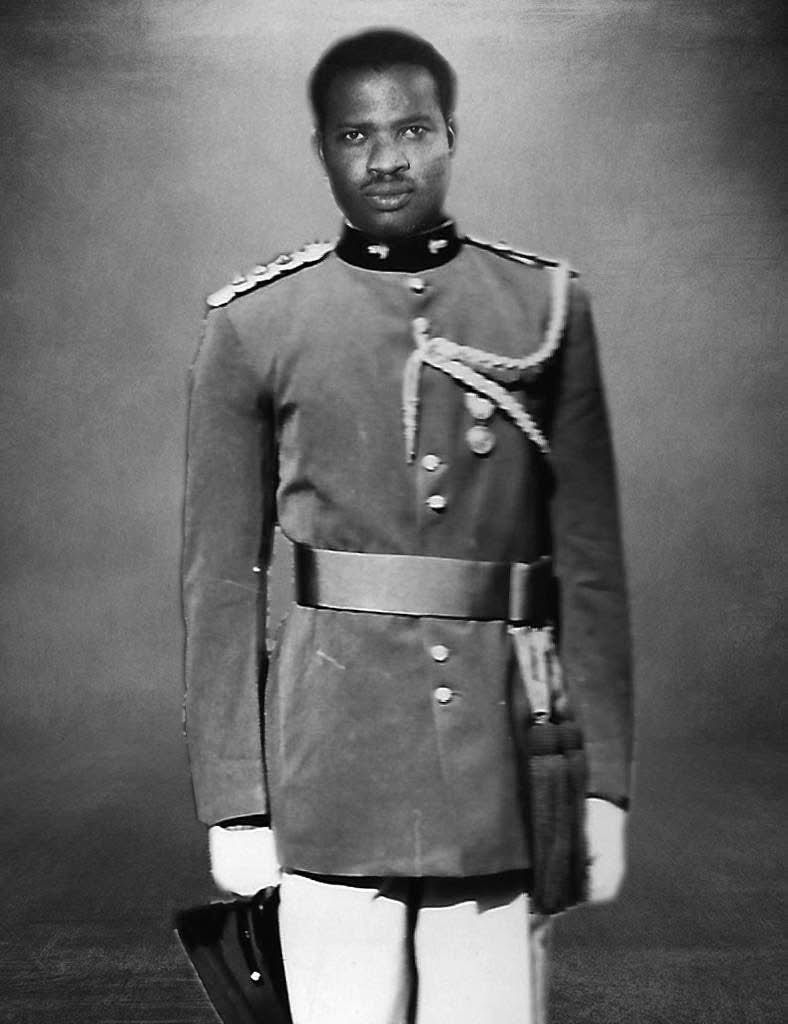
They arrested him for a coup he did not commit, locked him up without trial, and left him to rot in prison cells that were meant to break men and erase their names from history. Then the war came, and in one of those cruel twists that history often delivers, the man once branded a traitor became the very architect of resistance. From prison walls to the frontlines of survival, from silence to invention, from accusation to redemption. Ejike Aghanya did not just fight a war. He built one from nothing.
Ejike Ebenezer Obumneme Aghanya was born in Amawbia, Anambra State, in 1932, into a society that would later struggle to fully grasp the scale of what he would become. He was an engineer before he ever wore a uniform, a product of intellect and discipline. A graduate of Yaba College of Technology, he went further to pursue postgraduate studies in electrical engineering at Southampton College of Technology in England. At a time when Nigeria was still trying to define itself, Aghanya represented the kind of mind a young nation desperately needed. Educated, precise, forward thinking.
In 1962, he was seconded into the Nigerian Army and trained at the Royal Electrical and Mechanical Engineers school in the United Kingdom. There, he distinguished himself, eventually becoming the first Nigerian to command the Nigerian Army Electrical and Mechanical Engineers. He was not just competent, he was foundational. He was the kind of officer institutions are built around, the bridge between technical knowledge and military application.
Then came January 1966, and with it, suspicion, paranoia, and the collapse of trust within the Nigerian state. On January 18, Aghanya was arrested and accused, alongside Lieutenant Colonel Victor Banjo, of plotting to assassinate the Head of State, General Aguiyi Ironsi. There was no trial. There was no due process. There was only detention. He was thrown into Kirikiri Maximum Security Prison, later moved to Enugu and then Abakaliki prisons, held for over a year in a system that had already decided his guilt without needing proof.
Even those who actually planned the coup would later admit in their memoirs that Aghanya and Banjo were innocent. But by then, innocence had become irrelevant. In a nation gripped by fear and revenge, suspicion was enough. He remained behind bars until March 1967, when Colonel Odumegwu Ojukwu ordered his release in defiance of General Yakubu Gowon. It was not just a release. It was a turning point. Months later, the Nigerian Civil War would begin.
Aghanya was commissioned into the Biafran Army as a Colonel, and almost immediately, history placed an impossible burden on his shoulders. He was put in charge of the Research and Production Agency, the unit tasked with doing what seemed unthinkable. Building weapons without an industrial base, without supply chains, without external support, under blockade, under bombardment, under constant threat of extinction.
Nigeria had aircraft, armored divisions, naval superiority, and international backing.
Biafra had none of these.
What it had were minds. Engineers. Improvisers. Survivors. And at the centre of it all stood Aghanya.
Under his leadership, the Research and Production Agency created the Ogbunigwe, a devastating series of weapons that would redefine the war. These were not crude improvisations.
They were systems. Command detonation mines, improvised explosive devices, rocket propelled projectiles, and battlefield innovations that turned disadvantage into strategy. They built armored vehicles, refined fuel, developed communication systems, and produced ammunition in an environment where even basic materials were scarce.
They did not just produce weapons. They produced capability.
The Ogbunigwe became Biafra’s most feared and effective weapon. At the Abagana ambush in 1968, it was deployed with devastating precision, leading to the near annihilation of Nigeria’s 2nd Division. British journalist Frederick Forsyth would later describe the aftermath in stark terms, noting that it spread death and destruction over a wide area, with thousands of soldiers failing to return from that single engagement. It was not just a tactical victory. It was psychological warfare.
According to Biafran accounts at the time, the flying Ogbunigwe represented something even more significant. A rocket system wholly designed, developed, mass produced, and deployed in Africa, used in active combat before similar indigenous systems emerged elsewhere on the continent. At its peak, the Research and Production Agency was producing up to 500 units per day. In the middle of siege and starvation, they created an industrial war machine.
But Aghanya’s vision extended beyond weapons. He understood that Biafra could not win a conventional war. So in 1968, he proposed something radical. A guerrilla force operating behind enemy lines. Thus was born the Biafran Organisation of Freedom Fighters.
He recruited civilians, men and women alike, trained them in sabotage, intelligence gathering, and the use of locally produced explosives. These were not professional soldiers. They were ordinary people turned into instruments of resistance. South African instructors under Colonel Jan Breytenbach were brought in to train them in counterinsurgency tactics. The headquarters was established in Umuahia, and Aghanya was appointed Chief of Staff.
Among those who worked within this structure were some of the most influential intellectuals of the time. Chinua Achebe, the literary giant, and Dr Okonjo, father of Ngozi Okonjo Iweala, both played roles within this broader wartime framework. This was not just a military effort. It was an intellectual resistance. A fusion of science, strategy, and ideology.
Aghanya himself would later explain the logic with clarity. Biafra did not have the firepower to match its opponent. So it had to think differently. It had to adapt. It had to outthink rather than outgun. The objective was simple but profound. Drive the enemy out of Biafran land by any means necessary.
The war ended in January 1970. Biafra fell. The guns went silent. And like many who had carried the burden of that struggle, Aghanya quietly stepped away. He retired as a Colonel and eventually emigrated to the United States, where he lived out the rest of his life. On July 3, 2020, he died in Atlanta, Georgia, at the age of 87.
He was buried far from Amawbia, far from the land that shaped him and the war that defined him. But distance does not erase legacy.
Because what Aghanya represents cannot be buried.
His story is not just about war. It is about injustice. About a man imprisoned without trial, discarded by the very system he served, only to be called upon when survival demanded brilliance. It is about what happens when intellect is forced into crisis. When engineers become warriors. When scarcity becomes innovation.
The Ogbunigwe, whose name evokes destruction in multitudes, was more than a weapon. It was a statement. A declaration that blockade does not end a people. That deprivation does not silence ingenuity. That even in isolation, a determined people can create, adapt, and resist.
He was arrested for a crime he did not commit, held without trial for over a year, and released just in time to shape a war. Then he built the weapons that held off an advancing army. Ejike Aghanya did not just serve Biafra. He became one of the reasons it could fight at all.
Some men fight with guns. He fought with science.
And long after the war ended, long after the guns fell silent, his legacy continues to echo in every account of how a small, blockaded nation refused to disappear.

 OBLONG MEDIA GLOBAL INTELLIGENCE
Leave a comment