
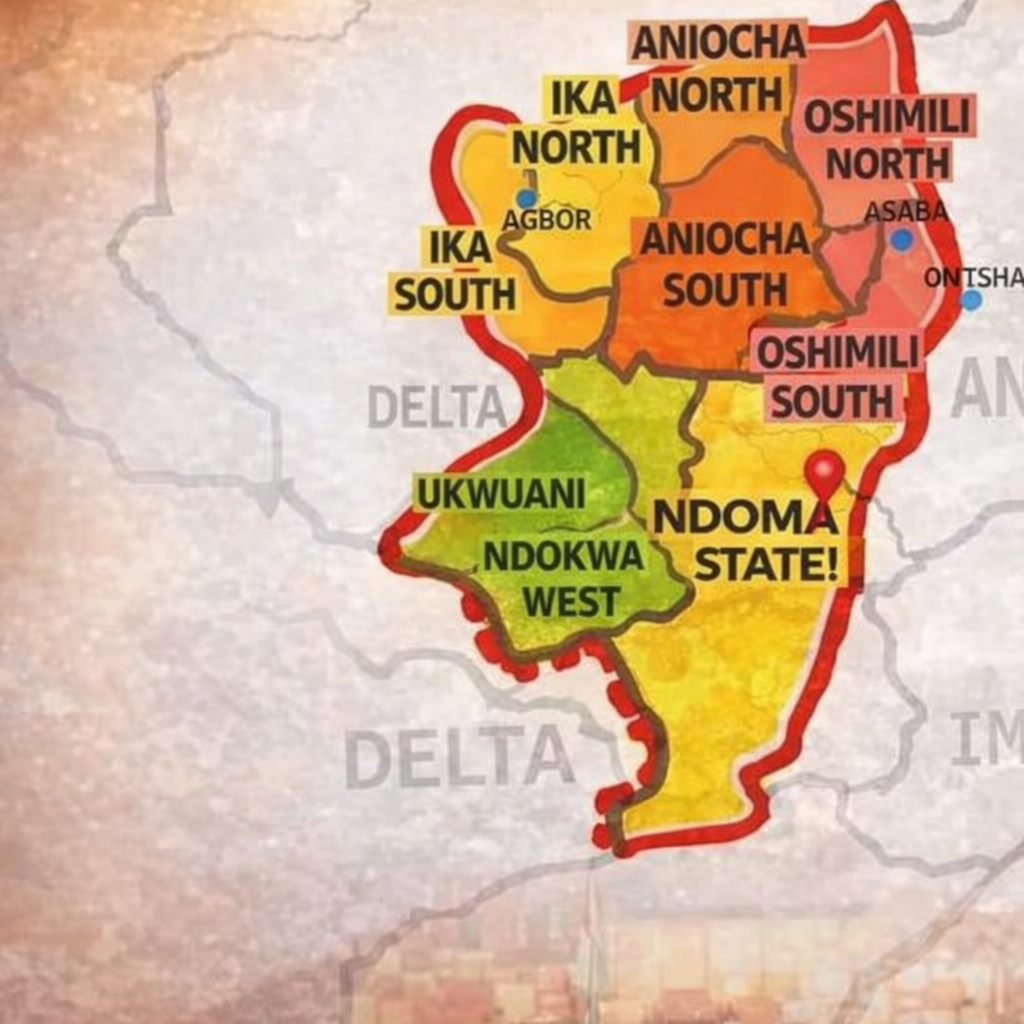
The creation and ceding of Anioma State back to the South East, much more than the proposed Anim State, portends a historic milestone achievement for the Igbo race, as it will mark the beginning of the historic reversal of the balkanization of the Igbo Commonwealth, which the British Colonial Government started in 1934, with the excision of West Niger ( largely Ezechime) Igbos into the then Benin Province. The remaining length of the Igbo balkanization nail was completely hammered in, at the onset of the Civil War, when the Marine and hydrocarbons resource rich Coastal Igbo territories, extending to the Igweocha (Porthacourt areas) and Igwenga (Opobo / Bonny areas) Atlantic frontiers, were mischievously excisioned to partially landlock the Igbo hinterlands and finally weaken the then nascent Biafran Republic.
The balkanization of the Igbo was a historical punishment for three perceived capital sins of ndi Igbo: The Ekumeku War, they waged against the British, the Biafran War against the Nigerian State, and their bravery cum commercial astuteness that prevented the Royal Niger Company and other European Merchant cartels from exercising full oligopolistic control of the prevalent market forces, in the pre colonial Niger Delta Palm oil trade. Hence the British and their Fulani Caliphate ally devised balkanization as a veritable divide-and-rule weapon to weaKen the Igbo Commonwealth, as well as decimate its might, as an evolving potential indefatigable black power. This they did vide the administrative excision of the Coastal and West Niger Igbos from the hinterland Igbos, in other to whittle the budding precolonial commercial organic solidarity among the Igbo race, as well as sow the seed of the identity crisis, we are witnessing today, within the fringes of the Coastal and West Niger Igbos.
In this nexus therefore, the Anioma State creation, rather than the newly proposed Anim State, as the sixth state of the South East, will be a veritable “fait accompli” and bold step towards the long awaited historic cum spiritual redemption and restoration of the hitherto whittled Igbo organic solidarity, that is badly needed to balance and increase the region’s political bargaining power, in the Nigerian complex political ecosystem, in which the South East, is derogatorily referred to, as an unviable “dot on the Nigerian map” with diminished political bargaining power and economic potentials. Consequentially therefore, Anioma State creation reinforces the geographical and demographic weight of the Igbo nation in the Nigerian intra-geopolitics, by remarkably erasing the hitherto “dot on the map” perception, especially given that, the new Anioma State will add approximately about 7,000 square miles to the Igbo territory, to increase its geographical footprints.
Also, in terms of Economic Viability, Anioma is a resource-rich territory, with substantial oil and gas economy, in addition to an integrated marine ecology that offers endless economic possibilities. Six of the nine LGAs in the proposed Anioma State are rich in oil and gas. When brought on board, this will nearly double the number of major oil bearing LGAs in the South East. This is the kind of economic advantage that the South East yearns for, in the face of the ever changing political economy realities of the current era, in Nigeria. Also Anioma is a formidable “ready-made” state with a pre-existing fully built up capital city in Asaba, an international airport, and a substantial infrastructure base, that reduces the burden of developing a new state from scratch. Another interesting dimension is the, Trading Hubs contiguity and extension possibilities, it offers the South East. The Asaba-Onitsha axis already forms one of West Africa’s busiest trade corridors. Thus Including Anioma in the South East, will further strengthen this extensive trade, industrial and logistics hub, that will be further consolidated, via an appropriate regional integration scheme, to replicate what the Lagos-Ogun industrial and logistics hub offers, the South West.
The political economy realities of the time we find ourselves, in today’s Nigeria, is increasingly leaning towards regional integration, amongst the component states of each geopolitical zone. More and more Component States have started coming together, under the banner of regional integration, to carry out mega ticket Schemes cum projects, especially in the strategic areas of regional security networks, monorail transportation systems, water works/ irrigation, power generation etc. This requires the pooling together of resources, vis-a-vis the individual comparative advantage of the cooperating states. Thus each zone requires some degree of ecosystem resource diversity in their component states. This is one of the major values, that South East extension into the Anioma territory, will bring to the table.
Also emergent centripetal undercurrents from the unfolding realities of international geopolitics, have started piercing and questioning the inherent contradictions cum fault lines, within the sub structures of the wobbling Nigerian federation. This seriously depicts that the law of dialectics is indeed at work in Nigeria. In classical political economy scholarship tradition, we presume them to act as the veritable laws of motion that govern the entire dynamics of a given society. Such laws of motion are fundamentally very disruptive in their very nature. The subtle undercurrents emanating from them, can tinker and reshape societies, from existing structural formats to new structural formats, in one fell swoop. They can, as well, totally obliterate entire societal structures, and in their place, birth entirely new societal structures. Therefore the years ahead, promise to get even more turbulent for the sub structures of the Nigerian Federalism, vis-a-vis the structure of it’s economy, in terms of fiscal designs. In the light of these unfolding uncertainties, the existing Nigeria state structures might become decrepit and possibly give way for a new order of societal structures, which is most likely to tilt in favour of agglomeration towards the existing six geopolitical zones of Nigeria. Who knows, you can never tell, the scenario might even tilt towards total dismemberment or other confederal structural forms, closer to it. But , as an incurable optimist, I don’t want to dare go there. I don’t even have the poetic license, nay leave of convenience, to dwell on worst case scenarios.
However, in the event of agglomeration of our hitherto decrepit thirty six states structures towards the six geopolitical zones, the South East, as it is, will be grossly disadvantaged, because it’s geographical ecosystem lacks the requisite diversity to thrive as a formidable economic unit. That was the mischief, those who created the defunct East Central State, had in mind. Yes, at the back of the mind of the Gowon’s Government (and their British Pseudo Advisers), who created the defunct East Central State, was the overriding intention to create a Subnational unit, that is grossly lacking in the geo-economic wherewithal to thrive as a formidable economic unit. Therefore the creation and ceding of the proposed Anioma State, to the South East geopolitical zone, is an epochal bold step, in reversing the said mischievous balkanization of the Igbo Commonwealth, by it’s colonial and Fulani Caliphate traducers. This should be the overriding agenda of the moment for the Igbo intelligentsia, technocrats and truly visionary politicians alike. This enlightened view, may not make sense to the nominal professional politicians, for whom, politics is perceived as a game of short run personal interest and parochial gratifications, rather than the existential interests of the wider society, at large. Also those who are leading the charge for the actualization of the proposed Anim or Adada or Etiti states, may dismiss this enlightened perspective, because it does not serve their immediate parochial interests, in terms of throwing up for grabs, new political seats like governorship, senatorial, house, assembly, civil service etc positions, which they possibly hope to occupy, on the short run. For such politicians, it’s all about “give us this day, our daily bread” and not about the long run political economy fate, of our unborn generations.
My concluding prayer therefore, is for God to grant us, in fact, all crucial Igbo political actors involved, and indeed, all our governors and legislators, the graces and wisdom of the biblical children of Isachar, who had understanding of the times. Yes, rather than “give us this day, our daily bread, Igbos (especially the promoters of the Anim State creation) need a deeper understanding of this moment in time, and what it’s emerging political economy realities, portends for the “dot on the map” nation.
Dr Ugochukwu Ndubisi (Okwadike)
(Writes from Gwarimpa Abuja)
http://www.oblongmedia.net
 OBLONG MEDIA GLOBAL INTELLIGENCE
Leave a comment