
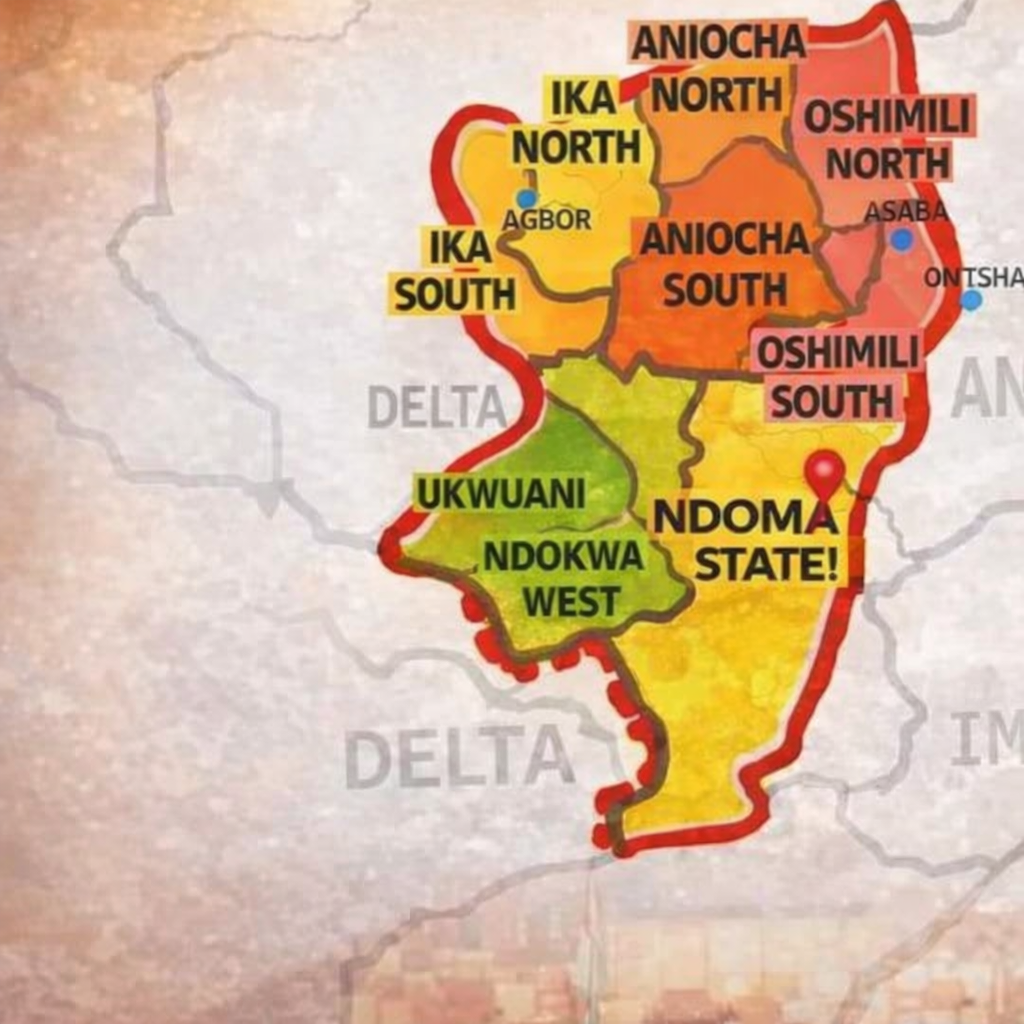
There is a fundamental difference between correcting a historic injustice and engineering a fresh one.
That distinction is what many people are either deliberately ignoring or cynically trying to blur in the current conversations around state creation in the South East and adjoining Igbo territories. On one hand is the case for Anioma State, a proposition that many see as a legitimate historical, cultural and geopolitical correction. On the other hand is the renewed push for ANIM State, a proposal increasingly viewed by critics as a suspicious political business contrivance that risks distorting history, destabilising existing realities, and dragging communities such as Ohaji Egbema into an agenda that does not reflect their deeper historical identity or long-term interests.
This is where the debate must stop being sentimental and start becoming serious.
The issue is not merely about drawing new lines on a map. It is about history, identity, political intent, resource control, and whether state creation is being pursued as an instrument of justice or as a vehicle for economic capture.
For many who understand the long arc of Igbo history, Anioma belongs squarely within the broader Igbo civilisational space. The fact that Anioma today sits inside the South South is, in this view, not the outcome of natural cultural evolution but the residue of political engineering, colonial manipulation, and later military era boundary distortions. By language, ancestry, memory, sacrifice, and historical consciousness, Anioma remains deeply tied to the Igbo nation. Those who make this argument insist that no amount of administrative relabelling can erase that reality.
Indeed, the case for Anioma is not built on convenience. It is built on reclamation.
Supporters of Anioma State argue that the proposed state would represent far more than a new administrative unit. It would amount to a historic reversal of the fragmentation of the Igbo commonwealth, a process many trace back to colonial restructuring and later wartime and postwar political calculations. The old British administrative order had already begun the partitioning of contiguous Igbo territories, especially in the West Niger axis. Then came the deeper fractures of the civil war era, when coastal and strategic hydrocarbon-rich Igbo linked territories were severed from the old Eastern heartland in ways many still regard as deliberate and punitive. To those who hold this view, what happened was not innocent boundary management. It was a classic divide and-rule strategy designed to weaken an enterprising, commercially vibrant, politically assertive people.
That is why the Anioma question carries such symbolic and strategic weight.
Its creation and alignment with the South East would not simply add another state to the zone. It would represent the beginning of a long overdue historical correction. It would expand the geographical footprint of the South East, strengthen its demographic and political bargaining power, and undermine the tired insult that the region is only a “dot on the map.” It would reconnect a people long estranged by administrative deceit, while also bringing into the South East a territory many regard as already socially and economically integrated with the Igbo world.
The case becomes even stronger when one considers viability.
Anioma is not an abstract dream requiring speculative foundations. It is widely seen as a ready made state formation with economic muscle, existing infrastructure, strategic location, and organic market linkages. The Asaba Onitsha corridor is already one of the busiest commercial corridors in West Africa. Asaba has infrastructure, airport access, and the kind of urban nucleus many newly proposed states can only fantasise about. Anioma also comes with substantial oil and gas potential, marine ecology, and trade corridor advantages that would deepen the economic possibilities of the South East in an era where regional integration is increasingly becoming the language of survival.
This is no small matter.
Across Nigeria, zones are beginning to understand that future competitiveness will not depend merely on federal allocations or political slogans, but on how effectively neighbouring states pool resources, integrate transport, harmonise security architecture, coordinate investment, and leverage comparative advantages. In that emerging order, the South East cannot afford to think small, emotional, or parochial. It must think historically and strategically. Anioma, in that context, appears not as a threat but as an opportunity.
But while that legitimate case exists, another project has emerged in its shadow, and that is
where the danger lies.
The renewed agitation around ANIM State is increasingly raising eyebrows because of what critics describe as its underlying political economy. Far from being a clean, historically coherent state creation proposal, it is seen by many as an opportunistic arrangement whose real attraction lies not in cultural logic but in resource arithmetic. In plainer language, the suspicion is that certain interests are less concerned about justice for communities and more interested in rearranging oil-bearing territories and economic corridors for future advantage.
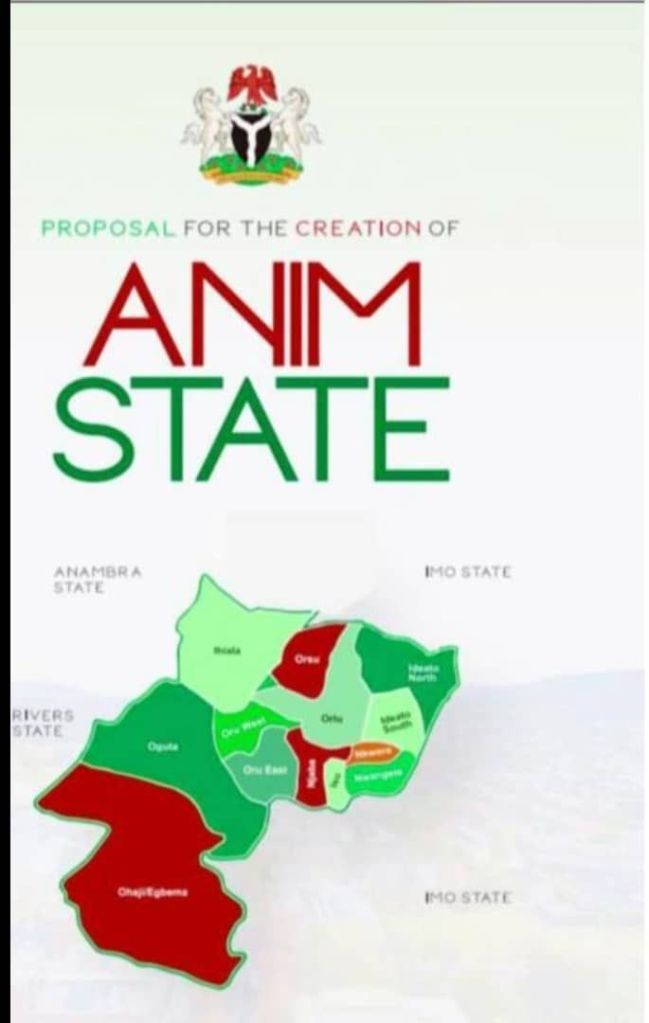
That is why Ohaji Egbema has become such a critical flashpoint.
Any attempt to casually fold Ohaji Egbema into a new arrangement without confronting the full history of its people is not only dishonest. It is dangerous.
The story of state creation in this region did not begin yesterday. There were earlier visions, earlier alignments, and earlier efforts to create administratively sensible entities based on geography, contiguity, history, and affinity. One of such serious proposals was the original Orashi State project championed by Chief Arthur Nzeribe. That proposal reportedly gained real traction in the National Assembly and even advanced through the first and second readings before political currents shifted. Later developments, including the emergence of other interests and fresh state proposals from elements within Orlu extraction, altered the trajectory.
Yet what stands out in that earlier Orashi conception is that it was defended with historical reasoning, not just raw appetite.
At a public interface in Enugu before the National Assembly committee on state creation, Dim Chukwuemeka Odumegwu Ojukwu reportedly appeared and lent support to the Orashi concept, grounding his intervention in historical and cultural facts. That support carried symbolic importance, especially given his maternal link to Aboh, a community now in Delta State. Aboh itself shares important geographical and historical relationships with Ndoni in Rivers State, and both are tied in meaningful ways to Oguta through the Orashi River system.
This wider Orashi belt reveals something crucial that today’s narrow schemers do not want people to think about: the old connections in this region were not artificial. They were riverine, commercial, ancestral, and organic.
Oguta shares strategic historical relationships not only toward Aboh and Ndoni, but also toward Ogbaru in Anambra State, through the Ogwu Ikpere Oshimili axis. It also shares border realities with Rivers-linked communities such as Ani Eze, Aseh and Agwe, through farmlands, creeks, fishing corridors and hydrocarbon zones. These are not invented linkages. They are part of the lived geography of the people. Shell BP, Agip, and later players such as Seplat, Sahara and Sterling Global did not discover these realities. They entered terrains whose histories predated corporate maps.
And this is why the Ohaji Egbema issue cannot be treated as a boardroom item.
There are accounts that during quiet negotiations in the course of earlier state creation calculations, Ohaji was ceded away in elite bargaining. Whether seen as tactical compromise or political betrayal, the memory remains significant. It suggests that powerful actors have long treated some communities not as peoples with history, but as movable assets in a larger game. That mentality is precisely what must be rejected now.
Ohaji Egbema is not a disposable bargaining chip.
Its people have a history. Its location has a history. Its excision from the old Owerri axis into Orlu zone did not fall from heaven. It was part of a broader pattern of political restructuring whose consequences are still being felt. To now turn around and use that already altered status as the basis for dragging Ohaji Egbema into a new state project driven largely by business and oil considerations would amount to compounding one injustice with another.
That is the heart of the argument.
If the objective is to correct history, then let history actually be corrected. Let Anioma, whose Igbo identity is historically grounded and whose detachment is widely seen as part of older political manipulations, be considered on its merits. But let nobody smuggle Ohaji Egbema into a contrived ANIM arrangement under the guise of equity while the real magnet remains oil, gas, land, and future strategic leverage.
The same historical sensitivity applies to Agwa Clan, whose own story exposes the fluidity and political nature of state and local government boundaries. Agwa, it is argued, was not originally part of Oguta LGA in the old divisional arrangement. It was carved from Owerri West into Oguta during the creation of Imo State in 1976 under Chief R. B. K. Okafor. Today, Agwa also hosts important oil interests. This only reinforces the point that boundary changes in this region have often had profound political and economic consequences. They have never been innocent technical exercises.
That is why today’s state creation debate must be approached with clean hands and a clear head.
The South East must not allow itself to be distracted by glittering but hollow proposals that promise new seats, new offices, new titles and new bureaucracies while quietly mortgaging the ancestral logic and economic security of communities. Too many politicians see state creation only through the lens of governorship slots, senatorial tickets, assembly seats, civil service structures, and patronage opportunities. But history is not obliged to respect opportunists. A people that fails to think beyond immediate appetite will wake up one day to discover that it has applauded the erosion of its own foundations.
That is why the choice before the Igbo political class and the wider public is stark.
Do they support a historically grounded project like Anioma, which many believe restores a severed limb to the Igbo body politic? Or do they become complicit in an agenda like ANIM, which critics say risks cannibalising existing communities, muddying historical truths, and subordinating peoplehood to petroleum calculations?
This is not a trivial distinction.
Anioma speaks to restoration.
ANIM, as presently perceived by its critics, reeks of rearrangement for advantage.
Anioma answers an old wound.
ANIM threatens to open a new one.
Anioma strengthens the strategic future of the South-East.
ANIM risks destabilising already delicate balances for reasons many suspect are less noble than advertised.
Those pushing any state creation formula that ignores the historical roots of Ohaji Egbema, the old Owerri connection, the politics of excision, and the riverine commercial cultural realities of the Orashi belt are not engaging in nation building. They are engaging in selective memory. And selective memory in politics is often the first cousin of deception.
The time has therefore come for Ndi Igbo, and especially serious thinkers from Imo and the wider South East, to stop reacting emotionally and start reasoning historically. State creation must not become a euphemism for resource capture. Communities must not be traded in whispers. Boundaries must not be redrawn in contempt of memory. And no people should be told to forget who they are simply because a new cartel of interests has found a more profitable map.
If there must be a sixth state that advances the deeper historical and geopolitical future of the Igbo nation, then the case for Anioma deserves urgent, intelligent and courageous attention.
But Ohaji Egbema must not be swallowed into a needless ANIM contraption designed around business interests while pretending to be a cultural rescue mission.
That would not be justice.
That would be history robbed in broad daylight.
By Hon. Chima Nnadi-Oforgu
Duruebube Uzii na Abosi
 OBLONG MEDIA GLOBAL INTELLIGENCE
Leave a comment