
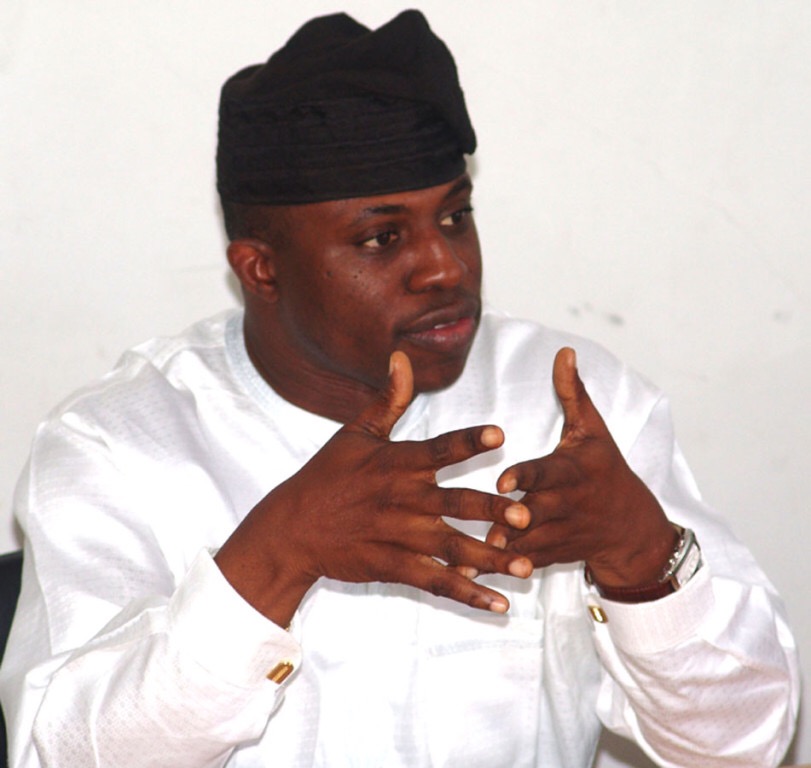
In 2003 I was elected to the House
of Representatives to serve the
Abeokuta South constituency, in
Ogun state. My eight years in
elected office made me less
optimistic about change in Nigeria,
but more realistic. The political
system was not designed to allow
people like me – a 37 year old from
the private sector who had studied
in the UK and at Harvard – to
become Speaker of the House of
Representatives, the role I held
from 2007 to 2011. Nevertheless, I was able to work within the system
successfully and make a
difference, so imagine the impact
20 or 30 influencers across the
different arms of government
could have on changing things
significantly.
A coalition of the willing
Soon after I was elected Speaker,
President Yar’Adua came to the
National Assembly and announced
that only 40% of the 2007 budget’s
capital expenditure had been
implemented, repeating a pattern
that had been ongoing since the
return to multi-party democracy in
1999. The question that I wanted
answered was: what happened to
the remaining 60%, especially when
we did not have a financing
shortfall?
I went to President Yar’Adua and
said I wanted to look into the issue
of unspent funds not being
returned or accounted for in the
following year’s budget. He advised
that pursuing the matter would
incur a backlash, but that if I was
ready for it he would support me. I
chose to use internal channels to
exert pressure rather than starting
a public discussion in the media.
The latter might have gained
nationwide interest but would have
done little to make reform happen.
A strategy that had the buy-in of
relevant stakeholders, people who
could actually make change
happen, was important.
I refused to sign the 2008 budget
for four months until unspent
funds from the previous year were
accounted for and returned.
Eventually, over ₦450 billion came
back, which in previous years would
have been lost. People knew what
was going on, even at the World
Bank and International Monetary
Fund. They chose to look the other
way. In 2009, when the President
announced how the budget had
performed, he also indicated the
return of ₦300 billion in unspent
funds. This was a marked shift in
how things were done. In total,
during my four years as speaker,
₦1.3 trillion in unspent funds were
returned.
If you can forge a coalition with key
stakeholders involved in the system
and the process, reform from
within is possible. During my
tenure, the Fiscal Responsibility Act
and the Freedom of Information
Act promoting transparency and
good governance were signed into
law. However, when President
Goodluck Jonathan succeeded
Yar’Adua, the coalition did not hold.
House reports of unremitted funds
in their trillions, reports on the
power probe, and the Petroleum
Industrial Bill forwarded to the
executive were not acted upon.
Without Yar’Adua to provide
protection, I was forced out of
office.
In the six months following my
departure, the petroleum subsidy
scandal emerged, where ₦248
billion was originally budgeted but
₦2.5 trillion had been spent by the
end of 2011. The excess crude
account of US$22 billion in 2011
had been depleted to US$2.2 billion
by 2015. It was against this
backdrop that The Economist
declared that Jonathan ran “a
clueless government” and was “an
ineffectual buffoon who let
politicians and their cronies fill
their pockets with impunity”.
Negotiating the system
General Buhari was elected
president in 2015 because the
electorate felt Nigeria needed
someone to deal with the security
situation, the Boko Haram
insurgency, as well as save it from
its oil dependency. However, if the
oil price goes back up to US$80 a
barrel we will revert to type, that is
a lack of economic complexity. My
advice to Buhari before he became
president was to think strategically
about how to manage his
government. It is my view that you
cannot avoid working with
politicians who are crooked,
because they have followership and
votes. Instead you have to think
strategically about where they can
be placed to have minimal negative
impact. At the same time you need
to identify key ministries and
positions where you want your
leaders with character to be.
Rather than becoming embroiled in
confrontation, efforts should be
made to negotiate a way of working
within the existing system. For
example, the political class in
Nigeria is funded and run by people
importing petrol and diesel. Nigeria
will never address its power
generating issues until the
government starts negotiating with
these people, because if the issue
is solved, they will be put out of
business. Instead ways need to be
found to allow them to invest their
money into the development of a
power sector. It is not an ideal
solution; but it could be a workable
one. As an example, private
individuals are building their own
refineries; should they negotiate
with government we can have
working refineries to meet the
needs of the Nigerian people.
In all of this there has to be a
better relationship forged between
executive, judiciary and legislature;
you cannot reconcile without
negotiation. However negotiation
does not happen frequently
enough in Nigerian politics.
Planning for the future
While some of the political class call
for a new constitution as a pre-
requisite for restructuring and
development, others believe that
this is a political point-scoring
exercise revived close to elections
and meant to distract rather than to
promote good governance in the
country. The federal structure is
not the reason why questions are
not being asked by State Houses of
Assembly about state and local
government. Nor is it the reason
why we have abandoned our
responsibilities in different aspects
of governance. But it is the easiest
thing to blame. It is like saying that
I did not pass my exams because
the questions were wrong. Nigeria’s
governance problems are a lot to
do with institutions and the
character of those running those
institutions.
Corruption is a problem, yes, but it
is a consequence of a bigger issue.
When I was appointed Speaker I
was given about 20 special advisors
to support my work. Some of them
did next to nothing, so I returned
five and handpicked mentees who I
knew were competent, determined
and ambitious. By the time I left
office in 2011 one was a senator,
two were in the House of
Representatives and one was a
minister. Bringing individuals into
the system to begin changing
things from within is what I hoped
for.
You cannot take on the National
Assembly, the judiciary or every
criminal, so you need to zero in on
what is important and what can
have the biggest long-term impact.
In Nigeria, it’s about succession
plans and getting the right people
in the right jobs. Those who can,
and will, make a lasting impact on
the education sector, for example a
university or a school. The thinking
has to be strategic. The president
should identify those who can be
trusted with the leadership of key
institutions in 10 years’ time and
should be readying and preparing
them. The problem is that most
politicians in Nigeria are not
interested in thinking about the
long haul; they see politics as a
100m sprint.
Dimeji Bankole is the former
Speaker of the House of
Representatives in Nigeria.

 OBLONG MEDIA GLOBAL INTELLIGENCE
Leave a reply to Mike Odion Cancel reply